Industry-Verified Manufacturing Data (2026)

Blast Gates

Based on aggregated insights from multiple verified factory profiles within the CNFX directory, the standard Blast Gates used in the Machinery and Equipment Manufacturing sector typically supports operational capacities ranging from standard industrial configurations to heavy-duty production requirements.

Technical Definition & Core Assembly

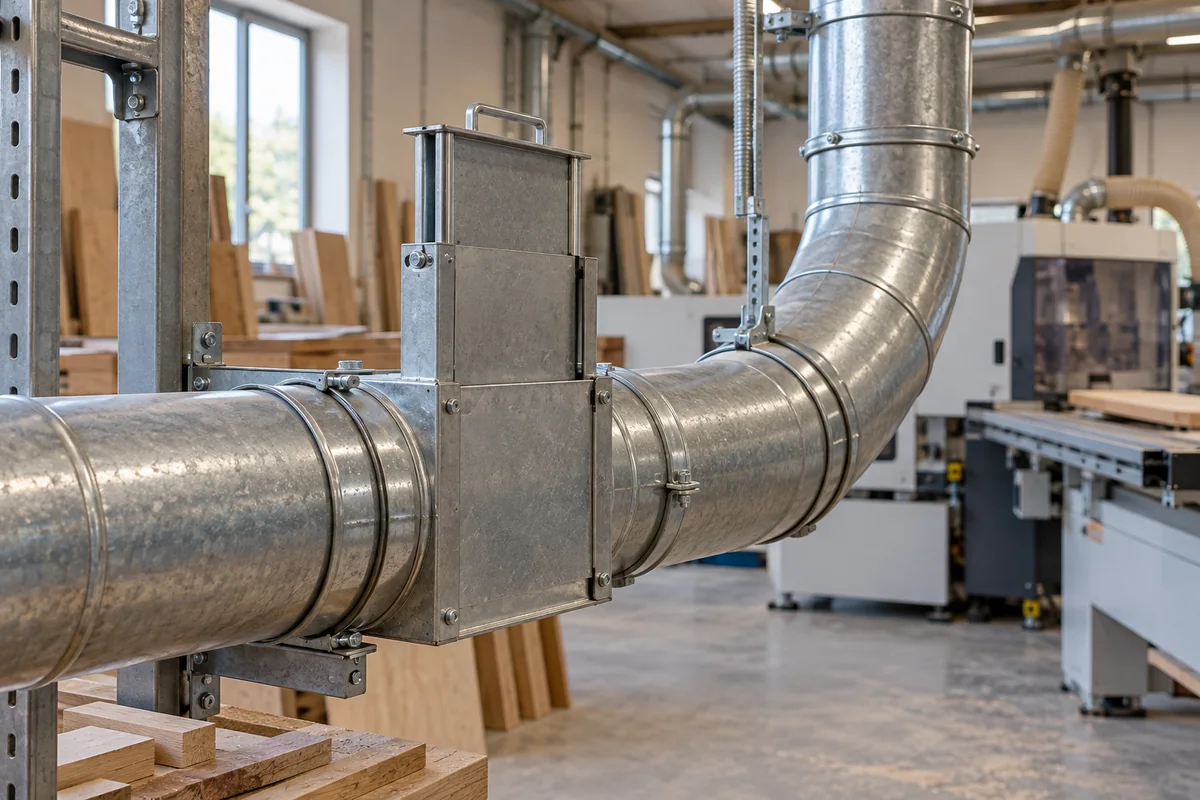
A canonical Blast Gates is characterized by the integration of Gate Blade/Plate and Frame/Housing. In industrial production environments, manufacturers listed on CNFX commonly emphasize Galvanized Steel construction to support stable, high-cycle operation across diverse manufacturing scenarios.

Flow control devices installed in ductwork systems to regulate or shut off air/material flow.
Product Specifications

Technical details and manufacturing context for Blast Gates

Definition
Blast gates are specialized valves or dampers used within industrial ductwork systems to control, redirect, or completely block the flow of air, dust, chips, or other materials. They function as critical isolation points, allowing operators to manage airflow to specific branches of a duct network, optimize system performance, and facilitate maintenance by sealing off sections.
Working Principle
A blast gate operates by sliding, pivoting, or rotating a gate or blade (often a flat plate or guillotine) across the duct's cross-section. When open, the gate retracts to allow unimpeded flow. When closed, it forms a seal against the duct walls, creating a barrier that stops flow. Manual, pneumatic, or electric actuators control the gate's position.
Common Materials
Galvanized Steel, Stainless Steel, Aluminum
Technical Parameters
  • Duct connection size (e.g., diameter for round ducts, width x height for rectangular ducts). (mm) Standard Spec
Components / BOM
  • Gate Blade/Plate
    The moving element that blocks or allows flow through the duct.
    Material: steel
  • Frame/Housing
    The structural body that mounts to the duct and provides sealing surfaces.
    Material: steel
  • Seal/Gasket
    Creates an airtight seal between the gate blade and frame when closed.
    Material: rubber or neoprene
  • Actuator/Handle
    Mechanism (manual lever, pneumatic cylinder, electric motor) to position the gate.
    Material: varies
Engineering Reasoning
0-1.5 bar differential pressure, -40°C to 120°C temperature range
Gate plate deflection exceeding 2.5 mm at 2.0 bar differential pressure, causing permanent deformation and loss of seal integrity
Design Rationale: Plastic deformation of gate plate material (typically 304 stainless steel) due to excessive bending stress exceeding yield strength (205 MPa) under differential pressure loads
Risk Mitigation (FMEA)
Trigger Abrasive particulate accumulation in gate track at concentrations exceeding 150 g/m³
Mode: Increased actuation torque beyond 15 N·m causing motor overload and gear train failure
Strategy: Install track purge system with 0.5 bar compressed air injection and hardened track liners (Rockwell C 55+)
Trigger Corrosive gas exposure (H₂S concentration > 50 ppm) at relative humidity > 60%
Mode: Pitting corrosion of gate plate sealing surfaces leading to leakage rates exceeding 5% of design flow
Strategy: Apply 250 μm thick PTFE coating to sealing surfaces and install humidity-controlled purge system

Industry Taxonomies & Aliases

Commonly used trade names and technical identifiers for Blast Gates.

Applied To / Applications

This component is essential for the following industrial systems and equipment:

Industrial Ecosystem & Supply Chain DNA

Complementary Systems
Downstream Applications
Specialized Tooling

Application Fit & Sizing Matrix

Operational Limits
pressure: Up to 10 bar (150 psi)
flow rate: 0.5 to 50 m³/s (1,000 to 100,000 CFM)
temperature: -20°C to 150°C
slurry concentration: Up to 30% solids by weight
Media Compatibility
✓ Dust/Air Mixtures ✓ Wood Chips/Sawdust ✓ Plastic Pellets
Unsuitable: Corrosive Chemical Gases (e.g., Chlorine, Ammonia)
Sizing Data Required
  • Duct Diameter (mm/inches)
  • Required Flow Rate (CFM/m³/s)
  • System Pressure Drop (Pa/in H₂O)

Reliability & Engineering Risk Analysis

Failure Mode & Root Cause
Wear and binding of gate plate or blade
Cause: Abrasive material flow causing erosion and material buildup, leading to increased friction and eventual jamming or incomplete closure.
Actuator or linkage failure
Cause: Corrosion, misalignment, or mechanical fatigue from repeated cycling under load, resulting in loss of gate control or inability to open/close.
Maintenance Indicators
  • Unusual grinding, scraping, or squealing noises during operation indicating material interference or wear
  • Visible air leakage around gate seals or incomplete closure, suggesting seal degradation or misalignment
Engineering Tips
  • Implement regular cleaning and inspection schedules to remove material buildup and check for wear on sealing surfaces and moving parts
  • Use appropriate abrasion-resistant materials for gate components and ensure proper alignment during installation to reduce uneven wear and binding

Compliance & Manufacturing Standards

Reference Standards
ISO 14691:2000 (Shaft couplings for industrial applications - General requirements) ANSI/ASME B73.1-2012 (Specifications for Horizontal End Suction Centrifugal Pumps for Chemical Process) DIN 2410-1:2016 (Blast gates - Part 1: Dimensions, requirements and testing)
Manufacturing Precision
  • Bore diameter: +/-0.05 mm
  • Flatness of sealing surfaces: 0.1 mm
Quality Inspection
  • Leakage test (pressure differential method)
  • Dimensional verification with coordinate measuring machine (CMM)

Factories Producing Blast Gates

Verified manufacturers with capability to produce this product in China

✓ 92% Supplier Capability Match Found

T Technical Director from United States Feb 19, 2026
★★★★★
"The technical documentation for this Blast Gates is very thorough, especially regarding technical reliability."
Technical Specifications Verified
P Project Engineer from United Arab Emirates Feb 16, 2026
★★★★☆
"Reliable performance in harsh Machinery and Equipment Manufacturing environments. No issues with the Blast Gates so far. (Delivery took slightly longer than expected, but technical support was excellent.)"
Technical Specifications Verified
S Sourcing Manager from Australia Feb 13, 2026
★★★★★
"Testing the Blast Gates now; the technical reliability results are within 1% of the laboratory datasheet."
Technical Specifications Verified
Verification Protocol

“Feedback is collected from verified sourcing managers during RFQ (Request for Quote) and factory evaluation processes on CNFX. These reports represent historical performance data and technical audit summaries from our B2B manufacturing network.”

19 sourcing managers are analyzing this specification now. Last inquiry for Blast Gates from Poland (1h ago).

Supply Chain Compatible Machinery & Devices

Heavy-Duty CNC Plasma Cutting Machine

Industrial machine for precision metal cutting using plasma arc technology

Explore Specs →
Automated Assembly Line System

Integrated production system for sequential component assembly operations

Explore Specs →
Automated Powder Coating System

Integrated industrial system for applying dry powder coatings to metal substrates.

Explore Specs →
Centrifugal Pump Impeller

Rotating component that transfers energy to fluid in centrifugal pumps.

Explore Specs →

Frequently Asked Questions

What materials are blast gates typically made from?

Blast gates are commonly manufactured from galvanized steel for corrosion resistance, stainless steel for high-temperature or corrosive environments, and aluminum for lightweight applications.

How do blast gates regulate airflow in ductwork systems?

Blast gates use a sliding or rotating gate blade/plate within a frame/housing to partially or completely block the duct, allowing precise control over air or material flow in industrial ventilation and conveying systems.

What maintenance do blast gates require?

Regular inspection of seals/gaskets for wear, lubrication of actuators/handles, and cleaning of gate blades to prevent material buildup ensure optimal performance and longevity of blast gates.

Can I contact factories directly on CNFX?

CNFX is an open directory, not a transaction platform. Each factory profile provides direct contact information and production details to help you initiate direct inquiries with Chinese suppliers.

Get Quote for Blast Gates

Request technical pricing, lead times, or customized specifications for Blast Gates directly from verified manufacturing units.

Your business information is encrypted and only shared with verified Blast Gates suppliers.

Thank you! Your message has been sent. We'll respond within 1–3 business days.

Need to Manufacture Blast Gates?

Connect with verified factories specializing in this product category

Add Your Factory Contact Us
Previous Product
Blank Magazine/Stacker
Next Product
Blow Pipe