Editorial Technical Reference

Diverting Gate

This page explains how Diverting Gate is classified within Machinery and Equipment Manufacturing. Technical values and manufacturer relationships are research references; confirm the current specification and supplier evidence for each order.

Technical Definition & Core Assembly

A mechanical component within a Diverting Chute Assembly that controls the direction of material flow by opening, closing, or redirecting the path.
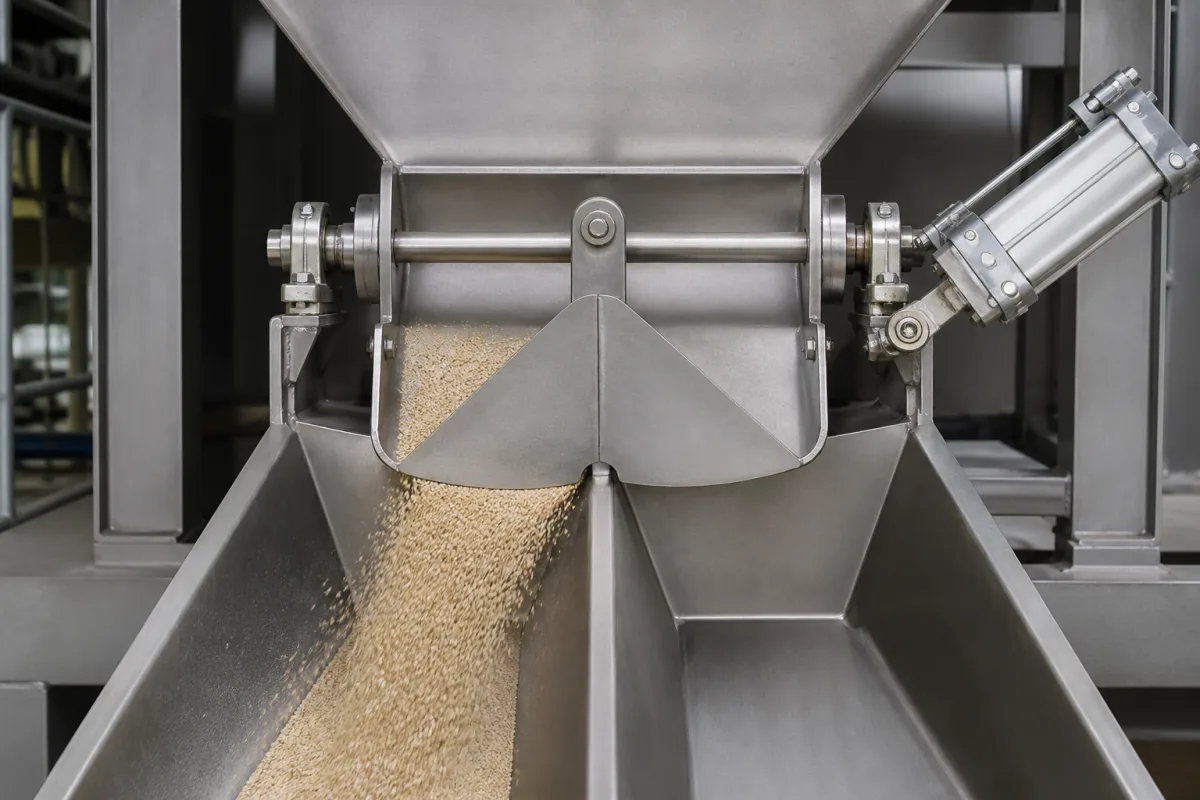
Representative product image. Confirm appearance and specifications with the manufacturer.

Product Specifications

Technical details and manufacturing context for Diverting Gate

Definition
The Diverting Gate is a critical part of the Diverting Chute Assembly, responsible for precisely directing the flow of bulk materials, parts, or products between different conveyor lines, processing stations, or storage bins. It operates by pivoting, sliding, or lifting to alter the material path, enabling sorting, merging, or distribution functions within automated handling systems. This component is typically installed at the junction of chutes or ducts, where it acts as a movable barrier to route material to the intended destination. The gate's design must accommodate the specific material characteristics, such as particle size, abrasiveness, and flow rate, to ensure reliable operation and minimal wear. The Diverting Gate is available in various configurations, including single or multiple outlets, and can be actuated manually or automatically. It is commonly used in industries such as mining, aggregate processing, food processing, and logistics, where efficient material routing is essential. The gate's construction materials, such as stainless steel, carbon steel, or abrasion-resistant polyurethane, are selected based on the application's requirements for corrosion resistance, wear resistance, and hygiene. The Diverting Gate is designed to operate within specified pressure and temperature ranges, and its performance is characterized by parameters such as leakage rate, response time, and actuation torque. Proper selection and installation are crucial to ensure optimal performance and longevity. The gate must be compatible with the existing control system, and its actuation mechanism should be chosen based on the required speed, force, and reliability. Regular maintenance, including inspection of seals and moving parts, is necessary to prevent failures and ensure consistent operation. The Diverting Gate is a versatile component that can be customized to meet specific application needs, with options for different sizes, materials, and control interfaces. It is important to verify all model-specific values and standards with the legal manufacturer or supplier before procurement.
Working Principle
The gate is typically actuated by a pneumatic cylinder, electric linear actuator, or rotary drive. Upon receiving a control signal (e.g., from a PLC or sensor), the actuator moves the gate plate or blade from one position to another, physically blocking one chute outlet while opening another, thereby diverting the material stream to the desired destination. The movement can be linear or rotary, depending on the design. The gate's position is often monitored by limit switches or sensors to provide feedback to the control system. The actuation force and speed are selected based on the material flow and the required response time. The gate must be properly sealed to prevent leakage and ensure efficient operation.
Common Materials
Stainless Steel, Carbon Steel, Abrasion-Resistant Polyurethane
Technical Parameters
ParameterTypical rangeNotes & selection driver
Nominal SizeDN80–DN300 mmMatches pipe bore; larger sizes on requestISO 6708
Operating Temperature-20–120 °CSeat material limits upper range
Leakage Rate0.01–0.1 %Class A for metal seat, B for soft seatISO 5208
Actuation Torque50–350 N·mRequired for manual or motorized operation
Response Time2–8 sFull stroke; depends on actuator
Control Voltage24 ±10% V DCOptional 110/230 V ACIEC 61131-2
Enclosure RatingIP54–IP65For actuator and limit switchesIEC 60529
Body MaterialWCB/CF8/CF8MCarbon steel or stainless steelASTM A216/A351
Seat MaterialPTFE/PPLSoft seat for tight shutoff
Weight15–120 kgDepends on size and material
Flange StandardPN16/ANSI150Drilling per standardISO 7005-1/ASME B16.5

Ranges are indicative industry figures for RFQ preparation, not a supplier commitment. Confirm every value and standard with the legal manufacturer before ordering.

Components / BOM
  • Gate Plate/Blade Part
    The physical barrier that redirects or stops material flow.
    Material: Stainless Steel
  • Actuator (Pneumatic Cylinder)
    Provides the linear or rotary motion to position the gate plate.
    Material: Aluminum Alloy, Steel
  • Mounting Frame/Bracket Part
    Secures the gate assembly to the chute structure.
    Material: Carbon Steel
  • Seal/Gasket Part
    Prevents material leakage around the gate edges when closed.
    Material: Polyurethane, Rubber
  • Limit Switch Optional
    Confirms the gate actually reached the open or closed position and reports it to the PLC.

Applied To / Applications

This component is essential for the following industrial systems and equipment:

Industrial Ecosystem & Supply Chain Structure

Complementary Systems
Downstream Applications
Specialized Tooling

Application Fit & Sizing Matrix

Operational Limits
pressure: Up to 10 bar
flow rate: 0.5 to 50 m³/h
temperature: -20°C to 150°C
slurry concentration: Up to 60% solids by weight
Media Compatibility
✓ Dry bulk solids (e.g., grains, powders) ✓ Granular materials (e.g., plastic pellets, minerals) ✓ Low-abrasion slurries (e.g., wastewater, food products)
Unsuitable: Highly corrosive chemicals (e.g., strong acids, chlorides)
Sizing Data Required
  • Material flow rate (m³/h or t/h)
  • Particle size and abrasiveness
  • Required actuation speed and duty cycle

Reliability & Engineering Risk Analysis

Failure Mode & Root Cause
Wear and abrasion
Cause: Continuous contact with abrasive materials in the flow stream, leading to material degradation and loss of sealing integrity.
Mechanical binding or jamming
Cause: Accumulation of debris, corrosion, or misalignment preventing smooth operation of the gate mechanism.
Maintenance Indicators
  • Unusual grinding or scraping noises during operation
  • Visible leakage around the gate seal or misalignment of the gate position
Engineering Tips
  • Implement regular lubrication and cleaning schedules to prevent debris buildup and corrosion.
  • Use wear-resistant materials or coatings on contact surfaces and ensure proper alignment during installation.

Indicative industry ranges for design and RFQ preparation. Confirm the exact figures and applicable standard with the manufacturer before specifying.

Compliance & Manufacturing Standards

Applicable Standards
ANSI/ASME B16.34 - Valves-Flanged, Threaded, and Welding End DIN EN 1092-1 - Flanges and their joints - Circular flanges for pipes, valves, fittings and accessories, PN designated

Quoted from the published standard.

Manufacturing Precision
  • Gate Seating Surface Flatness: 0.05mm
  • Stem Bore Alignment: +/-0.02mm
Quality Inspection
  • Hydrostatic Pressure Test (per API 598)
  • Dimensional Verification with CMM

Manufacturers of Diverting Gate

Manufacturer profiles associated with Diverting Gate.

Sourcing Diverting Gate from China?
Tell us your specification and target quantity — we will match it against manufacturer records and come back with the factories that fit.
Request manufacturers We manufacture this

Manufacturer listings support early research and capability understanding. They are not certification, ranking, or transaction guarantees.

Technical documentation
Request current drawings, revision history, and a signed specification sheet.
Manufacturing capability
Verify equipment lists, process limits, capacity, and representative production evidence.
Inspection readiness
Confirm test methods, calibrated equipment, sampling plans, and traceable reports.
Supplier transparency
Check the legal entity, factory address, ownership, certifications, and direct contacts.

CNFX does not score or rank suppliers. Buyers must verify all claims and documents with the legal manufacturer before ordering.

Supply Chain Compatible Machinery & Devices

Automated Powder Coating System

Integrated industrial system for applying dry powder coatings to metal substrates.

Explore Specs →
Centrifugal Pump Impeller

The centrifugal pump impeller is a critical rotating component that converts mechanical energy from the motor into kinetic energy in fluid systems.

Explore Specs →
High-Precision CNC Laser Cutting Machine

Computer-controlled industrial machine using focused laser beams to cut sheet metal with micron-level accuracy.

Explore Specs →
Industrial-Grade Hydraulic Cylinder Piston Rod

This industrial-grade piston rod is a precision-ground cylindrical component designed for use in hydraulic cylinders.

Explore Specs →

Frequently Asked Questions

What is the typical operating pressure range for a Diverting Gate?

The operating pressure range is typically 1.0 to 1.6 MPa. However, this is a reference range and must be verified for the specific model and application with the manufacturer.

What materials are commonly used for the gate body?

Common body materials include carbon steel (WCB) and stainless steel (CF8 or CF8M), as per ASTM A216/A351. The choice depends on the application's corrosion and wear requirements.

How is the Diverting Gate actuated?

It can be actuated by a pneumatic cylinder, electric linear actuator, or rotary drive. The actuation method is selected based on the required force, speed, and control system compatibility.

What is the leakage rate class for the gate?

The leakage rate is typically 0.01% to 0.1%, with Class A for metal seats and Class B for soft seats, as per ISO 5208. Confirm the actual class with the supplier.

Data Basis

Editorial classification, named public sources where available, and source-reviewed manufacturer records.

Preliminary Technical Classification
This page supports structured research, RFQ preparation, and supplier evaluation. It does not replace buyer-led supplier qualification, standards review, or technical approval.
Buyer enquiry

Request manufacturing insight for Diverting Gate

Ask for use case, specification boundaries, supplier type, and RFQ preparation information for this product.

Where it goes
Straight to the CNFX editorial desk, and to the manufacturer if this product is linked to a claimed profile. Nothing is broadcast to a supplier list.
Your details stay here
We do not sell or rent enquiry data, and we do not add you to a mailing list. Used only to answer this request.
No commission, no middleman
CNFX is a directory. We take no cut of any order and never negotiate on a supplier's behalf.
What we don't claim
A listing is not an endorsement. Qualify every supplier and verify every figure yourself before ordering.

Your business information is used only to process this request.

Thank you! Your message has been sent. We'll respond within 1–3 business days.
Sorry, we couldn't send your message. Please try again, or email us at contact@cnfx.com.

Need to Manufacture Diverting Gate?

Compare manufacturer profiles with relevant product and process capability.

Previous Product
Z-axis Ram/Spindle
Last Product
Get QuotesChat