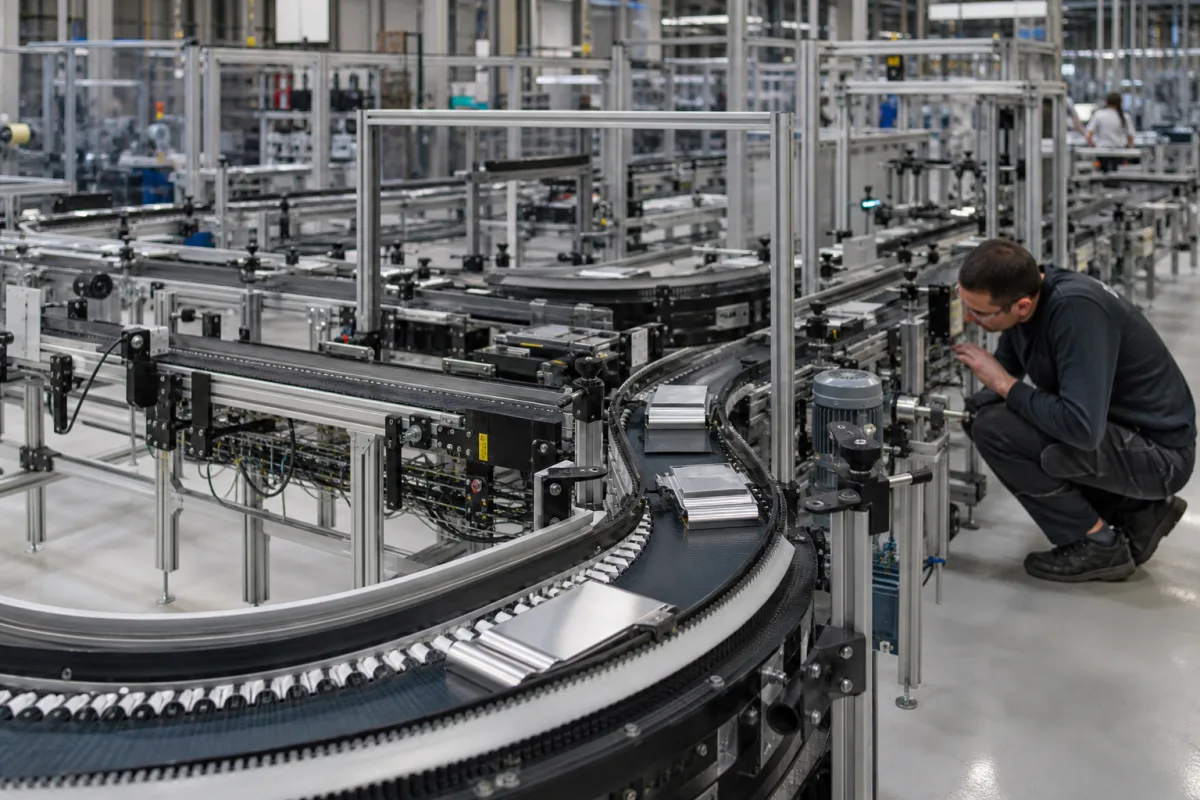
Industrial conveyor systems · Belt (slider-bed and roller-bed), roller (belt, V-belt, line-shaft and chain driven), chain, screw and special conveyors, matching load, speed, accumulation and layout, and stop, warning, guarding and lockout requirements
A conveyor system moves parts, packages or bulk materials along a fixed path through a plant, using belts, rollers, chains, screws or modular carrying surfaces driven by motors, with controls that start, stop, accumulate, merge and divert the load. Ask three things first: what the conveyor carries (size, weight, shape, bulk or unit) and how much per hour, what the route needs (straight, curves, inclines, accumulation, merges, diverts), and which controls, guarding and stop functions the plant's safety rules require.
Powered and gravity conveyor systems for unit loads and bulk materials in manufacturing, warehousing, food and packaging: belt, roller, chain, screw and modular conveyors as complete systems. Specialised conveyor families with their own pages — belt conveyors, PCB conveyor systems, pallet conveyors, screw conveyors, chip conveyors, pneumatic conveyors — and conveyor belting or chain sold alone are covered elsewhere except where compared.
CNFX editorial research · Sources checked October 11, 2026 · 4 sources
Plant Engineering's guide to powered belt and roller conveyors for unit handling (items with a definable shape such as packages, cartons and totes) says belt conveyors suit loads whose speed and spacing must be controlled, can run horizontally or incline and decline, and are fixed, portable or telescoping, operating at 40–60 fpm in the guide's figures with up to 200 fpm available and a maximum live load of about 150 lb/ft on belt widths of 12–36 in. Slider-bed belts run on a continuous surface with a 25–30% friction coefficient, needing larger motors, and suit small, unstable, light-to-medium irregular items, elevation changes and constant spacing; roller-bed belts run on rollers with about 5% friction, lasting longer at lower operating cost, with two or three rollers under every product. [1]
The guide says roller conveyors are the better choice for accumulation, because zero- and minimum-pressure options can slot or halt product, and for systems with merges, curves and diversions. Belt-driven (flat or V-belt) roller conveyors serve light-to-medium cartons and totes, V-belts flexing around curves; line-shaft conveyors drive each roller through polyurethane belts from one shaft, for light-to-medium transporting, sorting and accumulating; chain-driven roller conveyors serve medium-to-heavy loads, continuous chain for transport but not frequent starts and stops, and roller-to-roller chain for pallets, skids or drums up to 10,000 lb with starting, stopping and reversing. It lists selection factors as load dimensions and weight, throughput, safety, flexibility and expandability, economics, noise and automation level. [1]
Editorial calculation: for the same 1,000 lb of load on the belt, the guide's friction coefficients give a drag of about 250–300 lb on a slider bed against about 50 lb on a roller bed — five to six times less — which is why roller-bed belts need smaller motors and drives. [1]
Editorial note: bulk materials, PCBs, pallets, chips and pneumatic transport have their own CNFX pages; use this page to decide the family, then specify on the specific page.
Give the supplier the items or material conveyed (dimensions, weight, base shape, temperature, fragility), throughput per hour, layout drawing with elevations, curves, merges and diverts, accumulation needs, speed, environment (washdown, dust, temperature), controls and integration (PLC, WMS/MES), noise limits, safety requirements, power supply, and installation scope.
02
Plan controls, guarding and safety
OSHA 29 CFR 1926.555 (conveyors in construction) requires a means to stop the motor at the operator's station, and at the motor if the station is remote; an audible warning immediately before start-up; emergency stop switches that must be reset before the conveyor can restart; guarding of screw conveyor flights; guards where conveyors pass over work areas, aisles or passageways, with crossings marked; lockout and 'Do Not Operate' tagging during repairs; and conformity with ANSI B20.1 for design, construction, inspection, testing, maintenance and operation. [2]
Plant Engineering's safety sidebar adds on-off controls near workstations with more than one pushbutton station on long runs, an emergency pull cord along the conveyor, warning lights and buzzers before start-up, guards on drives, nip points between belts and pulleys, couplings and sprockets and under overhead conveyors, and noise control by lower speeds, less metal-to-metal contact, tight fasteners and quality bearings. [1]
Editorial note: OSHA 1926.555 applies to construction work; general-industry plants follow their own machine-guarding rules and ASME B20.1, so state the safety standard you require in the enquiry.
03
Compare conveyor system suppliers
These companies list conveyors for different industries; check that each one's range matches your load and layout.
04
Map the guarding rules that apply outside construction
Minnesota OSHA's instruction on guarding belt conveyors sets out which federal rules an inspector cites for conveyors outside construction and pulp and paper mills. Drive components (belts and pulleys, chains and sprockets) fall under 1910.219, which excludes the driving pulley on which the conveyor belt runs; in-going nip points, shear points and rotating parts fall under 1910.212(a)(1), and guarding by location is allowed at 8' or more above the floor. Where staff remove or bypass a guard for servicing, a lockout/tagout program under 1910.147 must be in place. Conveyors above exit passageways, aisles or corridors should leave a clearance of at least 6' 8". [3]
For pulp, paper and paperboard mills, the instruction cites 1910.261(c)(15): an emergency stop cable along the length of the conveyor, or stop buttons within 10 feet of each work station. It also notes that ANSI B20.1 2015 allows lubrication during operation only if shutdown is impractical and only by trained, qualified personnel. Where B20.1 'shall' provisions are not met, Minnesota can cite its general duty clause, for example for remotely or automatically controlled conveyors without emergency stop devices, or missing spill or pan guards. [3]
Editorial calculation: 8' is about 2.44 m and 6' 8" about 2.03 m (1 ft = 0.3048 m); give these heights to the supplier when routing conveyors over walkways. [3]
05
Size motorised-roller zones from the load and gear-ratio tables
Interroll's datasheet for its RollerDrive EC5000, a 60 mm motorised conveyor roller with the motor integrated in the tube, describes it as a drive for unit-handling conveyors carrying cartons, containers, tyres or lightweight pallets, suited to straight conveyors and especially to zero-pressure accumulation conveyors. The 50 W roller runs on 24 V or 48 V, with rated current of 3.4 A or 1.7 A and starting current of 7.5 A or 3.8 A, in ambient temperatures of 0 to 40 °C, and lists maximum installed noise of 55 dB(A), application-dependent. [4]
Load is rated per zone and per roller. A zone driven by the RollerDrive carries up to 2500 N with a polyamide drive head or 5000 N with a welded steel drive head; a single RollerDrive carries 1100 N without a drive head, 550 N with a polyamide PolyVee head and 1100 N with a welded steel PolyVee or double-sprocket head. These values assume two-dimensional loading of the tube; for one-dimensional loads such as pallets the load per roller is reduced, and not all rollers support the pallet. [4]
The gear ratio sets speed and torque, as the table shows; Interroll states that values may differ by up to ±20 % before run-in and stay within ±10 % for 95 % of rollers after it. [4] Editorial calculation: 0.52 m/s at 42:1 is about 102 fpm (0.52 × 196.85), above the 40–60 fpm belt speeds in Plant Engineering's guide, and 5000 N is about 1,124 lbf (5000 ÷ 4.448). Give the supplier your heaviest unit load, its footprint, zone length and required speed so it can choose the drive head and gear ratio. [1]
Gear ratio (50 W)
Max. / min. conveying speed (m/s)
Rated / acceleration torque (N·m)
9:1
2.41 / 0.12
0.63 / 1.58
18:1
1.20 / 0.06
1.27 / 3.17
42:1
0.52 / 0.03
2.96 / 7.40
108:1
0.20 / 0.01
7.07 / 13.00
06
Trace the system components
This is a functional reference built from the sources cited; it is not one maker's design.
Fill the specification fields with values for your plant
A conveyor system quotation needs values for your loads and layout. The table explains each field, gives published values where a reviewed source states them, and says what to obtain from the supplier.
Field
What it means and published values
Ask the supplier for
Conveyor family
Belt for controlled spacing; roller for accumulation and merges; chain-driven for heavy loads. [1]
The conveyor catalogue lists small tabletop, synchronous-belt, knife-edge, flat-belt and electric-roller units alongside aluminium profiles and accessories.
Presents complete powder-coating lines with pretreatment, booths, curing ovens, conveyor systems and controls; the conveyor is offered as part of a finishing line.
Offers Ro8 / Ro8 T enclosed-tube or trough screw conveyors for screenings, dewatered sludge, grit and industrial solids (HUBER group, Chinese contact).
Describes air, table-top-chain, modular-belt, accumulation and merge/discharge conveyors between bottling equipment; length, elevation and control zoning are project-defined.
Explore company information and manufacturing capabilities, then discuss the scope of your project with a relevant supplier.
Share this page
Compiled and source-reviewed by the CNFX editorial team.
Published product pages show what a company offers, not tested performance. Confirm the legal seller, factory, references and scope for your order. How we source and review
· Page last updated 13 October 2026
Buyer questions
Should I choose a belt or roller conveyor?
Belts suit loads that need controlled speed and spacing and elevation changes; rollers suit accumulation, merges, curves and diverts. [1]
Why is a roller-bed belt conveyor cheaper to run than a slider bed?
Its friction coefficient is about 5% against 25–30% for a slider bed, so it needs smaller motors and lasts longer. [1]
What safety features must a conveyor have?
OSHA 1926.555 requires stops at operator stations, an audible start-up warning, reset-before-restart emergency stops, guards over walkways and lockout during repairs. [2]
How high must an unguarded conveyor be to count as guarded by location?
Minnesota OSHA's instruction STD 1-12.9A allows guarding by location at 8' or more above the floor, and asks for at least 6' 8" of clearance where conveyors pass over exit routes. [3]
How much load can a motorised-roller accumulation zone carry?
Interroll's datasheet for its 60 mm RollerDrive EC5000 rates a zone at up to 2500 N with a polyamide drive head or 5000 N with a welded steel drive head, assuming two-dimensional loading; for pallets the load per roller is reduced. [4]
Sources and what still needs a direct check
Sources checked 2026-10-11. The Plant Engineering article summarises unit-handling conveyor practice with contributions from conveyor makers; OSHA 1926.555 is a US construction rule. Design for your plant must come from the supplier and the safety standard you apply.