This page explains how Dust Extraction Unit is classified within Machinery and Equipment Manufacturing. Technical values and manufacturer relationships are research references; confirm the current specification and supplier evidence for each order.
A specialized component designed to capture and remove dust particles generated during the electrode slitting process in battery manufacturing.
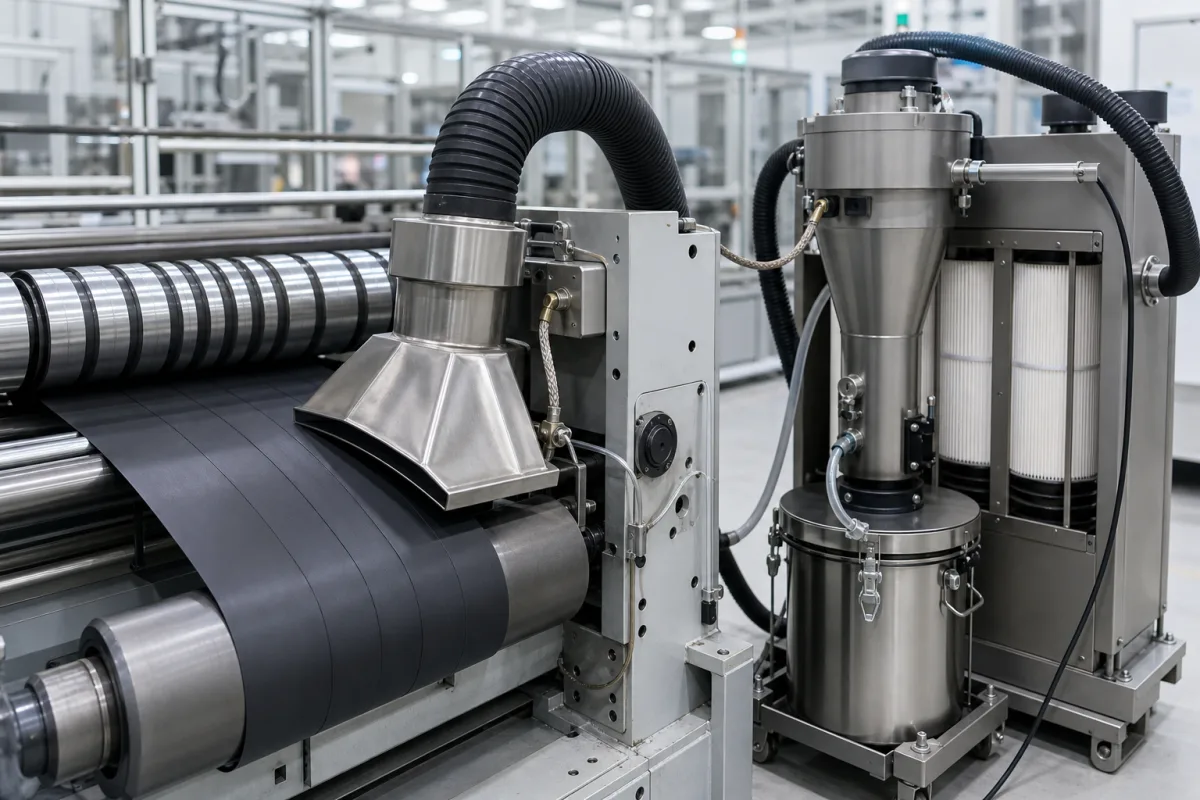
Technical details and manufacturing context for Dust Extraction Unit
| Parameter | Typical range | Notes & selection driver |
|---|---|---|
| Air Flow Rate | 500–2000 m³/h | Select based on dust load and duct length |
| Static Pressure | 1500–3000 Pa | Ensure sufficient suction at collection points |
| Filtration Efficiency | ≥99.9 % | For particles ≥0.3 μmISO 16890 |
| Filter Area | 10–50 m² | Larger area reduces pressure drop |
| Noise Level | ≤75 dB(A) | At 1 m distanceISO 3744 |
| Operating Temperature | 0–50 °C | Above 50°C may damage filter media |
| Power Supply | 380 ±10% V AC | Three-phase, 50/60 HzIEC 60038 |
| Power Consumption | 2.2–7.5 kW | Depends on fan size |
| Ingress Protection | IP54–IP65 | IP65 for washdown areasIEC 60529 |
| Weight | 150–500 kg | Increases with filter area and fan size |
| Dimensions (L×W×H) | 1200×800×1500–2000×1200×2000 mm | Check clearance for installation |
Ranges are indicative industry figures for RFQ preparation, not a supplier commitment. Confirm every value and standard with the legal manufacturer before ordering.
| pressure: | Max 0.5 bar |
| flow rate: | 100 to 1000 m³/h |
| temperature: | 0°C to +50°C |
| slurry concentration: | Max 5% solids by weight |
Indicative industry ranges for design and RFQ preparation. Confirm the exact figures and applicable standard with the manufacturer before specifying.
Quoted from the published standard.
Manufacturer profiles associated with Dust Extraction Unit.
Manufacturer listings support early research and capability understanding. They are not certification, ranking, or transaction guarantees.
A practical evidence checklist for RFQ preparation and supplier evaluation.
CNFX does not score or rank suppliers. Buyers must verify all claims and documents with the legal manufacturer before ordering.
It captures and removes dust particles generated during electrode slitting, preventing contamination and maintaining a clean environment.
It provides ≥99.9% filtration efficiency for particles ≥0.3 μm, as per ISO 16890, but verify for the specific model.
It requires a three-phase 380 V AC ±10% supply (50/60 Hz) per IEC 60038, with power consumption ranging from 2.2 to 7.5 kW.
Consider dust load, duct length, required static pressure, and filter area. Confirm all parameters with the manufacturer.
Editorial classification, named public sources where available, and source-reviewed manufacturer records.
Ask for use case, specification boundaries, supplier type, and RFQ preparation information for this product.
Compare manufacturer profiles with relevant product and process capability.