Industry-Verified Manufacturing Data (2026)

Dust Collection Bin

Based on aggregated insights from multiple verified factory profiles within the CNFX directory, the standard Dust Collection Bin used in the Machinery and Equipment Manufacturing sector typically supports operational capacities ranging from standard industrial configurations to heavy-duty production requirements.

Technical Definition & Core Assembly

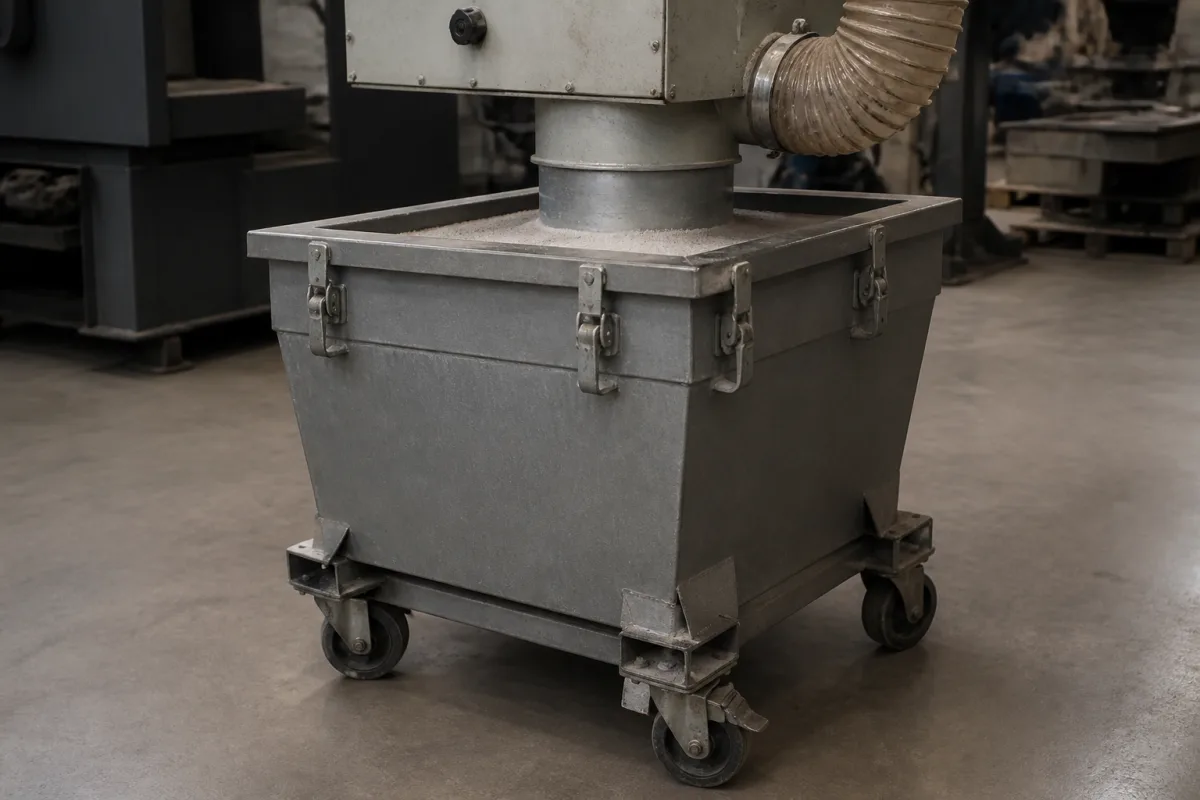
A canonical Dust Collection Bin is characterized by the integration of Bin Body and Access Door. In industrial production environments, manufacturers listed on CNFX commonly emphasize Galvanized steel construction to support stable, high-cycle operation across diverse manufacturing scenarios.

A container that collects and stores dust particles extracted from industrial processes.
Product Specifications

Technical details and manufacturing context for Dust Collection Bin

Definition
The dust collection bin is a critical component of dust extraction units, serving as the primary storage receptacle for captured particulate matter. It functions as the endpoint where dust accumulates after being separated from the air stream by filtration systems, allowing for periodic disposal while maintaining continuous operation of the extraction system.
Working Principle
Dust-laden air enters the extraction system and passes through filtration media where particles are separated. The collected dust falls by gravity into the collection bin below. The bin typically features a sealed design to prevent dust re-entrainment and may include level indicators or sensors to signal when emptying is required.
Common Materials
Galvanized steel, Stainless steel, Polyethylene
Technical Parameters
  • Storage capacity of the dust collection bin (L) Customizable
Components / BOM
  • Bin Body
    Primary container structure that holds collected dust
    Material: Galvanized steel
  • Access Door
    Sealed opening for emptying collected dust
    Material: Steel with rubber gasket
  • Mounting Flange
    Interface for connecting to dust extraction unit
    Material: Steel
  • Level Indicator
    Visual or electronic sensor to show dust fill level
    Material: Polycarbonate/Stainless steel
Engineering Reasoning
0-1.5 bar differential pressure, 0-80°C ambient temperature, 0-95% relative humidity
Structural failure at 2.1 bar differential pressure, material embrittlement below -20°C, corrosion acceleration above 60°C with chloride concentration >100 ppm
Design Rationale: Hopper stress concentration exceeding 235 MPa yield strength (ASTM A36 steel), polymer chain scission at glass transition temperature (Tg) for polypropylene components, galvanic corrosion potential >0.25V between dissimilar metals
Risk Mitigation (FMEA)
Trigger Electrostatic discharge accumulation exceeding 10 mJ ignition energy
Mode: Dust cloud deflagration propagating at 300 m/s
Strategy: Intrinsic safety grounding with resistance <1 ohm, conductive polymer liners with surface resistivity <10^6 ohm/sq
Trigger Cyclic loading at 0.5 Hz frequency with 0.3 mm displacement amplitude
Mode: Fatigue crack initiation at weld toe with Paris' law constant C=1.5e-10
Strategy: Full penetration welds with toe radius >3 mm, post-weld heat treatment at 650°C for 1 hour per inch thickness

Industry Taxonomies & Aliases

Commonly used trade names and technical identifiers for Dust Collection Bin.

Applied To / Applications

This component is essential for the following industrial systems and equipment:

Industrial Ecosystem & Supply Chain DNA

Complementary Systems
Downstream Applications
Specialized Tooling

Application Fit & Sizing Matrix

Operational Limits
pressure: 0 to 0.5 bar (gauge)
flow rate: Up to 5000 m³/h
temperature: -20°C to 80°C
slurry concentration: Up to 15% solids by weight
Media Compatibility
✓ Wood dust ✓ Metal grinding particles ✓ Plastic powder
Unsuitable: Highly corrosive chemical vapors
Sizing Data Required
  • Maximum dust generation rate (kg/h)
  • Required storage capacity (m³)
  • Available installation footprint (m²)

Reliability & Engineering Risk Analysis

Failure Mode & Root Cause
Structural fatigue cracking
Cause: Cyclic loading from material accumulation/emptying cycles combined with vibration from connected equipment, leading to stress concentration at welds or transitions.
Hopper bridging/arching
Cause: Material compaction due to moisture absorption, poor hopper geometry, or insufficient discharge assistance, causing flow obstruction and potential overpressure.
Maintenance Indicators
  • Visible dust leakage around seams or access points indicating seal failure or structural compromise
  • Unusual vibration or audible 'thumping' during operation suggesting material buildup or mechanical interference
Engineering Tips
  • Implement routine internal inspection for wall thinning and weld integrity, especially at transition zones and support points
  • Install and maintain proper hopper heating/insulation and vibratory aids to prevent material bridging and ensure consistent flow

Compliance & Manufacturing Standards

Reference Standards
ISO 16890:2016 - Air filters for general ventilation ANSI/ASME B31.3 - Process Piping for pressure integrity CE Marking - Machinery Directive 2006/42/EC for safety
Manufacturing Precision
  • Seam Weld Penetration: 100% with no voids
  • Filter Seal Surface Flatness: 0.5mm across diameter
Quality Inspection
  • Pressure Decay Leak Test at 1.5x operating pressure
  • Material Certification Verification for corrosion resistance

Factories Producing Dust Collection Bin

Verified manufacturers with capability to produce this product in China

✓ 97% Supplier Capability Match Found

T Technical Director from Canada Jan 18, 2026
★★★★★
"Reliable performance in harsh Machinery and Equipment Manufacturing environments. No issues with the Dust Collection Bin so far."
Technical Specifications Verified
P Project Engineer from United States Jan 15, 2026
★★★★☆
"Testing the Dust Collection Bin now; the technical reliability results are within 1% of the laboratory datasheet. (Delivery took slightly longer than expected, but technical support was excellent.)"
Technical Specifications Verified
S Sourcing Manager from United Arab Emirates Jan 12, 2026
★★★★★
"Impressive build quality. Especially the technical reliability is very stable during long-term operation."
Technical Specifications Verified
Verification Protocol

“Feedback is collected from verified sourcing managers during RFQ (Request for Quote) and factory evaluation processes on CNFX. These reports represent historical performance data and technical audit summaries from our B2B manufacturing network.”

7 sourcing managers are analyzing this specification now. Last inquiry for Dust Collection Bin from Germany (1h ago).

Supply Chain Compatible Machinery & Devices

Hydraulic Press

Industrial machine using hydraulic pressure to compress, form, or assemble materials

Explore Specs →
Heavy-Duty CNC Plasma Cutting Machine

Industrial machine for precision metal cutting using plasma arc technology

Explore Specs →
Automated Assembly Line System

Integrated production system for sequential component assembly operations

Explore Specs →
Automated Powder Coating System

Integrated industrial system for applying dry powder coatings to metal substrates.

Explore Specs →

Frequently Asked Questions

What materials are available for dust collection bins?

Our dust collection bins are available in galvanized steel for corrosion resistance, stainless steel for high-temperature applications, and polyethylene for chemical resistance and lightweight durability.

How do I monitor dust levels in the collection bin?

Our bins include a level indicator that provides visual or electronic feedback on dust accumulation, allowing for timely emptying and preventing overfilling that could affect system performance.

What maintenance is required for industrial dust collection bins?

Regular maintenance includes inspecting seals on the access door, cleaning the level indicator sensor, checking the mounting flange for secure attachment, and ensuring proper disposal of collected dust according to safety regulations.

Can I contact factories directly on CNFX?

CNFX is an open directory, not a transaction platform. Each factory profile provides direct contact information and production details to help you initiate direct inquiries with Chinese suppliers.

Get Quote for Dust Collection Bin

Request technical pricing, lead times, or customized specifications for Dust Collection Bin directly from verified manufacturing units.

Your business information is encrypted and only shared with verified Dust Collection Bin suppliers.

Thank you! Your message has been sent. We'll respond within 1–3 business days.

Need to Manufacture Dust Collection Bin?

Connect with verified factories specializing in this product category

Add Your Factory Contact Us
Previous Product
Ductwork
Next Product
Dust Collection Hopper