Editorial Technical Reference

Suction Hood

This page explains how Suction Hood is classified within Machinery and Equipment Manufacturing. Technical values and manufacturer relationships are research references; confirm the current specification and supplier evidence for each order.

Technical Definition & Core Assembly

A component of dust extraction systems that captures airborne particles at the source.
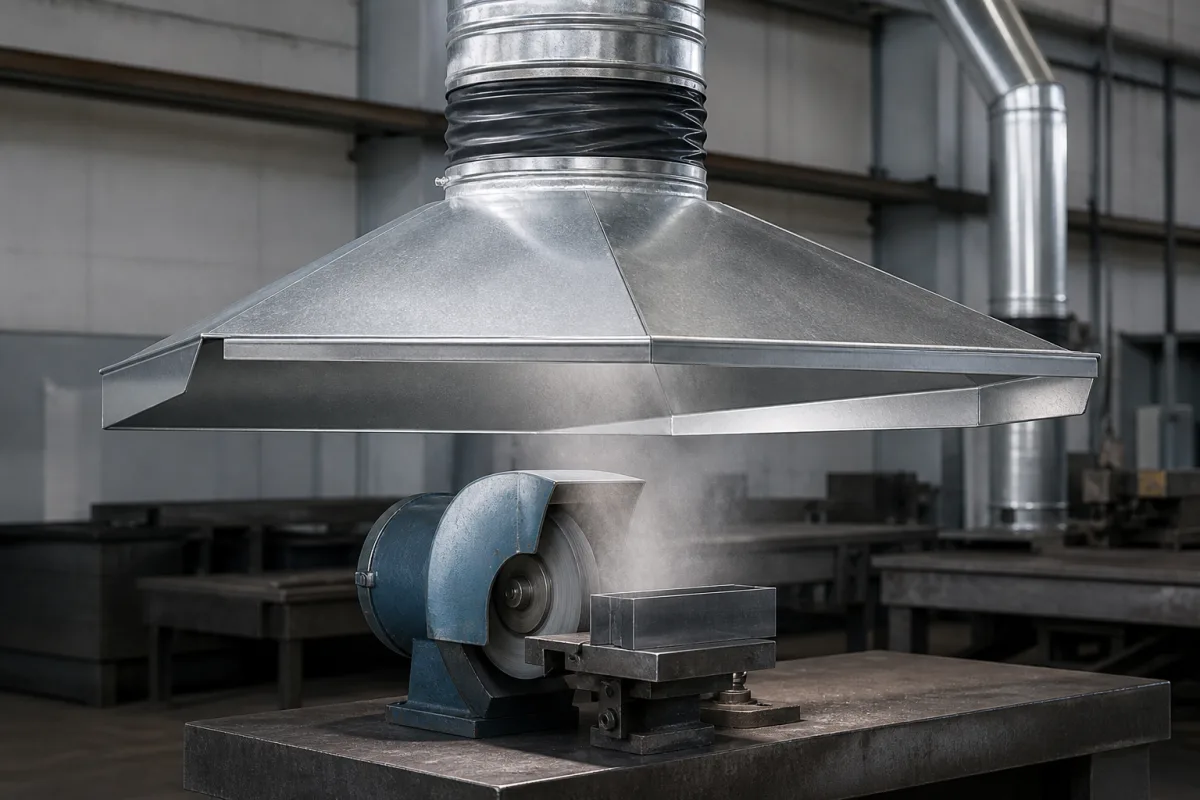
Representative product image. Confirm appearance and specifications with the manufacturer.

Product Specifications

Technical details and manufacturing context for Suction Hood

Definition
The suction hood is a critical part of dust extraction units, designed to enclose or surround dust-generating processes to efficiently capture airborne particles, dust, and fumes before they disperse into the work environment. It serves as the primary collection point where contaminated air enters the extraction system. The hood is available in materials such as galvanized steel, stainless steel, and polypropylene, with material grades including Q235B, 304, and 316L, depending on the application. Key parameters include airflow capacity ranging from 500 to 5000 m³/h, capture velocity from 0.5 to 2.5 m/s (per ACGIH guidelines), static pressure drop from 100 to 500 Pa, operating temperature from -20 to 80 °C, wall thickness from 1.5 to 3.0 mm, connection diameter from 100 to 400 mm (per ISO 780), weight from 5 to 50 kg, surface finish from Ra 3.2 to 6.3 µm (per ISO 1302), and noise level from 60 to 85 dB(A) (per ISO 3744). These values are reference ranges and must be verified for the specific model and application. The suction hood is a component, not a standalone system, and its performance depends on proper integration with the extraction system, including ductwork and fan selection. It is used in machinery and equipment manufacturing environments to control airborne contaminants. Always confirm model-specific values and standards with the legal manufacturer or supplier before procurement or installation.
Working Principle
The suction hood creates a localized airflow pattern that draws dust-laden air into the extraction system through negative pressure. Its design—shape, size, and placement—determines capture efficiency by creating sufficient air velocity to overcome particle inertia and environmental air currents. The hood must be positioned close to the dust source to maximize capture, and the airflow rate must be matched to the hood size and required capture velocity. Proper design ensures that contaminants are effectively removed before they disperse, protecting workers and the environment.
Common Materials
Galvanized steel, Stainless steel, Polypropylene
Technical Parameters
ParameterTypical rangeNotes & selection driver
Airflow Capacity500–5000 m³/hSelect based on capture velocity and hood size
Capture Velocity0.5–2.5 m/sHigher for toxic or fine dustACGIH
Static Pressure Drop100–500 PaAffects fan selection
Operating Temperature-20–80 °CFor standard materials; higher requires special alloys
Material GradeQ235B/304/316L304/316L for corrosive or hygienic applicationsGB/T 700, ASTM A240
Wall Thickness1.5–3.0 mmThicker for abrasive dust or structural rigidity
Connection Diameter100–400 mmMatch ductwork sizeISO 780
Weight5–50 kgDepends on size and material
Surface FinishRa 3.2–6.3 µmSmoother for food or pharmaceutical useISO 1302
Noise Level60–85 dB(A)At 1 m distance; lower for indoor useISO 3744

Ranges are indicative industry figures for RFQ preparation, not a supplier commitment. Confirm every value and standard with the legal manufacturer before ordering.

Components / BOM
  • Housing Part
    Main structural enclosure that defines capture zone
    Material: Galvanized steel
  • Flange Part
    Connection interface to extraction ductwork
    Material: Steel
  • Baffle Plate Part
    Directs airflow and improves capture efficiency
    Material: Steel
  • Mounting Brackets Part
    Secures hood to equipment or structure
    Material: Steel

Applied To / Applications

This component is essential for the following industrial systems and equipment:

Industrial Ecosystem & Supply Chain Structure

Complementary Systems
Downstream Applications
Specialized Tooling

Application Fit & Sizing Matrix

Operational Limits
pressure: Up to 0.5 bar (vacuum)
flow rate: 500-5000 m³/h
temperature: -20°C to 80°C
slurry concentration: Up to 5% solids by weight
Media Compatibility
✓ Wood dust ✓ Metal grinding particles ✓ Plastic powder
Unsuitable: Corrosive chemical vapors
Sizing Data Required
  • Required capture velocity (m/s)
  • Duct diameter (mm)
  • Source emission rate (kg/h)

Reliability & Engineering Risk Analysis

Failure Mode & Root Cause
Fatigue cracking
Cause: Cyclic stress from airflow pulsations and vibration, often exacerbated by improper mounting or resonance with connected equipment.
Corrosion or material degradation
Cause: Exposure to corrosive process gases, moisture, or chemical contaminants in the airstream, especially in high-humidity or acidic environments.
Maintenance Indicators
  • Unusual vibration or audible rattling indicating loose components or structural fatigue
  • Visible cracks, warping, or material discoloration on the hood surface
Engineering Tips
  • Implement regular vibration analysis and structural inspections to detect early fatigue signs before catastrophic failure
  • Apply protective coatings or select corrosion-resistant materials compatible with the specific process environment

Indicative industry ranges for design and RFQ preparation. Confirm the exact figures and applicable standard with the manufacturer before specifying.

Compliance & Manufacturing Standards

Applicable Standards
ISO 14644-1:2015 (Cleanrooms and associated controlled environments) ANSI/ASHRAE 110-2016 (Method of Testing Performance of Laboratory Fume Hoods) DIN EN 14175-2:2016 (Fume cupboards - Safety and performance requirements)

Quoted from the published standard.

Manufacturing Precision
  • Hood face velocity: +/-10% of design specification
  • Material thickness: +/-0.5mm for sheet metal components
Quality Inspection
  • Airflow uniformity test (using anemometer grid method)
  • Leakage test (using tracer gas or smoke generation method)

Manufacturers of Suction Hood

Manufacturer profiles associated with Suction Hood.

Sourcing Suction Hood from China?
Tell us your specification and target quantity — we will match it against manufacturer records and come back with the factories that fit.
Request manufacturers We manufacture this

Manufacturer listings support early research and capability understanding. They are not certification, ranking, or transaction guarantees.

Technical documentation
Request current drawings, revision history, and a signed specification sheet.
Manufacturing capability
Verify equipment lists, process limits, capacity, and representative production evidence.
Inspection readiness
Confirm test methods, calibrated equipment, sampling plans, and traceable reports.
Supplier transparency
Check the legal entity, factory address, ownership, certifications, and direct contacts.

CNFX does not score or rank suppliers. Buyers must verify all claims and documents with the legal manufacturer before ordering.

Supply Chain Compatible Machinery & Devices

Automated Powder Coating System

Integrated industrial system for applying dry powder coatings to metal substrates.

Explore Specs →
Centrifugal Pump Impeller

The centrifugal pump impeller is a critical rotating component that converts mechanical energy from the motor into kinetic energy in fluid systems.

Explore Specs →
High-Precision CNC Laser Cutting Machine

Computer-controlled industrial machine using focused laser beams to cut sheet metal with micron-level accuracy.

Explore Specs →
Industrial-Grade Hydraulic Cylinder Piston Rod

This industrial-grade piston rod is a precision-ground cylindrical component designed for use in hydraulic cylinders.

Explore Specs →

Frequently Asked Questions

What is the primary function of a suction hood?

The suction hood captures airborne particles, dust, and fumes at the source before they disperse into the work environment. It is the entry point for contaminated air into the extraction system.

How do I select the right suction hood material?

Material selection depends on the application. Galvanized steel is common for general use, stainless steel (304/316L) for corrosive or hygienic environments, and polypropylene for chemical resistance. Verify with the manufacturer.

What does capture velocity mean and why is it important?

Capture velocity is the air speed needed to capture particles at the source. It ranges from 0.5 to 2.5 m/s per ACGIH guidelines, with higher values for toxic or fine dust. It determines hood effectiveness.

Can the suction hood be used in high-temperature processes?

The standard operating temperature range is -20 to 80 °C. For higher temperatures, special alloys may be required. Always confirm with the manufacturer for your specific process.

Data Basis

Editorial classification, named public sources where available, and source-reviewed manufacturer records.

Preliminary Technical Classification
This page supports structured research, RFQ preparation, and supplier evaluation. It does not replace buyer-led supplier qualification, standards review, or technical approval.
Buyer enquiry

Request manufacturing insight for Suction Hood

Ask for use case, specification boundaries, supplier type, and RFQ preparation information for this product.

Where it goes
Straight to the CNFX editorial desk, and to the manufacturer if this product is linked to a claimed profile. Nothing is broadcast to a supplier list.
Your details stay here
We do not sell or rent enquiry data, and we do not add you to a mailing list. Used only to answer this request.
No commission, no middleman
CNFX is a directory. We take no cut of any order and never negotiate on a supplier's behalf.
What we don't claim
A listing is not an endorsement. Qualify every supplier and verify every figure yourself before ordering.

Your business information is used only to process this request.

Thank you! Your message has been sent. We'll respond within 1–3 business days.
Sorry, we couldn't send your message. Please try again, or email us at contact@cnfx.com.

Need to Manufacture Suction Hood?

Compare manufacturer profiles with relevant product and process capability.

Previous Product
Z-axis Ram/Spindle
Last Product
Get QuotesChat