Tray Mechanism
View system integration details
This page explains how Rack and Pinion Gear Set is classified within Machinery and Equipment Manufacturing. Technical values and manufacturer relationships are research references; confirm the current specification and supplier evidence for each order.
A mechanical component consisting of a linear rack and a rotating pinion gear that converts rotational motion into linear motion or vice versa.
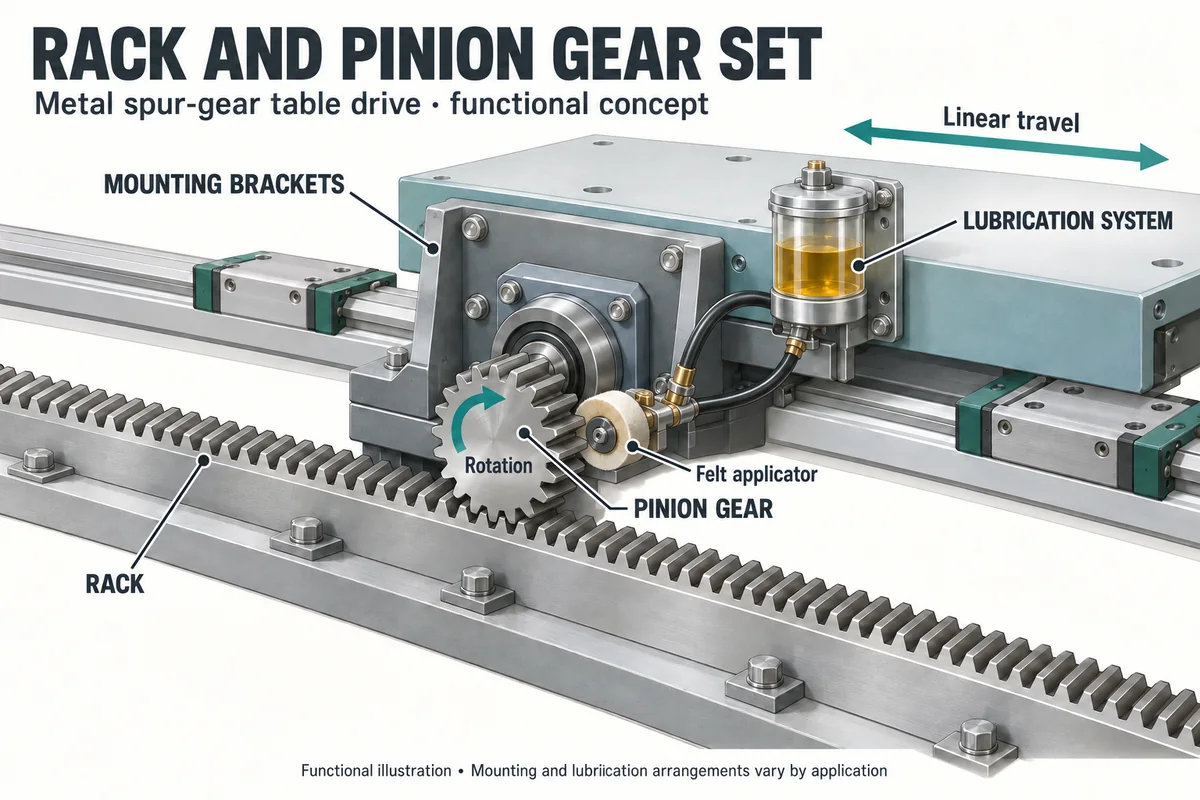
Technical details and manufacturing context for Rack and Pinion Gear Set
| Parameter | Typical range | Notes & selection driver |
|---|---|---|
| Module | 1–4 mm | Determines tooth size and load capacityISO 54 |
| Number of Teeth | 20–60 | Affects gear ratio and resolution |
| Pressure Angle | 20 ° | Standard angle for most applicationsISO 53 |
| Face Width | 10–50 mm | Wider face increases load capacity |
| Rack Length | 500–2000 mm | Determines travel distance |
| Accuracy Grade | 5–7 | Lower number means higher precisionISO 1328 |
| Max Linear Speed | 1–3 m/s | Higher speeds may require lubrication |
| Max Torque | 50–200 N·m | Exceeding may cause tooth breakage |
| Operating Temperature | -20–80 °C | Outside range may affect material properties |
| Material | C45 | Carbon steel for general useDIN 17200 |
| Surface Hardness | 50–60 HRC | Higher hardness improves wear resistanceISO 18265 |
| Weight | 5–20 kg | Depends on size and material |
Ranges are indicative industry figures for RFQ preparation, not a supplier commitment. Confirm every value and standard with the legal manufacturer before ordering.
| pressure: | Up to 100 bar |
| other spec: | Max linear speed: 2 m/s, Max rotational speed: 3000 rpm |
| temperature: | -40°C to 120°C |
Indicative industry ranges for design and RFQ preparation. Confirm the exact figures and applicable standard with the manufacturer before specifying.
Quoted from the published standard.
A practical evidence checklist for RFQ preparation and supplier evaluation.
Compare the published product scope and source details, then include your specifications and quantity in an enquiry.
Manufacturer profiles associated with Rack and Pinion Gear Set.
Explore company information and manufacturing capabilities, then discuss the scope of your project with a relevant supplier.
Ask for use case, specification boundaries, supplier type, and RFQ preparation information for this product.
It is commonly used in tray mechanisms to convert rotational motion into precise linear movement for positioning, loading, and unloading operations in automated systems.
Common materials include steel, stainless steel, aluminum alloy, and plastic for light-duty applications. The specific material grade should be confirmed with the supplier.
The module determines tooth size and load capacity, while the number of teeth affects gear ratio and resolution. These parameters must be chosen based on your application requirements and verified with the manufacturer.
Relevant standards include ISO 54 for modules, ISO 53 for pressure angle, ISO 1328 for accuracy grade, DIN 17200 for material, and ISO 18265 for hardness. Always verify compliance with the supplier.
This component is essential for the following industrial systems and equipment:
Commonly used trade names and technical identifiers for Rack and Pinion Gear Set.
Editorial classification, named public sources where available, and source-reviewed manufacturer records.
Compare manufacturer profiles with relevant product and process capability.