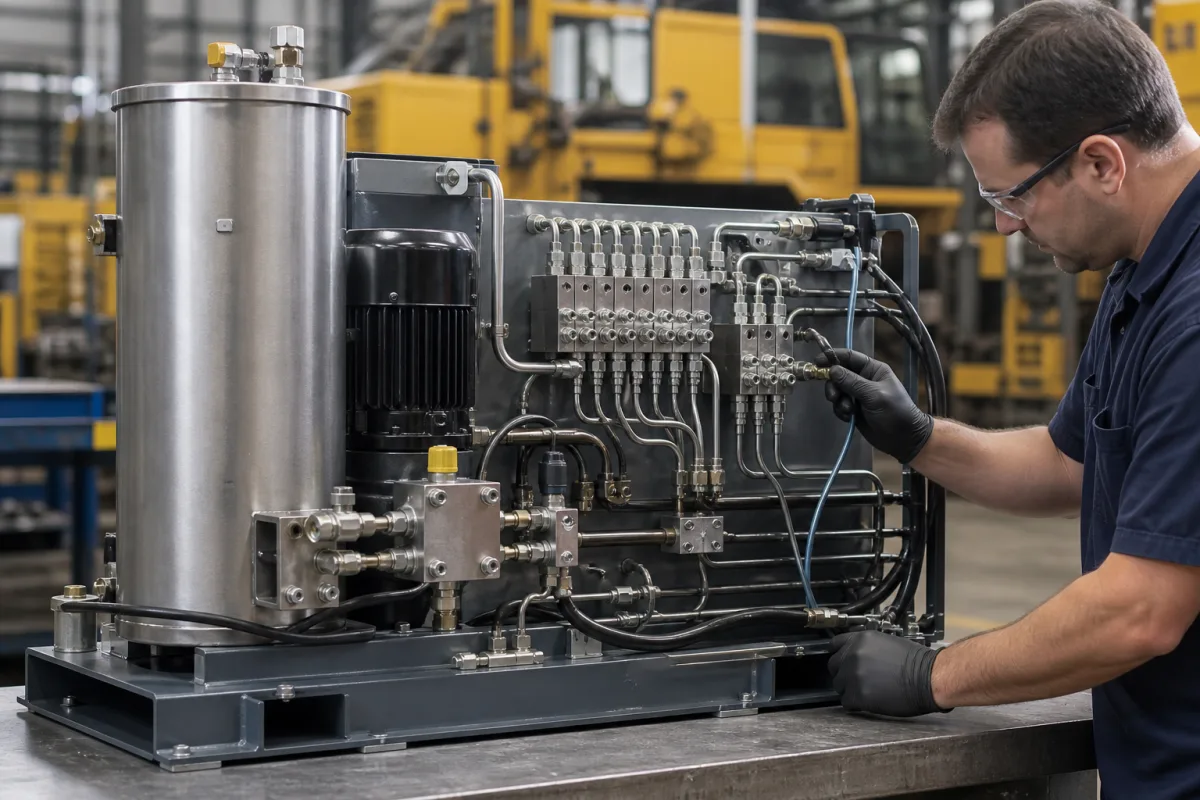
Machine maintenance · System type, metering, monitoring, lubricant grade and line length
A centralized lubrication system pumps grease or oil from one reservoir to the lubrication points on a machine. Ask three things first: how many points and how far apart, what lubricant grade, and whether every point must be monitored.
Centralized grease and oil lubrication systems for machines, vehicles and plant: pumps, metering devices, lines and controls. Engine lubrication parts, press-line stock lubricators, fittings sold alone and machines that merely include lubrication are outside this page.
CNFX editorial research · Sources checked October 11, 2026 · 5 sources
Graco, a lubrication equipment maker, explains that in a single-line parallel system a pump pressurises the main line and fills injectors, each serving one lubrication point and adjustable to deliver a precise amount; injectors work independently, so a failed injector or blocked line does not stop the rest. In a series progressive system, divider blocks are sized for each point and each piston depends on the flow of the previous one, so lubricant reaches the points in succession and reaching the last point confirms every point was served. [1]
Graco lists single-line parallel systems as able to handle lubricants up to NLGI 2 and oil, with different injector sizes for a wide output range; they need venting to reset the injectors. It notes that progressive systems need more extensive engineering and are harder to adjust or expand. [1]
Machinery Lubrication adds dual-line systems, which use two supply lines with a four-way valve sending grease alternately down each line while relieving the other; the second line adds a safety margin at extra cost and installation complexity. It states that indirect single-line systems account for more than 50 percent of the centralized grease system market. [2]
Give the supplier the machine, number and location of lube points, required amount and interval per point, line lengths, lubricant type and NLGI grade, temperature range, power supply, controller and monitoring needs.
02
Plan monitoring and system design
In a parallel system a blocked point is hard to detect: grease keeps flowing to the other valves and pump pressure does not rise, so there is no outward sign of the failure. [2] Graco says monitoring each injector would need a sensor per injector wired to the PLC, which is rarely economic, making regular inspection more important; basic monitoring uses a pressure switch. [1]
Machinery Lubrication lists the design parameters as the volume and frequency of grease at each point, the number of points, operating conditions, pump pressure, line diameter and distance to the points, and warns that long lines, metering valves and connections can fail from vibration and entrained air, so systems need regular checks. [2]
03
Compare pump data for a progressive system and a multi-outlet pump
Two pump pages from the Italian maker DropsA show the numbers that fix pump choice. The AI-P single piston pump is a pneumatic pump designed for progressive systems: it delivers 3 cm³ per stroke into the main line feeding a progressive distributor, at an operating pressure of 145 bar (2,103 psi), with fluid grease or grease of NLGI 000–2, a 0.8 kg reservoir with level sensor, an 8 mm pipe connection, an operating temperature of 0–40 °C, and lubrication cycles of up to one per minute. [4] The PoliPUMP is an electric multi-outlet pump that skips distributors: cam-driven single-acting pump elements on a 12 V or 24 V DC gear motor feed 12, 24 or 35 outlets directly through Ø4 push-in connections, at up to 80 bar at each outlet, from a standard 2 litre reservoir, for NLGI 00–2 grease and −10 to +60 °C operation; DropsA says it needs no external metering valves or cycle sensors. [5]
Editorial calculation: at the AI-P's maximum of one cycle per minute, 3 cm³ per stroke is 180 cm³ per hour into the progressive divider, which then splits it across its outlets; the 0.8 kg reservoir sets how often it has to be refilled. 145 bar is 1.8 times the PoliPUMP's 80 bar, which matters for long lines and stiff grease. [4][5]
Graco's point that progressive systems confirm every point was served when the last is reached, and Machinery Lubrication's warning that a blocked point in a parallel system gives no outward sign, apply when choosing between a divider-based system and one pump element per point: ask how a blocked outlet is detected on the quoted design. [1][2]
Progressive, single-line, dual-line and chain systems for wind, mining and farm machinery
Cisolube lists progressive, single-line, dual-line and chain lubrication systems, and rail, agricultural-machinery and customised lubrication systems, for uses including wind power, construction, agricultural and mining machinery. [3] Its page's type descriptions differ from those above, so confirm the system principle in the quotation.
05
Pump and reservoir, injectors, divider blocks, reversing valve, lines and controller
The metering row changes with the system type: injectors meter each point in a parallel system, divider blocks feed points in succession in a progressive one, and a reversing valve alternates two lines in a dual-line system. [1][2]
Pump output, pressure, lubricant grade, temperature, supply and reservoir for a lubrication system order
Nine of these eleven rows have no published value here, so take them from the pump offered: DropsA's AI-P, for example, gives 145 bar and 3 cm³ per stroke, and its PoliPUMP up to 80 bar per outlet. [4][5]
3 companies list this product among what they make. Company figures are quoted from each
company's own website; every card states where the relationship came from.
CisoLube
Manufacturing site to be confirmed for the order
Lists progressive, single-line, dual-line, chain and rail lubrication systems.
Explore company information and manufacturing capabilities, then discuss the scope of your project with a relevant supplier.
Share this page
Compiled and source-reviewed by the CNFX editorial team.
Each manufacturer above links to the page on that company's own website where the product is listed, with the date we checked it. How we source and review
· Page last updated 13 October 2026
Buyer questions
Single-line parallel or series progressive lubrication?
Parallel systems meter each point with an independent injector, but a blocked point is hard to detect; progressive systems feed points in succession so reaching the last point confirms all were served, at the cost of more engineering. [1][2]
When is a dual-line system used?
Dual-line systems alternate grease between two supply lines with a four-way valve; the second line adds a safety margin at extra cost and installation complexity. [2]
How do I know a centralized system is working?
A pressure switch gives basic monitoring; per-point monitoring on parallel systems needs a sensor per injector, so regular inspection still matters. [1][2]
What pressure does a centralized grease pump deliver?
DropsA lists 145 bar operating pressure and 3 cm³ per stroke for its AI-P pneumatic pump for progressive systems, and up to 80 bar per outlet for its PoliPUMP electric pump with up to 35 outlets. [4][5]
Sources and what still needs a direct check
Sources checked 2026-10-11. Graco and DropsA are lubrication equipment makers. Machinery Lubrication is a trade publication. Cisolube is a supplier listed on this page.