Industry-Verified Manufacturing Data (2026)

Separation Bowl

Based on aggregated insights from multiple verified factory profiles within the CNFX directory, the standard Separation Bowl used in the Machinery and Equipment Manufacturing sector typically supports operational capacities ranging from standard industrial configurations to heavy-duty production requirements.

Technical Definition & Core Assembly

A canonical Separation Bowl is characterized by the integration of Bowl Body / Shell and Disc Stack. In industrial production environments, manufacturers listed on CNFX commonly emphasize Stainless Steel (e.g., 316L) construction to support stable, high-cycle operation across diverse manufacturing scenarios.

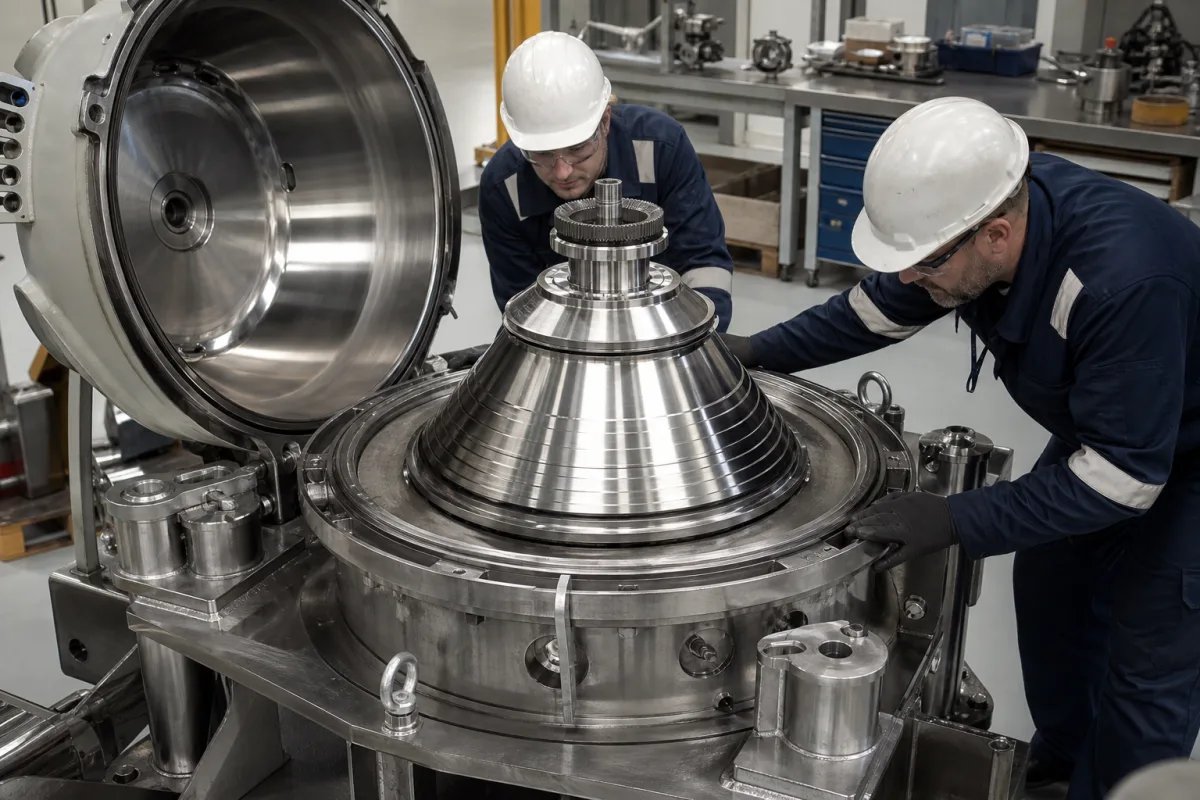
The rotating component in an industrial oil degumming centrifuge where centrifugal force separates phospholipids and other impurities from crude vegetable oils.
Product Specifications

Technical details and manufacturing context for Separation Bowl

Definition
The separation bowl is the core rotating assembly within an industrial oil degumming centrifuge. It is a high-speed, precision-engineered bowl where the crude oil mixture is subjected to intense centrifugal force. This force causes the denser phospholipid gums, solid impurities, and water to separate from the lighter purified oil, enabling continuous degumming and clarification of vegetable oils such as soybean, canola, and sunflower oil.
Working Principle
The bowl rotates at high speed (typically 5,000-10,000 RPM), generating centrifugal force thousands of times greater than gravity. The crude oil feed enters the center. The force stratifies the mixture based on density: purified oil (lightest) moves inward, phospholipid gums and water (intermediate density) form a middle layer, and heavy solids (densest) are forced to the outermost wall. Separate discharge ports or a self-cleaning mechanism then remove each separated phase continuously or intermittently.
Common Materials
Stainless Steel (e.g., 316L), Duplex Stainless Steel
Technical Parameters
  • Inner diameter of the bowl, critical for determining separation capacity, residence time, and g-force. (mm) Customizable
Components / BOM
  • Bowl Body / Shell
    Forms the main pressure-containing separation chamber.
    Material: Stainless Steel
  • Disc Stack
    Set of conical plates inside the bowl that increase effective settling area and separation efficiency.
    Material: Stainless Steel
  • Distributor
    Directs incoming feed evenly into the disc stack.
    Material: Stainless Steel
  • Top / Lid
    Seals the bowl and often contains ports for clarified oil and separated phases.
    Material: Stainless Steel
Engineering Reasoning
6000-12000 rpm at 85-95°C with feed viscosity 50-150 mPa·s
Material yield strength exceeded at 13500 rpm or 250°C thermal limit
Design Rationale: Centrifugal stress exceeding 316L stainless steel yield strength (290 MPa) or thermal expansion mismatch causing bowl distortion
Risk Mitigation (FMEA)
Trigger Imbalance exceeding 0.5 g·mm/kg due to uneven sediment accumulation
Mode: Critical vibration > 4.5 mm/s RMS causing bearing fatigue and bowl deformation
Strategy: Automated CIP backflush every 8 hours with 2% NaOH solution at 80°C
Trigger Phospholipid polymerization at >110°C forming adhesive gum deposits
Mode: Increased bowl mass moment of inertia causing motor overload and drive failure
Strategy: Temperature interlock at 105°C with PT100 sensors and PLC-controlled cooling jacket

Industry Taxonomies & Aliases

Commonly used trade names and technical identifiers for Separation Bowl.

Industrial Ecosystem & Supply Chain DNA

Complementary Systems
Downstream Applications
Specialized Tooling

Application Fit & Sizing Matrix

Operational Limits
pressure: Atmospheric to 3 bar (43.5 psi) max
flow rate: 5-100 m³/h (22-440 gpm) depending on bowl size
temperature: 50-90°C (122-194°F)
slurry concentration: Up to 30% solids by weight
Media Compatibility
✓ Crude soybean oil ✓ Crude sunflower oil ✓ Crude canola/rapeseed oil
Unsuitable: Highly abrasive slurries with silica content >5%
Sizing Data Required
  • Feed flow rate (m³/h)
  • Phospholipid content in crude oil (%)
  • Required separation efficiency (% phospholipid removal)

Reliability & Engineering Risk Analysis

Failure Mode & Root Cause
Imbalance-induced vibration
Cause: Uneven solids accumulation or component wear causing mass distribution asymmetry, leading to excessive dynamic loads and bearing fatigue
Bowl wall erosion/corrosion
Cause: Abrasive particle impingement or chemical attack from processed fluids, compromising structural integrity and separation efficiency
Maintenance Indicators
  • Excessive vibration or audible knocking during operation indicating imbalance or bearing failure
  • Visible leakage from bowl seals or abnormal discharge quality suggesting seal degradation or internal damage
Engineering Tips
  • Implement regular bowl balancing procedures and monitor vibration trends to detect imbalance early
  • Establish material compatibility protocols and install upstream filtration to minimize abrasive/chemical wear

Compliance & Manufacturing Standards

Reference Standards
ISO 1940-1:2003 (Balance quality requirements for rotors) ASME B46.1-2019 (Surface Texture) DIN 7150-1:2017 (Tolerances for fits)
Manufacturing Precision
  • Bore diameter: ±0.01 mm
  • Surface flatness: 0.05 mm
Quality Inspection
  • Dye Penetrant Test for crack detection
  • Dynamic balancing test to ISO 1940-1 Grade G2.5

Factories Producing Separation Bowl

Verified manufacturers with capability to produce this product in China

✓ 98% Supplier Capability Match Found

P Project Engineer from Singapore Feb 14, 2026
★★★★★
"As a professional in the Machinery and Equipment Manufacturing sector, I confirm this Separation Bowl meets all ISO standards."
Technical Specifications Verified
S Sourcing Manager from Germany Feb 11, 2026
★★★★★
"Standard OEM quality for Machinery and Equipment Manufacturing applications. The Separation Bowl arrived with full certification."
Technical Specifications Verified
P Procurement Specialist from Brazil Feb 08, 2026
★★★★★
"Great transparency on the Separation Bowl components. Essential for our Machinery and Equipment Manufacturing supply chain."
Technical Specifications Verified
Verification Protocol

“Feedback is collected from verified sourcing managers during RFQ (Request for Quote) and factory evaluation processes on CNFX. These reports represent historical performance data and technical audit summaries from our B2B manufacturing network.”

8 sourcing managers are analyzing this specification now. Last inquiry for Separation Bowl from Brazil (1h ago).

Supply Chain Compatible Machinery & Devices

Hydraulic Press

Industrial machine using hydraulic pressure to compress, form, or assemble materials

Explore Specs →
Heavy-Duty CNC Plasma Cutting Machine

Industrial machine for precision metal cutting using plasma arc technology

Explore Specs →
Automated Assembly Line System

Integrated production system for sequential component assembly operations

Explore Specs →
Automated Powder Coating System

Integrated industrial system for applying dry powder coatings to metal substrates.

Explore Specs →

Frequently Asked Questions

What materials are used in manufacturing separation bowls for oil degumming centrifuges?

Our separation bowls are manufactured from high-grade materials including Stainless Steel (316L) and Duplex Stainless Steel, offering excellent corrosion resistance and durability for harsh industrial oil processing environments.

What are the main components of a separation bowl assembly?

A complete separation bowl assembly typically includes the Bowl Body/Shell, Disc Stack, Distributor, and Top/Lid. These components work together to create the centrifugal force needed for efficient separation of impurities from crude vegetable oils.

How does a separation bowl improve oil degumming efficiency?

The separation bowl's rotating design generates powerful centrifugal force that effectively separates phospholipids and other solid impurities from crude vegetable oils, resulting in higher purity oil with improved clarity and reduced processing time compared to traditional methods.

Can I contact factories directly on CNFX?

CNFX is an open directory, not a transaction platform. Each factory profile provides direct contact information and production details to help you initiate direct inquiries with Chinese suppliers.

Get Quote for Separation Bowl

Request technical pricing, lead times, or customized specifications for Separation Bowl directly from verified manufacturing units.

Your business information is encrypted and only shared with verified Separation Bowl suppliers.

Thank you! Your message has been sent. We'll respond within 1–3 business days.

Need to Manufacture Separation Bowl?

Connect with verified factories specializing in this product category

Add Your Factory Contact Us
Previous Product
Sensors (Proximity/Vision)
Next Product
Separation Chamber