Industry-Verified Manufacturing Data (2026)

Servo Actuator (Linear/Rotary)

Based on aggregated insights from multiple verified factory profiles within the CNFX directory, the standard Servo Actuator (Linear/Rotary) used in the Machinery and Equipment Manufacturing sector typically supports operational capacities ranging from standard industrial configurations to heavy-duty production requirements.

Technical Definition & Core Assembly

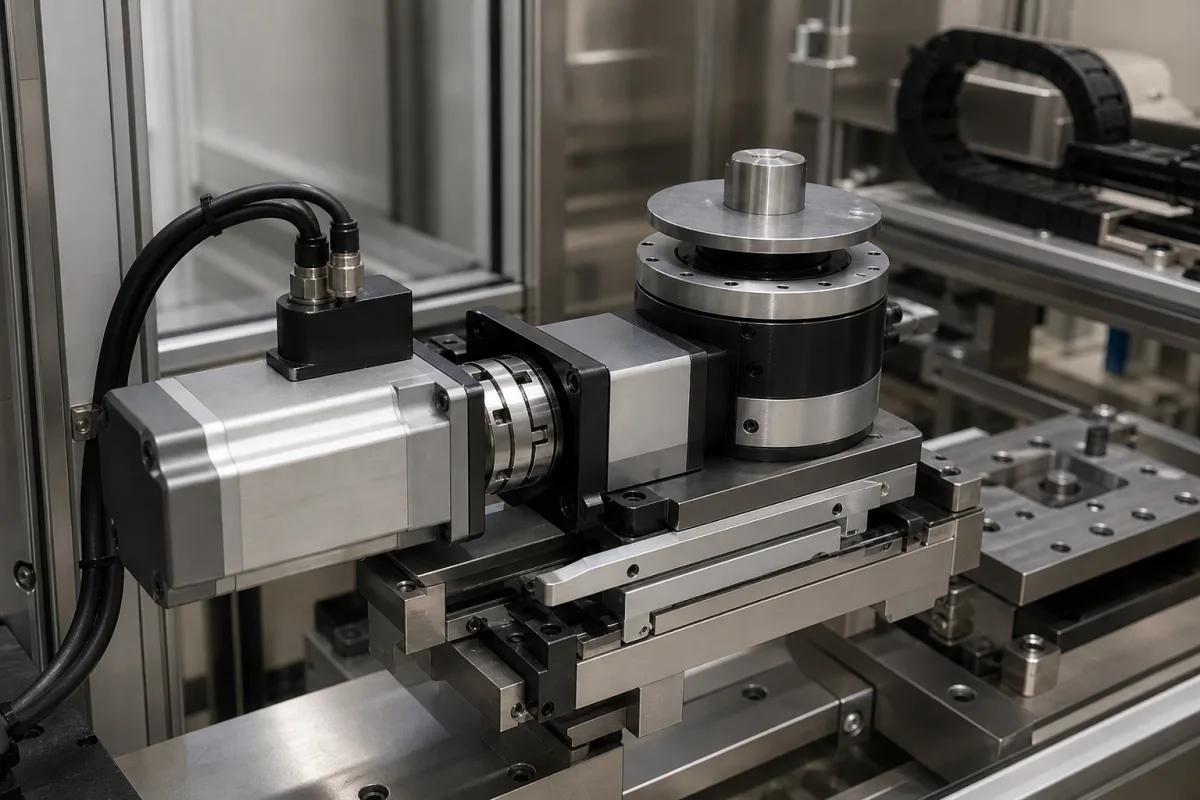
A canonical Servo Actuator (Linear/Rotary) is characterized by the integration of Servo motor and Transmission mechanism. In industrial production environments, manufacturers listed on CNFX commonly emphasize Aluminum alloy housing construction to support stable, high-cycle operation across diverse manufacturing scenarios.

A precision electromechanical device that converts control signals into precise linear or rotary motion for positioning and force control in automated systems.
Product Specifications

Technical details and manufacturing context for Servo Actuator (Linear/Rotary)

Definition
Within a Stacking Mechanism, the servo actuator provides controlled, repeatable motion to position components (such as pallets, boxes, or products) during stacking operations. It ensures accurate placement, consistent force application, and synchronized movement with other system components to build stable stacks according to programmed patterns.
Working Principle
Receives low-power control signals (typically pulse or analog) from a servo drive/controller. An internal motor (AC, DC, or brushless) generates torque, which is transmitted through a mechanical transmission (such as a ball screw for linear motion or a gearbox for rotary motion) to produce precise output movement. A feedback device (encoder or resolver) continuously monitors position/speed and sends data back to the controller, forming a closed-loop system for accurate motion control.
Common Materials
Aluminum alloy housing, Steel transmission components (ball screw/gears), Copper windings, Neodymium magnets, Polymer seals/bearings
Technical Parameters
  • Stroke length (for linear) or rotation angle (for rotary) (mm) Customizable
Components / BOM
  • Servo motor
    Converts electrical energy into mechanical torque
    Material: Steel laminations, copper windings, neodymium magnets
  • Transmission mechanism
    Converts motor rotation into linear motion (ball screw) or modifies speed/torque (gearbox)
    Material: Hardened steel, bronze
  • Feedback encoder
    Measures position/speed and provides closed-loop control data
    Material: Glass/plastic disk, photoelectric sensors
  • Housing
    Protects internal components and provides mounting interface
    Material: Aluminum alloy
Engineering Reasoning
0.01-1000 Nm torque, 0.001-2 m/s linear velocity, 0.1-1000 μm positioning accuracy
Continuous torque exceeding 120% rated torque for >60 seconds, winding temperature >155°C, encoder signal loss >10 ms
Design Rationale: Permanent magnet demagnetization at Curie temperature (80-200°C depending on NdFeB/SmCo composition), ball screw plastic deformation at Hertzian contact stress >3.5 GPa, resolver/encoder photodiode saturation at >100,000 lux
Risk Mitigation (FMEA)
Trigger Back-EMF voltage spike exceeding 150% rated voltage during rapid deceleration
Mode: Insulation breakdown in stator windings causing phase-to-phase short circuit
Strategy: Dynamic braking resistor network with 10 ms response time, IGBT gate driver with desaturation detection
Trigger Lubricant starvation in ball screw assembly due to <0.1 μm filtration failure
Mode: Metal-to-metal contact causing Brinell indentation >10 μm depth on recirculating balls
Strategy: Closed-loop lubrication system with 5 μm absolute filtration, Hall-effect viscosity monitoring at 1 Hz sampling

Industry Taxonomies & Aliases

Commonly used trade names and technical identifiers for Servo Actuator (Linear/Rotary).

Applied To / Applications

This component is essential for the following industrial systems and equipment:

Industrial Ecosystem & Supply Chain DNA

Complementary Systems
Downstream Applications
Specialized Tooling

Application Fit & Sizing Matrix

Operational Limits
pressure: Atmospheric to 1 bar (typical), up to 2 bar for sealed variants
other spec: Max velocity: 1-2 m/s (linear), 3000-6000 rpm (rotary); Duty cycle: Continuous to intermittent; IP rating: IP54 to IP67
temperature: -10°C to +80°C (operating), -20°C to +100°C (storage)
Media Compatibility
✓ Clean dry air ✓ Hydraulic oil (mineral-based) ✓ Non-corrosive gases
Unsuitable: High-concentration abrasive slurries or corrosive chemicals
Sizing Data Required
  • Required force/torque (N or Nm)
  • Stroke length/rotation angle (mm or degrees)
  • Positioning accuracy/repeatability (mm or arc-sec)

Reliability & Engineering Risk Analysis

Failure Mode & Root Cause
Bearing fatigue and wear
Cause: Inadequate lubrication, contamination ingress, or excessive axial/radial loads leading to pitting, spalling, or brinelling of bearing surfaces.
Encoder or feedback system failure
Cause: Electrical noise interference, mechanical misalignment, or environmental contamination (dust, moisture) causing signal loss, drift, or complete failure in position sensing.
Maintenance Indicators
  • Unusual audible noise such as grinding, clicking, or whining during operation, indicating mechanical wear or misalignment.
  • Erratic or jerky motion, loss of positioning accuracy, or failure to hold position, suggesting feedback issues or drive component degradation.
Engineering Tips
  • Implement a strict preventive maintenance schedule for lubrication and contamination control, using manufacturer-specified lubricants and ensuring seals are intact.
  • Install proper shielding and grounding for electrical components to minimize noise interference, and regularly calibrate the feedback system to maintain accuracy.

Compliance & Manufacturing Standards

Reference Standards
ISO 15552:2016 (Pneumatic fluid power - Standard cylinders) ANSI/ASME B5.54-2005 (Specification for machine tool spindles) DIN 5480-1:2006 (Splined connections with involute splines based on reference diameters)
Manufacturing Precision
  • Positioning repeatability: +/-0.01mm
  • Backlash: <0.05 degrees
Quality Inspection
  • Load cycle endurance test (minimum 1 million cycles)
  • IP rating verification test (e.g., IP65 for dust/water resistance)

Factories Producing Servo Actuator (Linear/Rotary)

Verified manufacturers with capability to produce this product in China

✓ 92% Supplier Capability Match Found

P Procurement Specialist from United States Feb 20, 2026
★★★★★
"The Servo Actuator (Linear/Rotary) we sourced perfectly fits our Machinery and Equipment Manufacturing production line requirements."
Technical Specifications Verified
T Technical Director from United Arab Emirates Feb 17, 2026
★★★★★
"Found 39+ suppliers for Servo Actuator (Linear/Rotary) on CNFX, but this spec remains the most cost-effective."
Technical Specifications Verified
P Project Engineer from Australia Feb 14, 2026
★★★★★
"The technical documentation for this Servo Actuator (Linear/Rotary) is very thorough, especially regarding technical reliability."
Technical Specifications Verified
Verification Protocol

“Feedback is collected from verified sourcing managers during RFQ (Request for Quote) and factory evaluation processes on CNFX. These reports represent historical performance data and technical audit summaries from our B2B manufacturing network.”

18 sourcing managers are analyzing this specification now. Last inquiry for Servo Actuator (Linear/Rotary) from Thailand (17m ago).

Supply Chain Compatible Machinery & Devices

Hydraulic Press

Industrial machine using hydraulic pressure to compress, form, or assemble materials

Explore Specs →
Heavy-Duty CNC Plasma Cutting Machine

Industrial machine for precision metal cutting using plasma arc technology

Explore Specs →
Automated Assembly Line System

Integrated production system for sequential component assembly operations

Explore Specs →
Automated Powder Coating System

Integrated industrial system for applying dry powder coatings to metal substrates.

Explore Specs →

Frequently Asked Questions

What is the difference between linear and rotary servo actuators?

Linear servo actuators produce straight-line motion for pushing/pulling applications, while rotary servo actuators provide rotational motion for turning or positioning tasks. Both use servo motors with feedback control for precision.

What maintenance is required for servo actuators in industrial environments?

Regular inspection of seals and bearings, lubrication of transmission components, and monitoring of encoder feedback signals. Aluminum housing resists corrosion, while polymer seals protect against contaminants in manufacturing settings.

How do I select the right servo actuator for my machinery application?

Consider required force/torque, speed, precision needs, environmental conditions (IP rating), and feedback requirements. Our actuators with steel ball screws and neodymium magnets offer high efficiency for demanding manufacturing equipment.

Can I contact factories directly on CNFX?

CNFX is an open directory, not a transaction platform. Each factory profile provides direct contact information and production details to help you initiate direct inquiries with Chinese suppliers.

Get Quote for Servo Actuator (Linear/Rotary)

Request technical pricing, lead times, or customized specifications for Servo Actuator (Linear/Rotary) directly from verified manufacturing units.

Your business information is encrypted and only shared with verified Servo Actuator (Linear/Rotary) suppliers.

Thank you! Your message has been sent. We'll respond within 1–3 business days.

Need to Manufacture Servo Actuator (Linear/Rotary)?

Connect with verified factories specializing in this product category

Add Your Factory Contact Us
Previous Product
Sequence Controller
Next Product
Servo Actuator / Linear Motor