Disc stack separators · Disc count, radii and cone angle in the sigma value, scaling by Q/Σ, real-flow correction, disc spacing
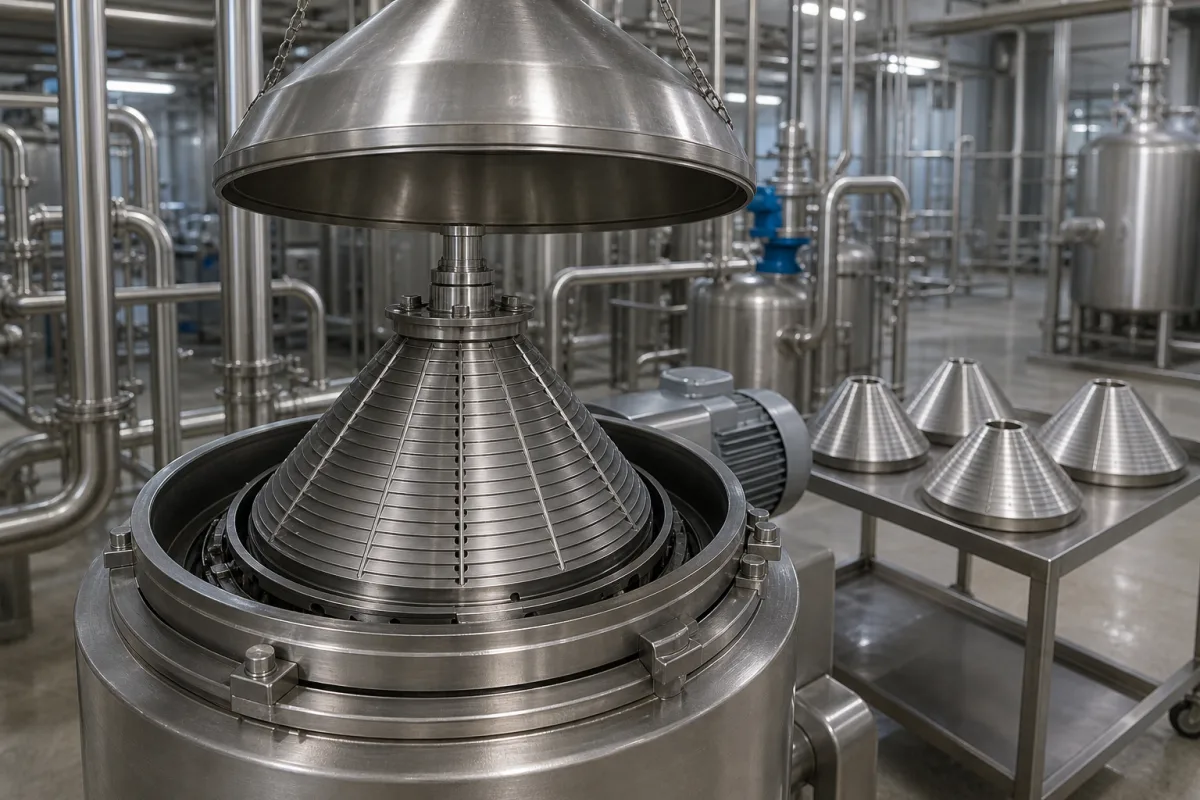
A disc stack is the set of closely spaced conical discs inside a separator bowl; the feed flows between the discs, solids settle onto their undersides under centrifugal force and slide out to the bowl wall, and clarified liquid flows inward and out, as in the open separator pictured with its disc stack exposed. Ask three things first: what equivalent settling area (Σ) the bowl and disc stack give at operating speed, what throughput per Σ your product needs for the required clarity, and how solids are discharged and the discs are made and spaced.
Disc stack (disc bowl) centrifugal separators and their disc stacks for clarifying liquids and separating immiscible liquids, including nozzle and intermittent-discharge types. Decanter centrifuges, tubular bowl centrifuges, basket centrifuges and laboratory centrifuges are outside this page.
CNFX editorial research · Sources checked October 12, 2026 · 4 sources
An Alfa Laval paper in BioProcess International (2020) gives the equivalent settling area of a disc stack centrifuge as Σ = 2πnω²(r₂³ − r₁³) ÷ (3g tan θ), where n is the number of discs, θ the disc half-cone angle, r₁ and r₂ the inner and outer disc radii in metres and ω the angular speed in rad/s; dividing the feed flow Q (m³/s) by Σ gives a load factor used to scale between similar machines. [1]
A Biogen patent on clarifying cell cultures gives the same expression using (N − 1) for the number of discs, and describes the disc machine: feed enters at the axis, is accelerated and flows through closely spaced conical discs — "disk spacing is often between 0.5 to 3 mm" to shorten the settling distance and "the disc angle is often between 40 and 50 degrees" so solids slide down into the solids space; solids are discharged through nozzles or intermittently through ports at the bowl periphery. [2]
Editorial calculation: for a stack of 50 discs with outer radius 0.068 m and an assumed inner radius of 0.02 m, a 45° half-cone angle and 12,000 rpm (ω ≈ 1,257 rad/s), Σ ≈ 2π × 50 × 1,257² × (0.068³ − 0.02³) ÷ (3 × 9.81 × 1) ≈ 5,200 m². Because Σ grows with ω², running the same bowl at half speed cuts Σ to a quarter. The disc count and inner radius are assumed examples.
Give the supplier the product and its solids or second liquid phase (particle size, densities, viscosity, temperature), feed flow and solids content, required clarity or separation, any small-scale Q/Σ data, solids discharge preference, hygiene and cleaning needs, materials, and whether the unit must be hermetic.
02
Scale throughput with Q/Σ and a correction factor
The Biogen patent explains that Σ combines centrifuge size and operating speed, and that scale-up keeps Q/Σ constant: a Q/Σ shown in small-scale tests to give the required clarity sets the Σ needed at production flow, or the achievable throughput of a given machine. It applies a correction factor of 0.4 to 0.7, meaning real performance is estimated at 40 to 70% of the idealised prediction. [2]
A Thermo Fisher application note on scale-down models notes that a correction factor of 0.4 has been reported in the literature for stainless steel disc stack centrifuges, to account for non-ideal flow between the discs, and that the factor is found empirically by comparing separation with a batch centrifuge. [3] In the Biogen work, removal efficiency fell as Q/Σ increased, and the g-force at the solids-space radius of 0.093 m reached about 15,000 × g at 12,000 rpm. [2]
Editorial calculation: at 12,000 rpm, ω²r ÷ g is about 1,257² × 0.093 ÷ 9.81 ≈ 15,000, matching the patent's figure; at the disc outer radius of 0.068 m it is about 11,000 × g.
03
Read a pilot test that varies disc angle and Σ
Merkel, Blättler (BASF) and Königsson (Alfa Laval), in Chemical Engineering & Technology (2018), validated a flocculant screening method on a hermetic pilot disc stack centrifuge fed through a rotating hollow spindle at the bottom, with the flocculant dosed into the inlet spindle. Fitted with 40° or 35° discs and run at 10,000 rpm, the stack gave equivalent settling areas Σ of 1,696, 2,605, 2,848 and 3,049 m², or semi-empirical KQ values of 40, 61, 66 and 71, calculated from disc count, inner and outer radii and half-cone angle. Feed was varied from 60 to 1,000 L/h. With effective flocculants, separation efficiency stayed above 99% up to more than 500 L/h of clear phase, at load factors above 8 L per KQ per hour; in the hermetic design the sludge had to be pushed out against centrifugal force by the feed pump, and one flocculant blocked the heavy-phase outlet. [4]
Editorial calculation: going from Σ = 1,696 to 3,049 m² is an 80% increase from the disc set alone at the same 10,000 rpm, which by the Q/Σ rule above would allow about 80% more flow for the same clarification; 500 L/h at KQ 61 is about 8.2 L per KQ per hour, matching the load factor the authors report. Ask a supplier for Σ (or KQ) for each disc set it offers, and test your feed at the flow per Σ you intend to run. [4][2]
Suppliers linked to this page list disc stack separators; each card links to the page reviewed.
Listings include disc stack separators for dairy cream and milk skimming, yeast, edible and lubricating oils, biodiesel and oil-water separation, nozzle separators, and disc separators within oilfield solids-control ranges. Ask each supplier for the disc count, radii and angle (or the Σ value at rated speed), the discharge system, and the bowl's maximum speed and materials.
05
Trace the separator parts
This is a functional reference built from the sources cited; it is not one maker's specification.
Fill the specification fields with values for your product
A disc stack separator quotation needs values for your product. The table explains each field, gives published values where a reviewed source states them, and says what to obtain from the supplier.
Explore company information and manufacturing capabilities, then discuss the scope of your project with a relevant supplier.
Share this page
Compiled and source-reviewed by the CNFX editorial team.
Published product pages show what a company offers, not tested performance. Confirm the legal seller, factory and scope for your order. How we source and review
· Page last updated 13 October 2026
Buyer questions
What is the sigma value of a disc stack centrifuge?
Alfa Laval gives Σ = 2πnω²(r₂³ − r₁³)/(3g tan θ), the equivalent settling area set by disc count, radii, half-cone angle and speed. [1]
How do I scale a disc stack separator?
Keep Q/Σ constant from tests; a Biogen patent estimates real performance at 40–70% of the ideal prediction. [2]
How far apart are the discs?
The Biogen patent says "disk spacing is often between 0.5 to 3 mm" and "the disc angle is often between 40 and 50 degrees". [2]
How much does the disc set change a disc stack centrifuge's capacity?
In one pilot study at 10,000 rpm, swapping disc sets (35° or 40°) changed the equivalent settling area from 1,696 to 3,049 m²; separation stayed above 99% up to about 500 L/h of clear phase. [4]
Sources and what still needs a direct check
Sources checked 2026-10-12. The Alfa Laval paper and the Biogen patent describe sigma theory for disc stack centrifuges in bioprocess clarification; Thermo Fisher's note reports a literature correction factor.