Industry-Verified Manufacturing Data (2026)

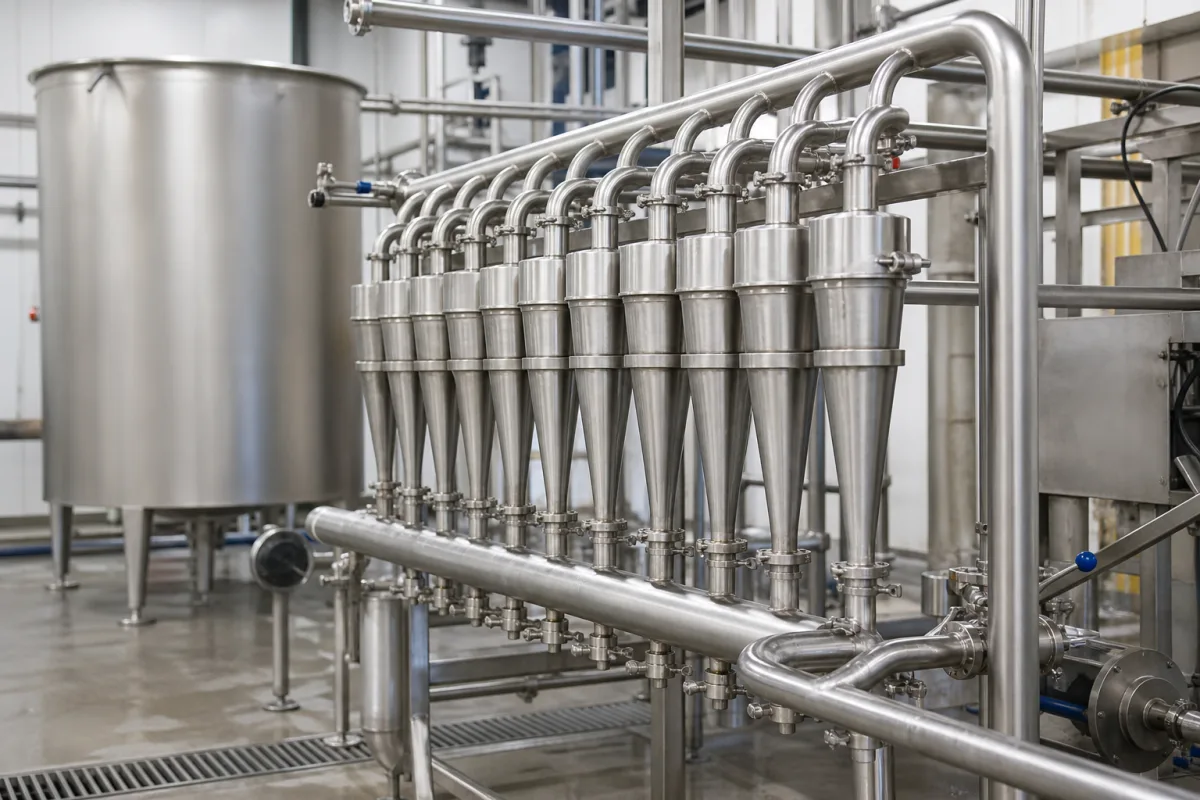
Starch Hydrocyclone Separation Cone

Based on aggregated insights from multiple verified factory profiles within the CNFX directory, the standard Starch Hydrocyclone Separation Cone used in the Manufacture of Grain Mill Products, Starches and Starch Products sector typically supports operational capacities ranging from standard industrial configurations to heavy-duty production requirements.

Technical Definition & Core Assembly

A canonical Starch Hydrocyclone Separation Cone is characterized by the integration of Conical Body and Inlet Flange. In industrial production environments, manufacturers listed on CNFX commonly emphasize Polyurethane construction to support stable, high-cycle operation across diverse manufacturing scenarios.

Precision conical component for starch-protein separation in wet milling processes.

Product Specifications

Technical details and manufacturing context for Starch Hydrocyclone Separation Cone

Definition
A critical hydrocyclone component used in starch manufacturing for separating starch granules from protein and fiber. This precision-machined conical part creates centrifugal forces that separate particles by density and size. It's essential in modern starch processing plants for achieving high-purity starch extraction. The component directly impacts starch yield, quality, and production efficiency in grain milling operations.
Working Principle
Utilizes conical geometry to accelerate starch slurry, creating centrifugal separation where denser starch particles migrate outward while lighter proteins concentrate centrally.
Common Materials
Polyurethane, Ceramic-lined steel, Stainless steel 316L
Technical Parameters
  • Critical separation angle affecting particle trajectory (degrees) Customizable
  • Operating pressure for optimal separation efficiency (bar) Customizable
Components / BOM
  • Conical Body
    Primary separation surface creating centrifugal force
    Material: Polyurethane or ceramic-lined steel
  • Inlet Flange
    Connects to slurry feed pipe with pressure seal
    Material: Stainless steel 316L
  • Apex Valve Optional
    Controls underflow discharge of concentrated starch
    Material: Wear-resistant polyurethane
  • Vortex Finder
    Directs overflow (protein-rich stream) exit
    Material: Stainless steel 316L
Engineering Reasoning
0.3-1.2 MPa inlet pressure, 15-35°C process temperature, 8-12% solids concentration
Cone wall erosion exceeding 2.5 mm thickness reduction, vortex finder blockage >70% cross-sectional area, apex discharge density deviation >0.15 g/cm³ from setpoint
Design Rationale: Hydrodynamic boundary layer separation causing particle impingement erosion at Reynolds numbers >5000, centrifugal force imbalance from density gradient fluctuations exceeding 8%
Risk Mitigation (FMEA)
Trigger Abrasive silica particle concentration >0.8% in feed slurry
Mode: Conical surface erosion rate exceeding 0.1 mm/1000 operating hours
Strategy: Installation of alumina ceramic liner with 9.0 Mohs hardness rating
Trigger Feed density fluctuation exceeding ±5% from 1.08 g/cm³ setpoint
Mode: Vortex instability causing starch-protein separation efficiency drop below 92%
Strategy: Implementation of real-time density control with Coriolis flow meters and PID tuning at 0.5s response time

Industry Taxonomies & Aliases

Commonly used trade names and technical identifiers for Starch Hydrocyclone Separation Cone.

Industrial Ecosystem & Supply Chain DNA

Complementary Systems
Downstream Applications
Specialized Tooling

Application Fit & Sizing Matrix

Operational Limits
pressure: Max 6 bar (87 psi)
flow rate: 10-100 m³/h per unit
temperature: 5°C to 80°C
slurry concentration: 5-40% solids by weight
Media Compatibility
✓ Corn starch slurry ✓ Potato starch slurry ✓ Wheat starch slurry
Unsuitable: High-viscosity fluids (>500 cP) or abrasive mineral slurries
Sizing Data Required
  • Feed slurry flow rate (m³/h)
  • Target starch recovery efficiency (%)
  • Inlet solids concentration (% by weight)

Reliability & Engineering Risk Analysis

Failure Mode & Root Cause
Abrasive erosion
Cause: High-velocity starch slurry containing abrasive particles (e.g., sand, grit) wears away the cone's internal surface, particularly at the apex and inlet zones, leading to wall thinning and eventual perforation.
Clogging and bridging
Cause: Accumulation of fibrous materials, oversized starch granules, or agglomerates in the cone's narrow sections (especially the apex), often due to improper feed consistency, insufficient water flow, or upstream screening failures, causing flow disruption and separation inefficiency.
Maintenance Indicators
  • Visible slurry leakage or weeping from the cone body or apex, indicating wall erosion or seal failure.
  • Audible change in flow noise (e.g., gurgling, irregular splashing) or increased vibration, suggesting partial clogging, air ingress, or imbalance in feed pressure.
Engineering Tips
  • Install and maintain upstream screening (e.g., vibrating screens, sieves) to remove abrasive contaminants and oversized particles before the hydrocyclone, reducing wear and clogging risks.
  • Implement routine apex and vortex finder inspections with ultrasonic thickness testing to monitor erosion rates, and schedule replacements based on wear trends rather than fixed intervals to prevent unexpected failures.

Compliance & Manufacturing Standards

Reference Standards
ISO 9001:2015 - Quality management systems ASTM E11 - Standard Specification for Woven Wire Test Sieve Cloth and Test Sieves CE Marking - EU conformity for machinery safety (Machinery Directive 2006/42/EC)
Manufacturing Precision
  • Cone taper angle: +/- 0.5°
  • Inlet/outlet diameter concentricity: 0.1mm TIR
Quality Inspection
  • Hydrostatic pressure test (1.5x operating pressure)
  • Surface roughness verification (Ra ≤ 0.8μm for internal surfaces)

Factories Producing Starch Hydrocyclone Separation Cone

Verified manufacturers with capability to produce this product in China

✓ 96% Supplier Capability Match Found

P Project Engineer from Australia Feb 14, 2026
★★★★★
"Reliable performance in harsh Manufacture of Grain Mill Products, Starches and Starch Products environments. No issues with the Starch Hydrocyclone Separation Cone so far."
Technical Specifications Verified
S Sourcing Manager from Singapore Feb 11, 2026
★★★★★
"Testing the Starch Hydrocyclone Separation Cone now; the Cone Angle (degrees) results are within 1% of the laboratory datasheet."
Technical Specifications Verified
P Procurement Specialist from Germany Feb 08, 2026
★★★★★
"Impressive build quality. Especially the Cone Angle (degrees) is very stable during long-term operation."
Technical Specifications Verified
Verification Protocol

“Feedback is collected from verified sourcing managers during RFQ (Request for Quote) and factory evaluation processes on CNFX. These reports represent historical performance data and technical audit summaries from our B2B manufacturing network.”

8 sourcing managers are analyzing this specification now. Last inquiry for Starch Hydrocyclone Separation Cone from Brazil (1h ago).

Frequently Asked Questions

What materials are available for the starch hydrocyclone separation cone?

Our starch hydrocyclone cones are available in polyurethane, ceramic-lined steel, and stainless steel 316L to suit different processing requirements and durability needs.

How does the hydrocyclone cone improve starch-protein separation efficiency?

The precision conical design creates centrifugal forces that efficiently separate starch granules from protein particles based on density differences, resulting in higher purity starch recovery.

What maintenance is required for starch hydrocyclone cones?

Regular inspection of the apex valve and vortex finder is recommended. Ceramic-lined and stainless steel options offer excellent wear resistance, reducing maintenance frequency in continuous wet milling operations.

Can I contact factories directly on CNFX?

CNFX is an open directory, not a transaction platform. Each factory profile provides direct contact information and production details to help you initiate direct inquiries with Chinese suppliers.

Get Quote for Starch Hydrocyclone Separation Cone

Request technical pricing, lead times, or customized specifications for Starch Hydrocyclone Separation Cone directly from verified manufacturing units.

Your business information is encrypted and only shared with verified Starch Hydrocyclone Separation Cone suppliers.

Thank you! Your message has been sent. We'll respond within 1–3 business days.

Need to Manufacture Starch Hydrocyclone Separation Cone?

Connect with verified factories specializing in this product category

Add Your Factory Contact Us
Previous Product
Industrial Starch Centrifugal Sieving Machine
Next Product
Starch Slurry Flow Control Orifice Plate