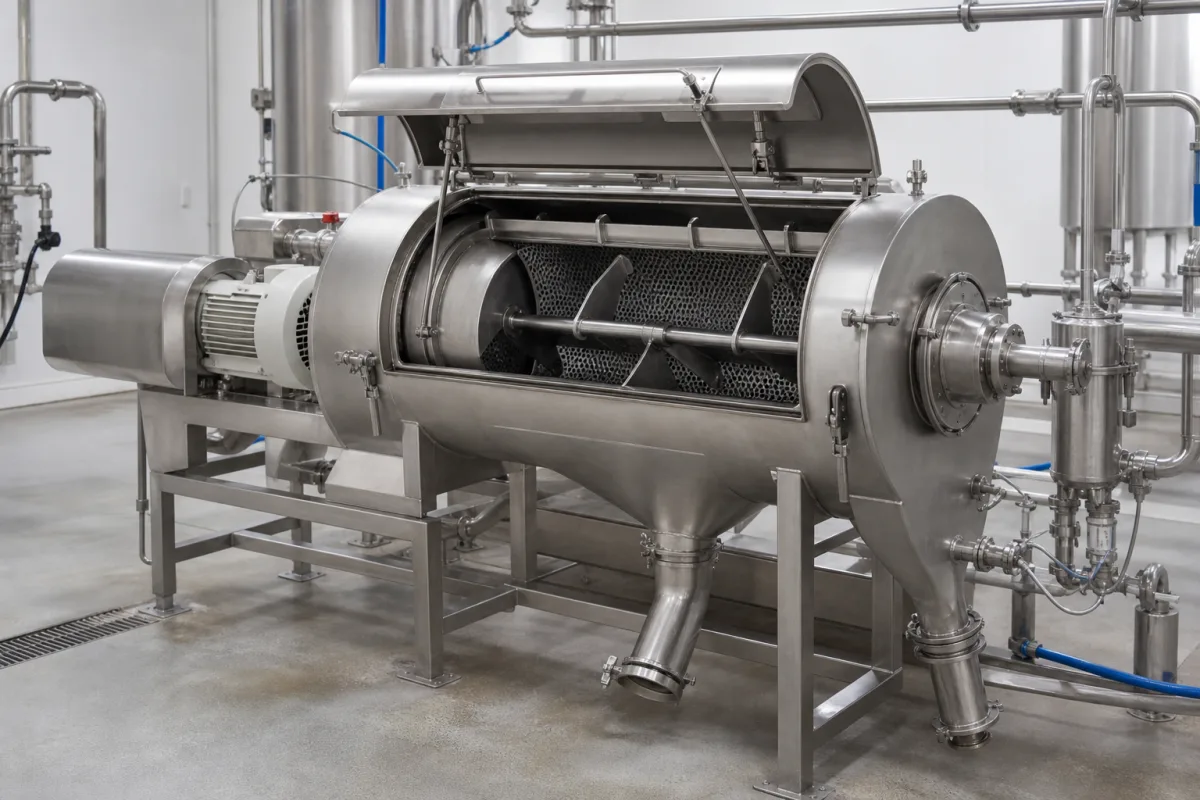
Centrifugal sieves for starch slurries · Rotating conical sieves with perforated plate or wire gauze for starch extraction and fibre washing, horizontal paddle-type centrifugal screeners for slurries, mesh to 20 µm, flows to 100,000 l/h, AISI 316 wetted parts and belt or direct drives
A centrifugal sieve spins a slurry against a screen so that liquid and fine starch pass through while fibre and coarse solids are carried off separately, continuously. In starch plants it separates starch milk from pulp and fibre after rasping or milling. Ask three things first: what the slurry is and which particles must pass or be retained, how much flow it must handle, and which sieve type, screen opening, drive and materials suit the line.
Continuous centrifugal sieves for starch and similar food slurries: rotating conical centrisieves and horizontal paddle-type centrifugal screeners, with their screens, drives and housings. Hydrocyclones, vibrating screens (see vibrating screen), separator centrifuges and dryers are outside this page.
CNFX editorial research · Sources checked October 12, 2026 · 4 sources
Choose the sieve type and screen for the separation
LARSSON lists its GL600, GL850 and GL1050 centrisieves for starch extraction from rasped potatoes and tapioca, dewatering of pulp and fine fibre sieving, and for fruit juice. It says its sieve cones are made for two duties: perforated plate for coarse sieving and wire gauze for fine sieving, and that the sieves can be integrated with pumps and automatic controls in a starch extraction system. [1][2]
Russell Finex describes its Liquid Solid Separator as a centrifugal separator in which a rotating element spins material inside a mesh screen: larger and heavier solids are retained while liquid and smaller particles pass through media as fine as 20 microns, with solids and liquid discharged continuously from separate outlets. It lists uses including spent grain dewatering, pectin, oat milk and fermentation broths, and offers trials on the buyer's own slurry. [3]
Give the supplier the slurry (raw material, solids content, temperature, pH), what must pass the screen (starch, juice) and what must be retained (fibre, pulp), target screen opening, flow rate, number of washing stages, wash water, available power and voltage, materials and hygiene requirements, and space.
02
Size capacity, drive and materials
LARSSON states its centrifugal sieves are made entirely of stainless steel: AISI 316 (EN 1.4401) for media-contact parts, including the perforated sieve plate and wire gauze, and AISI 304 (EN 1.4301) for other parts; even the transmission housing is stainless. The GL600 is belt driven with motors of 4–15 kW, the GL850 11–37 kW and the GL1050 37–55 kW, and the GL1050 can be supplied with direct drive and a frequency converter. [2][1]
Russell Finex states its separator handles flows up to 100,000 l/h (26,000 gal/h) at mesh sizes down to 20 microns, in a fully contained design, and can be tailored by mesh size, material of construction, inlet and outlet configuration and discharge system. [3]
Editorial calculation: 100,000 l/h is 100 m³/h, or about 1.67 m³ per minute. [3]
03
Choose the screen medium for the sieve basket
ANDRITZ's brochure on wedge wire and perforated components for the starch industry (edition 1.0/03.2026) says its centrifugal screens use a punched or cut support basket with an inlay basket in wedge wire or ConiPerf, the latter welded or supplied in segments, in a wear-resistant alloy, and that exact slot widths are checked by camera. It lists the opening ranges for each medium: wedge wire with slot widths from 0.015 mm, filtration inside-out or outside-in and radial or axial slots; ConiPerf with triangular or slotted openings from 0.06 mm in sheet up to 1.5 mm thick, smoothed or polished; micro-perforation with holes from 0.05 mm in sheet up to 6 mm; milled slots from 0.1 mm in sheet up to 10 mm; and drilled or punched holes from 0.4 mm in sheet up to 20 mm. The same brochure lists 120° bent (DSM) screens, conical centrifuge baskets and screw-press baskets for fibre washing and dewatering. [4]
Editorial calculation: 0.015 mm is 15 µm and 0.06 mm is 60 µm, so a wedge-wire inlay can be specified finer than the 20 µm screens Russell Finex lists for its separator, while the finest ConiPerf opening is three times wider. State the opening you need for the extraction or fibre-washing stage, and ask for the measured slot tolerance and the basket's open area, since both decide how much starch passes and how much reports to the fibre. [4][3]
Ask any supplier for sieve type and screen opening, capacity on your slurry, starch loss to the fibre fraction, wash water per stage, rotor speed, motor power and drive type, wetted materials, cleaning method, screen replacement, dimensions and weight, and whether a trial on your material is possible.
05
Sieve cone, rotor and drive in a starch centrisieve
Part
Role
Fix in the order
Sieve cone or screen
Lets liquid and fine starch pass; retains fibre. [2][3]
Screen opening, slurry capacity and starch lost to the fibre
Rotor speed, separation efficiency and fibre moisture have no published value in the reviewed sources; ask for them as results of a trial on your own slurry, which Russell Finex offers for its separator.
Field
What it means and published values
Ask the supplier for
Basket Rotation Speed (rpm)
Not stated in the reviewed sources.
Speed.
Sieve Mesh Size (microns)
Down to 20 µm on one screener; wedge-wire slots from 15 µm; plate or gauze cones. [3][4][2]
Explore company information and manufacturing capabilities, then discuss the scope of your project with a relevant supplier.
Share this page
Compiled and source-reviewed by the CNFX editorial team.
Each manufacturer above links to the page on that company's own website where the product is listed, with the date we checked it. How we source and review
· Page last updated 13 October 2026
Buyer questions
What screens do starch centrisieves use?
LARSSON uses perforated plate cones for coarse sieving and wire gauze for fine sieving. [2]
How fine can a centrifugal screener separate?
Russell Finex lists mesh down to 20 microns at flows up to 100,000 l/h. [3]
What materials are centrisieves made of?
LARSSON uses AISI 316 for media-contact parts and AISI 304 for other parts. [2]
What screen openings are available for a starch centrifugal sieve basket?
One component maker lists wedge-wire slots from 0.015 mm, ConiPerf openings from 0.06 mm and micro-perforated holes from 0.05 mm for starch-industry screens. [4]
Sources and what still needs a direct check
Sources checked 2026-10-12. LARSSON Starch Technology and Russell Finex make centrifugal sieves and separators.