Test instruments · Measurement category, fused leads and probes, accuracy in counts, and safe use
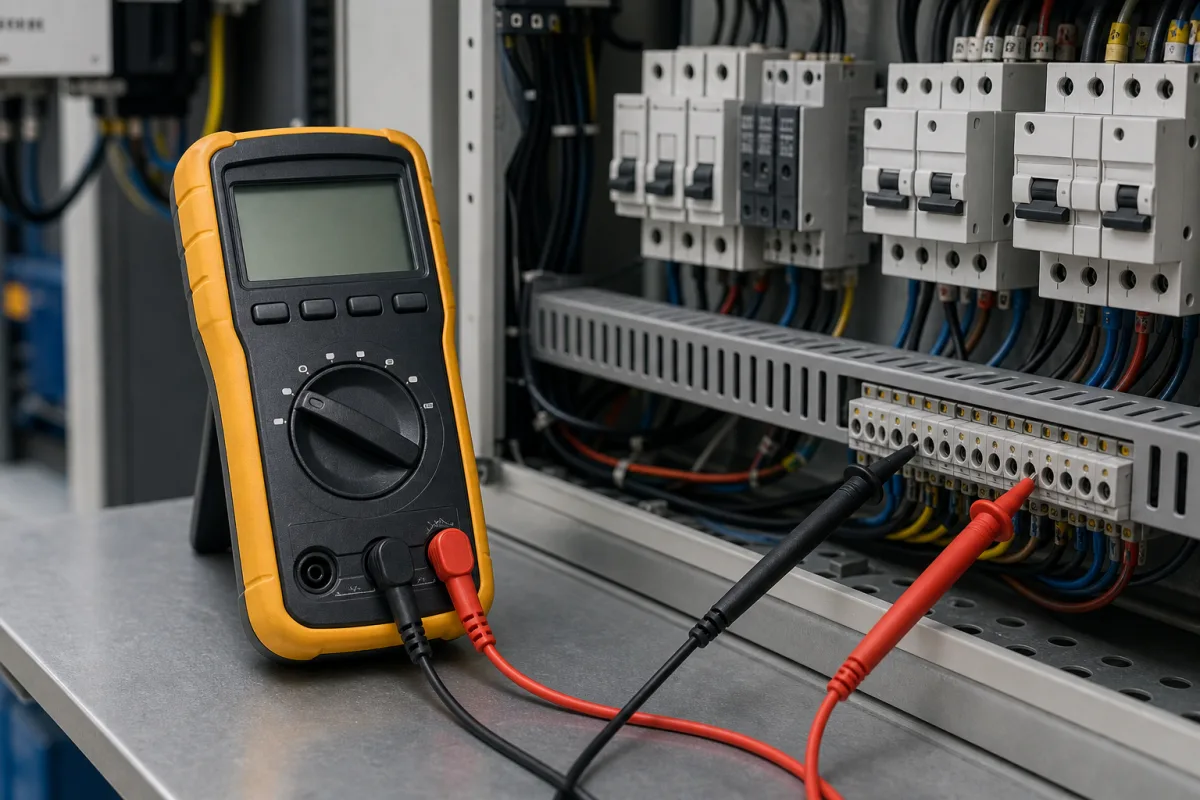
A portable digital multimeter measures voltage, current and resistance in a handheld case with test leads; some models, such as the one used as an example below, also measure capacitance, frequency and temperature. Ask three things first: the measurement category and voltage it is rated for, the accuracy and counts on the ranges you use, and the leads, probes and fuses supplied.
Handheld digital multimeters for electrical, electronics and HVAC work, including clamp-style multifunction meters where they measure the same quantities. Bench multimeters, test leads sold on their own, and insulation or loop testers are outside this page.
CNFX editorial research · Sources checked October 11, 2026 · 4 sources
Match the CAT rating, leads and probes to the circuit
The UK Health and Safety Executive's guidance GS38 explains that BS EN 61010 measurement categories reflect the overvoltage expected at the point of measurement: CAT IV at the source of the low-voltage installation such as meters and primary overcurrent devices, CAT III in the building installation such as distribution boards and sockets, and CAT II on circuits connected to the installation such as appliances and portable tools. Using CAT II equipment on a CAT III installation is listed as a cause of accidents. [1]
GS38 says test probes, clips and leads should conform to BS EN 61010-031, be marked with their CAT rating, have finger barriers, and leave an exposed metal tip of no more than 4 mm, preferably 2 mm or less; with a multimeter they should have high-breaking-capacity fuses rated, in GS38's words, "not exceeding 500 mA" except with loop impedance or RCD testers, where GS38 cites 10 A. Such fuses can add up to 2 Ω to a lead, which matters for resistance readings, and glass fuses are not suitable. [1]
Accidents also come from a meter set to a current or resistance range while measuring voltage, a lead falling off a terminal, damaged leads and makeshift equipment. To prove a circuit dead, GS38 prefers a proprietary voltage detector to a multimeter, proved before and after use. [1]
Give the supplier the circuits and CAT level, maximum voltage and current, functions needed (AC/DC volts and amps, resistance, capacitance, frequency, temperature), accuracy on your ranges, leads and probe tips, fuse ratings, calibration certificate and environment.
02
Check impulse withstand and the meter's protection against wrong connections
Hioki, a test instrument maker, shows why the CAT rating matters: in its recorded example a solenoid valve switching on a 100 V AC line produced an impulse of close to 1,000 V. Under IEC 61010-1 a meter must withstand the impulse voltage expected for its category and voltage to ground; Hioki's example is that a CAT II (300 V) multimeter must withstand an impulse of 2,500 V. [3]
Hioki's category descriptions are: CAT II from the power plug of a device on an outlet to its power supply circuit; CAT III from the distribution panel to fixed equipment connected directly to the supply and to outlets; CAT IV the building's lead-in and the circuit from the service entrance to the meter or distribution panel. It gives two of its own instruments as examples of dual ratings: a pocket tester rated CAT III 300 V and CAT II 600 V, and a digital multimeter rated CAT IV 600 V and CAT III 1,000 V. [3]
Hioki explains that the current and resistance circuits have low impedance, so connecting the meter across a supply on those settings drives an overcurrent that can burn out the meter and, through the short, the distribution panel; protections include a fuse, omitting the A terminal, a rotary-switch interlock on the terminals, and, on Hioki meters, an overcurrent protection circuit rated to withstand overvoltage for up to 1 minute. It also notes that capped test leads with a shorter exposed tip reduce short-circuit accidents, the same point GS38 makes with its 4 mm limit. [3][1]
Editorial calculation: Hioki's 1,000 V impulse on a 100 V AC line is 10 times the nominal voltage, and about 7 times the 141 V peak of a 100 V RMS sine wave (100 × √2); a meter's working-voltage rating alone does not show that margin, which is why the CAT figure is quoted with it. [3]
03
Work out what the accuracy specification means
Fluke's published specifications for its 87V handheld meter show the format: DC voltage accuracy ±(0.05% + 1), AC voltage ±(0.7% + 2) true RMS, DC current ±(0.2% + 2), resistance ±(0.2% + 1), with a 6,000-count display (19,999 counts in high-resolution mode), CAT III 1,000 V and CAT IV 600 V ratings to EN 61010-1, and operating temperature −20 to 55 °C. [2]
Editorial calculation: the first term is a percentage of the reading and the second is counts of the last digit. With 6,000 counts, a 600.0 V range shows 0.1 V per count. A 230.0 V AC reading at ±(0.7% + 2) is uncertain by 1.61 + 0.2 ≈ ±1.8 V. A 24.00 V DC reading on a 60.00 V range (0.01 V per count) at ±(0.05% + 1) is uncertain by 0.012 + 0.01 ≈ ±0.02 V. [2]
Ask suppliers for the accuracy table per range and function, the temperature and calibration period it applies to, and the count of the display.
04
Compare what suppliers offer
Suppliers linked to this page list digital multimeters; each card links to the page reviewed.
All-Sun, FNIRSI, GVDA and ACCUD list digital multimeters with other test and measuring instruments; Coolink and Wipcool list multimeters among HVAC tools; SUIN lists digital multimeters with calibrators and signal instruments; Wrindu lists UNI-T branded multimeters alongside its own high-voltage test equipment.
A trade-electrician meter shows which headline figures appear on a maker's specification page. Klein Tools lists its MM720 as a true-RMS auto-ranging meter with a 6,000-count reverse-contrast LCD, 1,000 V AC/DC, 10 A AC/DC, 60 MΩ resistance, 6,000 µF capacitance and 1 Hz–500 kHz frequency ranges, a thermocouple temperature range of −40 to 1,000 °C (−40 to 1,832 °F), a low-impedance (LoZ) mode for identifying stray or ghost voltages, CAT IV 600 V and CAT III 1,000 V ratings, IP42 ingress protection, a 2 m (6.6 ft) drop rating, two AAA batteries, and a mass of 346 g; test leads are supplied with CAT III/CAT IV safety caps. Its product page does not list accuracy per range. [4]
Editorial note: the MM720 and Fluke's 87V share the same CAT IV 600 V / CAT III 1,000 V pair and a 6,000-count display, so compare quotes on the accuracy table per range, the input fuse ratings and the lead set supplied rather than on these headline figures; GS38's limits on exposed probe tips apply to the leads whichever meter is chosen. [4][2][1]
05
Trace the meter components
This is a functional reference built from the sources cited; it is not one maker's parts list.
Fill the specification fields with values for your work
A multimeter quotation needs values for your circuits. The table explains each field, gives published values where a reviewed source states them, and says what to obtain from the supplier.
Explore company information and manufacturing capabilities, then discuss the scope of your project with a relevant supplier.
Share this page
Compiled and source-reviewed by the CNFX editorial team.
Published product pages show what a company offers, not tested performance. Confirm the legal seller, factory and scope for your order. How we source and review
· Page last updated 13 October 2026
Buyer questions
Which CAT rating do I need for a distribution board?
HSE GS38 places distribution boards and socket outlets in measurement category III; meters and primary overcurrent devices at the supply are CAT IV. [1]
What does ±(0.7% + 2) mean?
0.7% of the reading plus 2 counts of the last digit. In Fluke's example format, a 230.0 V AC reading would be uncertain by about ±1.8 V (editorial calculation). [2]
Should a multimeter be used to prove a circuit dead?
HSE GS38 recommends a proprietary voltage detector rather than a multimeter, proved before and after use. [1]
How large are the voltage impulses a multimeter must survive?
Hioki recorded close to 1,000 V on a 100 V AC line when a solenoid valve switched, and cites a 2,500 V impulse withstand for a CAT II 300 V meter under IEC 61010-1. [3]
What is a LoZ (low-impedance) mode on a multimeter?
Klein Tools describes the MM720's low-impedance (LoZ) mode as a way to identify and eliminate ghost or stray voltages; the meter is rated CAT IV 600 V and CAT III 1,000 V. [4]
Sources and what still needs a direct check
Sources checked 2026-10-11. HSE is the UK safety regulator. Fluke, Hioki and Klein Tools are multimeter makers; Fluke's and Klein Tools' published specifications illustrate the rating and accuracy formats and Hioki's guidance explains impulse withstand and meter protection. None is a recommendation.