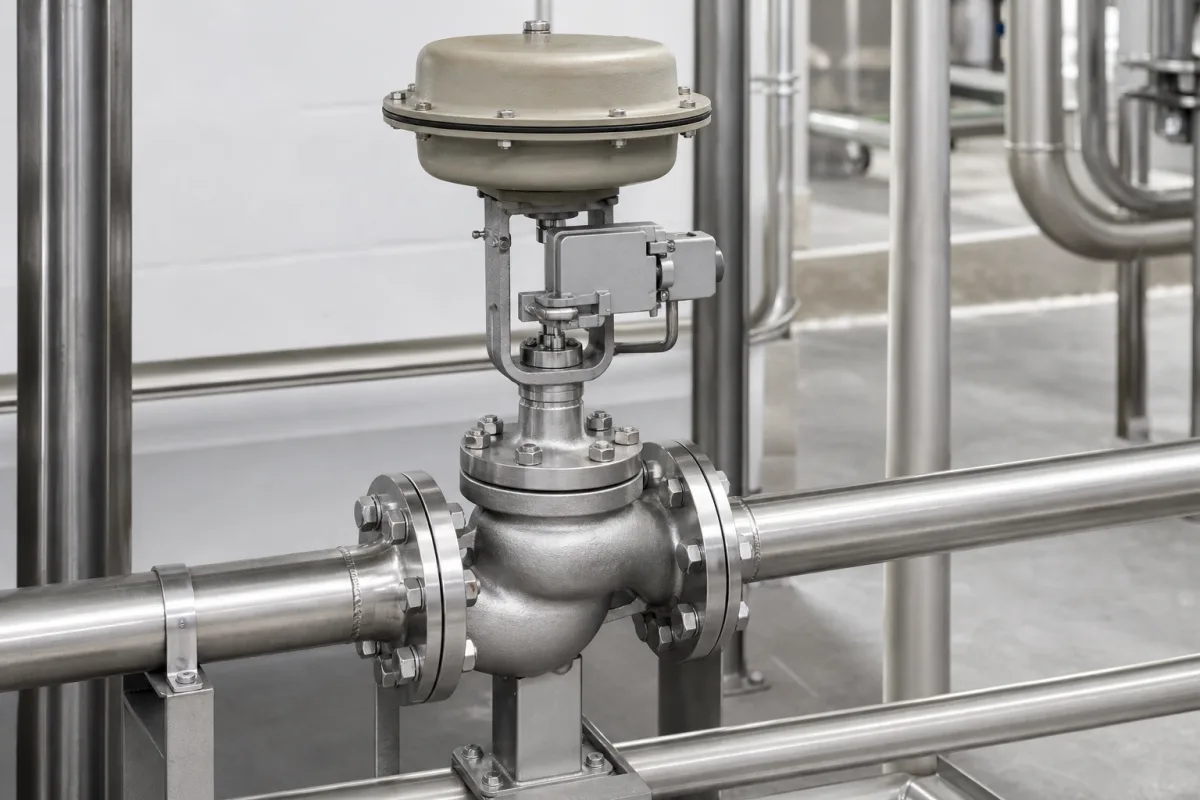
Low-flow (micro-flow) pneumatic flow control valve for small dosing and pilot-plant lines
Low-flow and micro-flow control valves · Kvs from 0.0001, 2–15 mm seats, rangeability that shrinks with the trim, filters and shut-off on small bores
A low-flow or micro-flow control valve is a small globe or angle valve, threaded or flanged from about ⅛ in to 1 in, whose plug and seat are machined to pass tiny, controllable flows of liquid, gas or steam under a pneumatic diaphragm actuator and positioner. It is chosen by flow coefficient rather than pipe size. The questions that matter: which Kvs or Cv trim brackets the flow, how much turndown that trim really has, whether the medium is clean enough for a 2–4 mm seat, and what pressure, temperature and leakage the small body is rated for.
Pneumatic low-flow and micro-flow control valves with trims from Kvs 0.0001 up to about 5 (Cv 6), for pilot plants, research rigs, additive injection and small dosing lines, including their interchangeable micro-trims and bellows or extension bonnets. General-purpose pneumatic globe control valves, their sizing at three operating points, shut-off classes and actuator choice, are covered on the Pneumatic globe control valve page; loose plugs supplied as trim parts are covered on the Control valve plug page. Slide gates that meter molten steel from ladles and tundishes are covered on their own page. Hydraulic (oil-circuit) flow control valves, pneumatic speed controllers, pilot-operated waterworks flow control valves and medical infusion flow regulators are different products and outside this page.
CNFX editorial research · Sources checked October 12, 2026 · 4 sources
Kvs steps from 0.0001 to 1.6 and the seat each one needs
SAMSON designed its Type 3510 for controlling low flow rates in pilot plants and technical research facilities. Its trims climb in standard steps from Kvs 0.00010 through 0.00016, 0.00025 and so on to 1.6, on only four seat sizes: [1]
All four groups use a 4 mm plug stem and 7.5 mm travel. Because of the two seat threads, trims can be swapped within Kvs 0.0001 to 0.4 or within 0.63 to 1.6, but not across that boundary. [1] Editorial note: if a pilot plant may later run at five or ten times its design flow, choose a body whose seat thread accepts both the start-up and the larger trim.
BCST's ZJHY small-flow valve covers the upper end of the same territory: seat diameters of 1.5 to 15 mm with rated Kv from 0.025 to 2.23, in G3/8, 1/2, G3/4 and G1 bodies, with a single-seat plunger plug in 304, 316 or 316L and linear or equal-percentage characteristics. [4]
Editorial calculation: Kv is the water flow in m³/h at 1 bar pressure drop, and Cv ≈ 1.156 × Kv. SAMSON's smallest trim, Kvs 0.0001, therefore passes about 0.1 L/h of water at 1 bar drop, under 2 mL per minute, and its 1.6 trim about 1.85 Cv.
Kvs range (SAMSON Type 3510)
Seat Ø
Rangeability
Restrictions in the data sheet
0.0001 to 0.0063
2 mm
Below 15:1
Linear or on/off only (equal percentage from Kvs 0.01); seat and plug only in 1.4122/1.4112 or Stellite® combinations [1]
M10x1 seat thread, shared with the smaller trims [1]
0.63 to 1.6
10 mm
50:1
M16x1 seat thread; these versions only up to PN 100 [1]
Give the supplier the medium and its state, minimum, normal and maximum flow, inlet and outlet pressure at each, temperature, required characteristic, body connection and pressure rating, bonnet type (standard, extension, bellows), fail position, positioner signal, and any filter already upstream.
02
Below Kv 0.1 the turndown shrinks and dirt becomes the failure
SAMSON rates the Type 3510 at 50:1 rangeability, but less than 50:1 when Kvs is below 0.1 and less than 15:1 for the 0.0001–0.0063 trims, which are offered as linear or on/off trims only. [1]
Editorial calculation: at 50:1 a Kvs 0.4 trim controls down to Kv 0.008; a Kvs 0.0063 trim at the stated limit of below 15:1 controls no lower than about Kv 0.0004. When the minimum and maximum flows of a process are more than about 15× apart in the smallest range, plan for a trim change or a second valve rather than one micro-trim.
The small gaps that give these valves their resolution also trap particles. BCST states that when an unclean medium is regulated, blockage of the small throttling clearance has to be taken care of. [4] Badger Meter's Research Control Valve manual advises small micron filters, where the process permits, for valves with its Low Flow "P" series inner valves, and warns that over-torquing the seat on the smaller letter or "P" trims can shrink the orifice until plug and seat gall when the valve strokes. [3]
Badger Meter sets its standard air-to-open valves to lift off the seat at about 3.25 psig instrument signal and open fully at 15 psig, with 90 psig air at the inlet; process pressure can unbalance that and need the spring adjuster reset. [3]
03
PN 400 bodies, cryogenic to 450 °C bonnets and the leakage of a lapped micro-seat
Small bores let these valves reach pressure ratings far above their size class. The SAMSON Type 3510 is built from PN 40 to PN 400 in stainless steel, −10 to +220 °C as standard and −196 to +450 °C with an insulating section; a metal bellows seal up to PN 250 or PN 325 has an external tightness of ≤10⁻⁵ mbar·l/s. [1]
The two Badger Meter documents state different leakage figures, Class IV on the product page for size 0 and larger trims and Class III in the manual for installed replacement trims; the manual adds that bubble-tight shut-off can be reached by lapping, but not on any "P" series trim. [2][3] Ask the supplier which class applies to the exact trim ordered, with the test.
Badger Meter lists the Type 807 in ¼ to 1 in line sizes with linear, equal-percentage, quick-opening or double-taper trims and states flow range as 0–6 Cv, and its manual says spare trims come in 39 Cv sizes. [2][3] Editorial calculation: 6 Cv ÷ 1.156 = 5.2 Kv; the same product page also prints the range as 0–85.8 Kv, which does not match that conversion, so confirm the metric figure with the maker.
12 companies list this product among what they make. Company figures are quoted from each
company's own website; every card states where the relationship came from.
BCST Group
Manufacturing site to be confirmed for the order
Lists the ZJHY pneumatic small-flow control valve: multi-spring diaphragm actuator, seats 1.5–15 mm, Kv 0.025–2.23, stainless bodies.
Explore company information and manufacturing capabilities, then discuss the scope of your project with a relevant supplier.
Share this page
Compiled and source-reviewed by the CNFX editorial team.
Each manufacturer above links to the page on that company's own website where the product is listed, with the date we checked it. How we source and review
· Page last updated 13 October 2026
Buyer questions
How small can a control valve trim go?
SAMSON's Type 3510 data sheet lists Kvs trims from 0.0001 upward on a 2 mm seat; Badger Meter offers 39 Cv trim sizes for its research valves. [1][3]
Does a micro-flow trim keep 50:1 rangeability?
No. SAMSON gives 50:1 only from Kvs 0.1 upward, 15:1 to 50:1 for 0.01–0.25, and below 15:1 for Kvs 0.0001–0.0063. [1]
Why do low-flow valves need filters?
BCST warns that unclean media can block the small throttling clearance, and Badger Meter advises small micron filters for its low-flow P series trims. [4][3]
Sources and what still needs a direct check
Sources checked 2026-10-12. SAMSON, Badger Meter and BCST are control-valve makers; the figures come from SAMSON's Type 3510 data sheet (DIN version, November 2022), Badger Meter's Type 807 product page and Research Control Valve user manual (January 2026), and BCST's ZJHY product page.