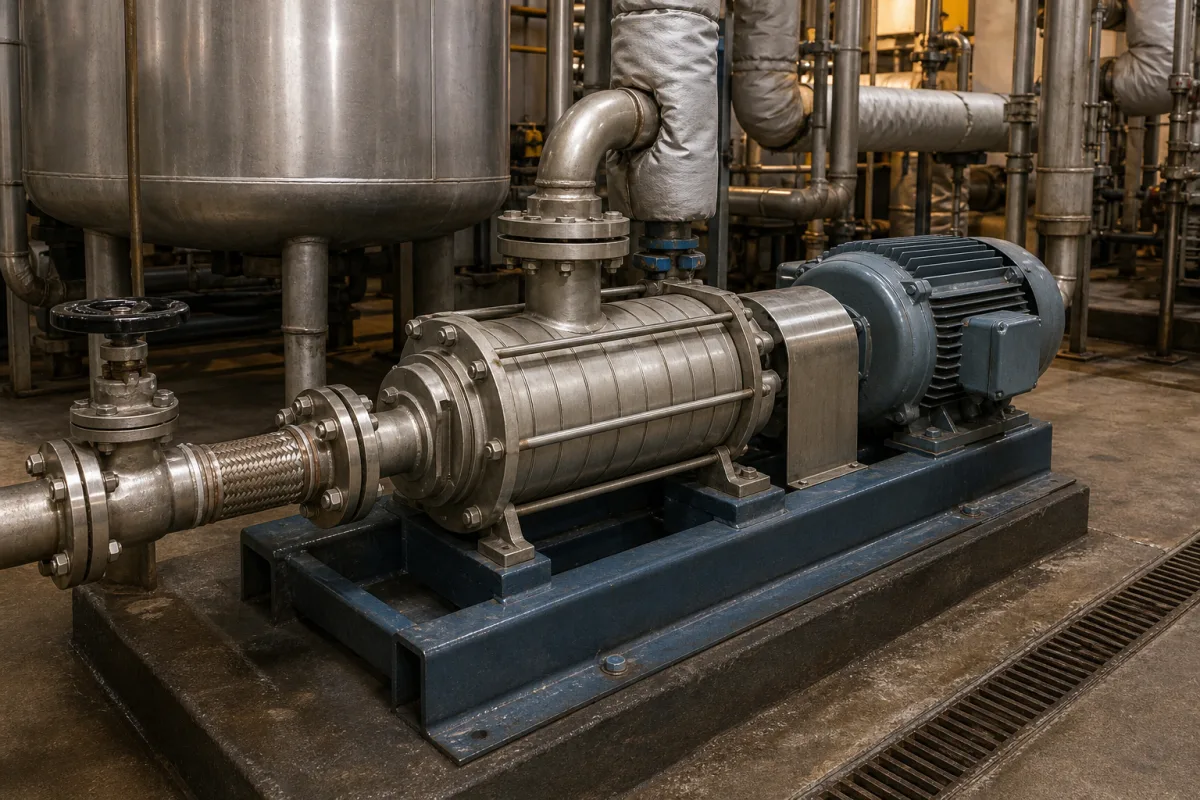
Condensate pumps · electric centrifugal pumps and steam- or air-driven mechanical pumps that return steam condensate from vented receivers to the boiler house, condensate temperature and cavitation, instantaneous discharge flow, and small HVAC condensate pumps for air-conditioning drainage
Steam condensate is hot water close to its boiling point, so pumping it back from a vented receiver to the boiler house needs a pump designed for that duty: an electric centrifugal pump built to resist cavitation, or a mechanical pump driven by steam or compressed air. A separate class of small condensate pumps drains water from air-conditioning units. Ask three things first: which duty (steam condensate or HVAC drainage), what flow, temperature and lift, and what motive power or electricity is available.
Electric and mechanical (positive displacement) condensate recovery pumps and packaged units for steam systems, and small condensate removal pumps for air-conditioning equipment. Boiler feed pumps, steam traps and general water pumps are outside this page except where compared.
CNFX editorial research · Sources checked October 12, 2026 · 6 sources
Spirax Sarco, a steam systems maker, explains that condensate forms close to its boiling point. A centrifugal pump has a low-pressure zone at the eye of its impeller, so near-boiling condensate can flash into steam bubbles there; as the bubbles move outward into higher pressure they implode, which is cavitation, a noisy process that damages pump internals. It therefore recommends pumping condensate with electric pumps built for the task, and keeping condensate in atmospheric systems at or below 98 °C. Some pumps are limited to 94 or 96 °C, depending on design, speed and the height of the receiver above the pump. [1]
Spirax gives the vapour pressure points behind this: water boils at 100 °C at atmospheric pressure, at 170 °C at 7 bar g, and at 90 °C at 0.7 bar a. [1]
Give the supplier the condensate flow rate, temperature and receiver arrangement, the lift and back-pressure to the return point, the available electricity or motive steam or air pressure, hazardous-area or wet-location constraints, packaged receiver requirements, and materials.
02
Choose an electric or a mechanical pump
Spirax describes a mechanical (positive displacement) condensate pump as a body that fills by gravity, with a float that operates changeover valves. When the float rises to a set level, a vent valve closes and an inlet valve opens to let steam or air pressurise the body and push the condensate out; as the level falls the valves change back. It needs no extra control system and runs only when needed. Spirax suggests mechanical pumps where maintenance is an issue, where the environment is hazardous, humid or wet, where electricity is not at hand, or where condensate must be removed from temperature-controlled equipment that may stall. [1]
Because a mechanical pump cycles, Spirax notes that its instantaneous discharge rate can be up to six times the filling rate, and that this figure, not the average flow, must be used to size the discharge pipe. Sizing needs the maximum condensate flow reaching the receiver and the available motive steam or air pressure. [1]
For air-conditioning drainage, Chinafore and Wipcool list compact condensate pumps such as mini pumps and tank pumps with drain accessories, and Zhejiang Feiyue lists condensate pumps among HVAC tools. Guangzhou Xinheng lists automatic condensate pumps among its industrial pumps. [2][3][4][5]
Editorial calculation: a mechanical pump filled at 1,000 kg/h may discharge at up to 6,000 kg/h while it is emptying.
03
Put a value on returning condensate
The US Department of Energy's Steam Tip Sheet #8 recommends maximising hot condensate return to the boiler: returned condensate at 130–225 °F reduces the cold makeup water (50–60 °F) to be heated, cuts makeup water, treatment chemicals and sewer disposal, and high-purity condensate reduces blowdown losses. It states that condensate can hold more than 10% of the steam's energy and gives heat remaining in condensate as (hc − hm) / (hs − hm): for 180 °F condensate (148 Btu/lb), 55 °F makeup (23 Btu/lb) and 100 psig steam (1,189 Btu/lb), 11.0%. [6]
Its worked example returns an additional 10,000 lb/h of condensate at 180 °F for 8,000 hours a year, at 80% boiler efficiency, $8.00/MMBtu fuel, $0.004/gal combined water, sewage and treatment cost and an assumed 12% flash steam loss, giving $33,760 water, sewage and chemical savings and $88,000 fuel savings, $121,760 a year in total. It also reports a specialty paper plant that cut boiler makeup from about 35% of steam production to 14–20% by returning more condensate, saving more than $300,000 a year, and recommends repairing return leaks and insulating return piping. [6]
Editorial calculation: the sheet's figures give 125 / 1,166 ≈ 10.7%, which it rounds to 11.0%. 10,000 lb/h is about 4,536 kg/h, or roughly 4.5 t/h of condensate; 180 °F is about 82 °C and 55 °F about 13 °C. If that flow were returned by a mechanical pump whose discharge can reach six times the filling rate, the discharge line would be sized for up to about 27 t/h. Use your own fuel, water and operating-hour figures. [6][1]
Give the condensate flow and temperature now lost to drain, operating hours, fuel and water costs, boiler efficiency and return distance and lift, so the supplier can size the pump and you can judge payback.
04
Duty, temperature limit, drive and discharge rate
The discharge flow row applies only to mechanical pumps, which empty at up to six times their filling rate; the line is sized for that burst, not the average. [1]
Field
What it means and published values
Ask the supplier for
Duty
Steam condensate recovery or HVAC drainage. [1][2]
Pump class for your duty.
Temperature
Atmospheric condensate ≤98 °C (some pumps 94–96 °C). [1]
Rated temperature and NPSH.
Drive
Electric, or steam/air motive pressure (mechanical). [1]
Motive pressure needed.
Discharge flow
Mechanical pumps: up to 6× filling rate while discharging. [1]
Explore company information and manufacturing capabilities, then discuss the scope of your project with a relevant supplier.
Share this page
Compiled and source-reviewed by the CNFX editorial team.
Each manufacturer above links to the page on that company's own website where the product is listed, with the date we checked it. How we source and review
· Page last updated 13 October 2026
Buyer questions
Why can hot condensate damage a centrifugal pump?
Near-boiling condensate flashes at the low-pressure impeller eye and the bubbles implode further out, causing cavitation. [1]
How hot can condensate be for an electric pump?
Spirax recommends no more than 98 °C in atmospheric systems, with some pumps limited to 94 or 96 °C. [1]
How does a mechanical condensate pump work?
A float opens a steam or air inlet to pressurise the body and push condensate out, then resets as the level falls. [1]
How much energy does returned condensate save?
DOE states it can hold more than 10% of a steam system's energy; its example of 10,000 lb/h at 180 °F saves about $121,760 a year under stated costs. [6]
Sources and what still needs a direct check
Sources checked 2026-10-12. Spirax Sarco's Steam Engineering Tutorials describe condensate pumping from the maker's side. Supplier pages show what each company lists.