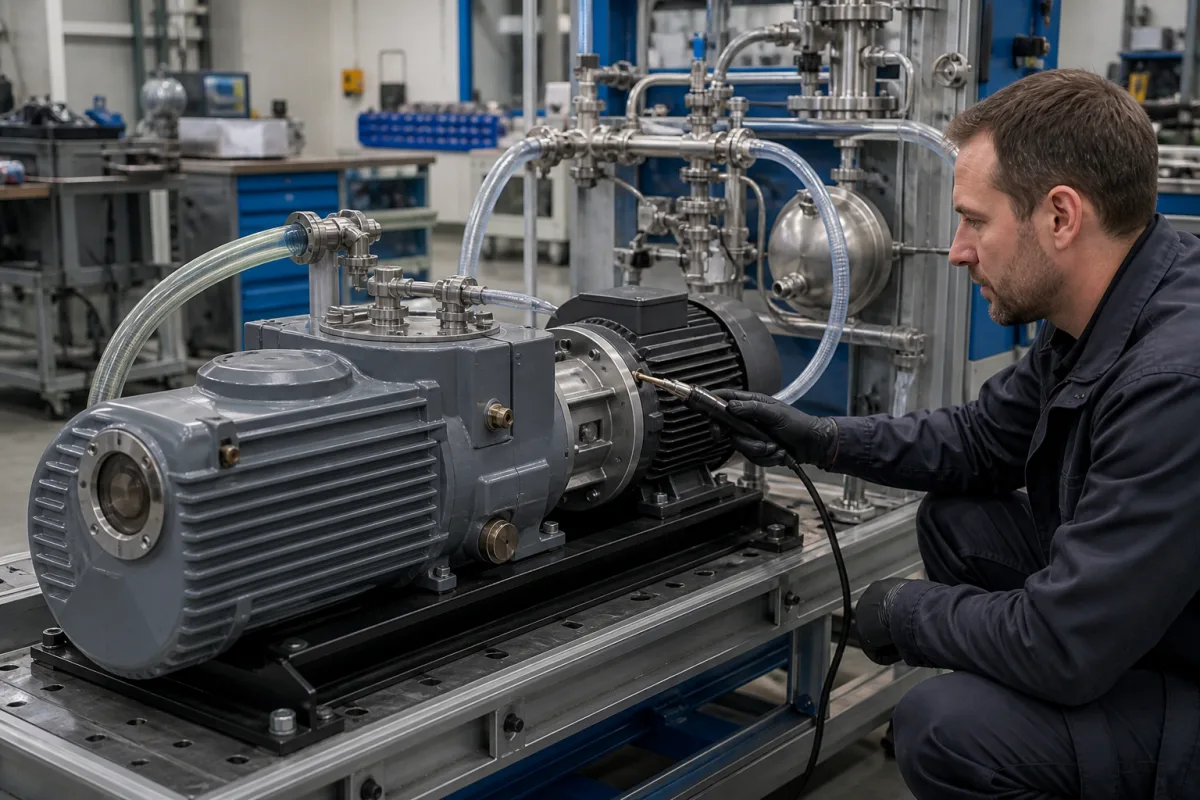
Process vacuum · Pump type, vapour handling and pump-down time
Start with the gas, not the pump. Water vapour, solvents and dust decide whether an oil-sealed pump survives or a dry screw pump is worth its price. Choose the type for the gas, then size the pumping speed for the pump-down time and the gas load at operating pressure.
Rough- and medium-vacuum pumps for drying, degassing, distillation, packaging, moulding and vacuum handling: oil-sealed rotary vane, dry screw, liquid ring and Roots combinations. Turbomolecular and other high-vacuum pumps are covered on the high-vacuum pump page.
CNFX editorial research · Sources checked October 12, 2026 · 10 sources
Pfeiffer describes the rotary vane pump as oil-sealed: the oil lubricates, seals gaps and fills dead volume. It suits the low and medium vacuum ranges, ideally where the pumped medium does not condense at pump temperature; where substances attack the oil or condense despite gas ballast and accessories, a different backing pump should be selected. Two-stage versions reach lower ultimate pressures than single-stage ones. [1]
Dry screw pumps use two contactless counter-rotating screw rotors with no oil in the pumping chamber. Pfeiffer notes that water-cooled screw and multi-stage Roots pumps have been replacing oil-lubricated rotary vane pumps in the 100–600 m³/h class, and that its dry screw pumps suit chemical, dusty or condensate-producing processes; their effective pumping speed falls below about 1 hPa. [2]
Pfeiffer also notes that at high gas throughputs with gas ballast, oil mist is carried out of a rotary vane pump, which an oil mist filter can separate and return; filters and separators can protect against dust and some vapours within limits. [1]
Tell the supplier every gas and vapour in the stream, including solvents, water, acids and dust, their quantities and whether any are flammable. That list decides the pump type more than the target pressure does.
02
Handle water and solvent vapour with gas ballast
Leybold explains that vapour can only be compressed to its saturation pressure at pump temperature: water vapour in a pump at 70 °C condenses above 312 mbar, so it condenses before the exhaust valve opens. Gas ballast admits a defined quantity of air before compression so the valve opens first and the vapour leaves with the air. [4]
Leybold sets two conditions for pumping vapour: the pump must be at operating temperature and the gas ballast valve open; it advises running the pump for half an hour with the valve open first, which raises pump temperature by about 10 °C. [4]
Pfeiffer adds that without gas ballast a pump with an outlet below 100 °C cannot displace even small amounts of pure water vapour; condensate dissolves in the oil, raises the base pressure and can cause corrosion. Gas ballast slightly worsens the attainable base pressure, and water-vapour tolerance is quoted in hPa or mbar on the data sheet. [3]
03
Size pumping speed for pump-down and operating gas load
Leybold separates three sizing questions: the effective pumping speed to reach a pressure in a given time, the speed to remove gas and vapour released continuously at operating pressure, and the speed to finish a process that produces vapour, such as drying. In the rough vacuum range, the speed needed for pump-down depends only on pressure, volume and time. [5]
Leybold warns that single-stage rotary vane and rotary piston pumps lose pumping speed below about 10 mbar with gas ballast and below 1 mbar without, and that the simple pump-down equations apply only when the ultimate pressure “is by several orders of magnitude lower than the desired pressure”. In its worked example, a 2,000 L vessel with a 120 s time constant reaches the target in about 18.5 min, which it rounds up to 25 min after adding reading uncertainty and a 20% safety factor. [5][6]
As an editorial calculation example only, using the constant-speed relation t = (V/S)·ln(p₀/p): to take a 500 L chamber from 1,013 mbar to 10 mbar in 2 minutes needs about 0.5 m³ ÷ (2/60 h) × ln(101.3) ≈ 69 m³/h of effective speed at the chamber, before allowing for pipe conductance, leaks, outgassing and vapour.
Pfeiffer defines ultimate pressure as the pressure a blank-flanged pump approaches with no gas inlet, where usable pumping speed is zero; data sheets now give base pressure measured under ISO 21360-1. Choose a pump whose base pressure is well below the operating pressure. [3]
Give the chamber volume, target pressure and time, and the gas or vapour released during the process. A pump sized only for empty-chamber pump-down will stall when the product starts to release vapour.
04
Liquid ring, dry screw and rotary vane lines on the linked supplier sites
Vacculex pairs screw, Roots and liquid ring pumps with customised vacuum systems; Souz and Value cover the liquid ring and rotary vane ends of the range. [7][8][9]
Baosi, for example, lists the GSD160B oil-free dry screw pump at 160 m³/h and 273 kg; Souz lists 2BV, 2BEA, 2BEC and 2SK liquid ring pumps alongside dry screw and scroll pumps; Value lists single- and two-stage rotary vane and VSP dry screw pumps. [10][7][9]
05
Rotors, gas ballast valve, oil mist filter and motor in a process vacuum pump
Part
Role
Fix in the order
Rotor and vanes or screw rotors
Trap and compress gas; screw rotors run without contact or oil. [1][2]
Pump principle, stages and rotor materials or coatings.
Housing or stator
Encloses the pumping chamber; dry screw housings are cooled at the outlet side. [2]
Material, cooling method and cooling water demand.
Inlet and outlet ports
Connect to the chamber and exhaust; Pfeiffer lists an inlet sieve and a silencer with non-return valve as standard equipment on its screw pumps. [2]
Flange sizes, inlet screen and exhaust silencer.
Gas ballast valve
Admits air or inert gas so vapour leaves before condensing. [4][3]
Ballast flow and inert-gas option.
Oil, oil mist filter and separators (oil-sealed pumps)
Seal and lubricate; filters return oil and protect against dust and vapours. [1]
Oil type, mist filter and inlet traps.
Motor
Drives the pump; speed and base pressure depend on mains frequency. [1]
Power, voltage, frequency and enclosure.
06
Pumping-speed curve, base pressure, mains frequency and enclosure for a vacuum pump order
Four rows rest on Leybold and Pfeiffer notes: speed falling at low pressure, base pressure under ISO 21360-1, mains frequency and pump temperature. Motor power, noise, IP rating, mass and dimensions come only from the data sheet of the pump offered.
Field
What it means and published values
Ask the supplier for
Pumping speed (m³/h)
Effective speed at the chamber sets pump-down time; speed falls at low pressure. [5]
Pumping-speed curve against inlet pressure.
Ultimate pressure (Pa)
Pfeiffer: “Today, base pressure is specified instead of ultimate pressure” (ISO 21360-1:2012); gas ballast raises it slightly. [3]
Base pressure with and without gas ballast.
Motor power (kW)
Rises with speed and compression.
Rated power and power at operating pressure.
Voltage (V)
Supply match.
Voltage range.
Frequency (Hz)
Speed and base pressure depend on mains frequency. [1]
Paste it into your enquiry below or into an email to a maker, then replace every bracket.
Gas: [all gases and vapours; quantities; water; solvents; acids; dust; flammable or toxic]
Pressure: [operating pressure; lowest pressure; base pressure needed]
Pump-down: [chamber volume; start and target pressure; required time]
Gas load: [vapour or gas released during the process; leak rate]
Type: [oil-sealed, dry screw, liquid ring, with or without Roots booster]
Utilities: [voltage; frequency; cooling water; service liquid; exhaust routing]
Accessories: [gas ballast or inert purge; inlet filter or trap; oil mist filter; silencer]
Documents: [pumping-speed curve; base pressure and water-vapour tolerance; manual; ATEX if needed]
12 companies list this product among what they make. Company figures are quoted from each
company's own website; every card states where the relationship came from.
Souz Vacuum
Manufacturing site to be confirmed for the order
Lists 2BV, 2BEA, 2BEC and 2SK liquid ring pumps, rotary vane, Roots, dry screw and scroll vacuum pumps.
Explore company information and manufacturing capabilities, then discuss the scope of your project with a relevant supplier.
Share this page
Compiled and source-reviewed by the CNFX editorial team.
Each manufacturer above links to the page on that company's own website where the product is listed, with the date we checked it. How we source and review
· Page last updated 13 October 2026
Buyer questions
Why does my rotary vane pump oil turn milky?
Water vapour condensing in the pump. Leybold and Pfeiffer explain that gas ballast lets vapour leave before it condenses; without it, condensate dissolves in the oil, raises base pressure and can corrode the pump. [4][3]
When should I choose a dry screw pump?
Pfeiffer notes dry screw pumps run without oil in the pumping chamber and suit chemical, dusty or condensate-heavy processes; they have been replacing oil-sealed pumps in the 100–600 m³/h class. [2]
How do I estimate pump-down time?
Leybold notes that in rough vacuum it depends only on volume, effective pumping speed and target pressure, provided the pump's ultimate pressure is far below the target; add margin as speed falls at low pressure. [5][6]
Sources and what still needs a direct check
Sources checked 2026-10-12. Leybold and Pfeiffer Vacuum are vacuum pump manufacturers; their knowledge pages explain principles that apply across makes. Supplier pages describe their own offers. ISO 21360-1 and PNEUROP documents were not read for this page.