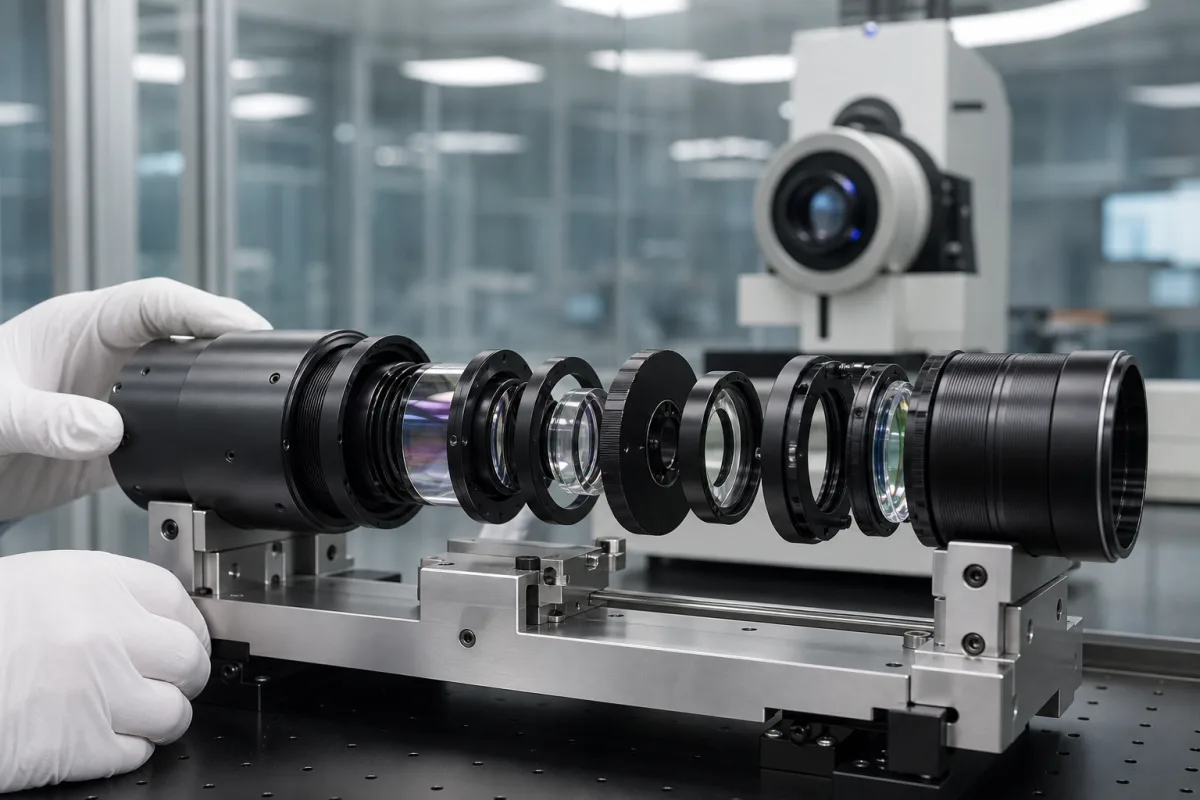
Athermal lens barrel assembly: titanium, aluminium and Invar shells that hold focus as the temperature changes
Precision and infrared optics · the barrel that holds a lens group at its designed spacing over temperature: why a single-material barrel drifts out of focus, how an Invar–aluminium shell stack compensates, and what Invar 36 does and does not deliver
In a precision optical instrument the barrel is not only a tube with threads. Lens spacing and the distance from the last lens to the detector change as the barrel expands, the lenses themselves change shape and refractive index, and the image goes out of focus. An athermal barrel is built from metals chosen so that these changes cancel: a titanium front barrel matched to germanium and silicon lenses, and a rear stack of low-expansion Invar and high-expansion aluminium shells that moves the lenses the opposite way. The picture shows a barrel stripped into its sections, cells and spacers on an alignment rail. The design turns on three questions: how much focus drift the optics produce per degree, what shell geometry cancels it in the space available, and how the low-expansion metal behaves outside room temperature.
Lens barrels and barrel assemblies for precision and infrared optics designed to hold focus over temperature: barrel materials, multi-shell athermal stacks, supports and the thermal testing that proves them. Threaded retaining, lock and spacer rings that hold lenses inside barrels are covered on the Precision optical lens mounting ring page; complete multi-element camera and machine-vision lenses, and barrel construction for centring accuracy, are covered on the Multi-element imaging lens assembly page.
CNFX editorial research · Sources checked October 12, 2026 · 3 sources
Why a single-material barrel drifts: thermo-optic 9.7 nm/°C plus thermoelastic 20.3 nm rms/°C in a 270 mm titanium barrel
The Korea Research Institute of Standards and Science (KRISS) analysed a mid-infrared reimaging assembly with four germanium and silicon lenses at f/2.7, mounted first in a conventional single-shell barrel. [1]
KRISS states that modern optical systems are expected to work from −40 to +70 °C, and that the conventional single machined barrel is known to give poor athermalization, with lens displacement large enough to cause defocus. Its own assembly saw a uniform 8 to 32 °C, ±12 °C about a 20 °C assembly temperature, with gradients below 1 °C. [1]
Editorial note: the paper's extracted text prints micrometre quantities with an 'm' (for example its 3.39 µm interferometer wavelength appears as 3.39 mm, and the same paper gives it as 3,390 nm); the focus shifts on this page are therefore given in µm. The paper also quotes the single-shell sensitivity as both 29.8 and 30.0 nm/°C; both figures are shown.
Item
KRISS single-shell barrel
Barrel
Ti6Al4V, 270 mm long, 159 mm largest diameter, chosen for a CTE close to Ge and Si; back focal length about 100 mm [1]
Supports
Three Invar flexures, two front and one stiffer rear support for the 3 kg detector module [1]
About 20.3 nm rms/°C against a system limit of 15.0 nm rms/°C; defocus dominant, coma and astigmatism negligible [1]
Combined
29.8 nm/°C predicted; 30.0 nm/°C quoted in the results [1]
Focus shift
About −2.9 µm per +1 °C, needing a negative change in lens-to-focal-plane distance [1]
Give the barrel supplier the operating and survival temperature ranges, the lens materials, the back focal length, the defocus or wavefront budget per °C, and where the barrel is fixed to the instrument.
02
Three 100 mm shells, Invar–aluminium–Invar: about −2.2 µm/°C of compensation, 8.1 nm/°C measured, and 47 G vibration
A classic two-shell re-entrant compensator would have needed long shells; KRISS instead nested three shells of equal length.
Using Invar 36 (CTE about 1 × 10⁻⁶/°C) and Al 6061 (about 23 × 10⁻⁶/°C), the two-shell re-entrant design would have needed shells about 237 mm and 137 mm long, which did not fit and lacked rigidity against vibration. The three-shell barrel uses an Al 6061 middle shell between an outer and an inner Invar 36 shell, all 100 mm long, about 1.5 mm thick, 102 mm outer diameter, with 0.5 mm gaps filled by Al 6061 spacer rings. The outer shell carries the titanium front barrel, in which the four lenses are bonded with about 0.3 mm of epoxy; the inner shell is fixed at the focal plane. [1]
The stack was expected to give about −2.2 µm/°C of lens-to-focal-plane change against the −2.9 µm/°C needed, leaving a residual of −0.716 µm/°C; KRISS notes that full compensation needs a material pair with a larger CTE difference. Thermoelastic defocus fell from 20.1 to 1.9 nm/°C, and the combined prediction from 29.8 to 11.6 nm/°C. In test, with the barrel in a thermal shroud on an Invar baseplate, six type K thermocouples, a 3.39 µm interferometer and a computer-generated hologram, the measured defocus gradient was 8.1 nm/°C over 22–34 °C; the paper also cites a theoretical expectation of 4.8 nm/°C in that section. The first natural frequency was 284.2 Hz, and optical performance was unchanged after random vibration up to 47 G. [1]
Editorial calculation: a 100 mm shell pair differing by 22 × 10⁻⁶/°C moves 100 mm × 22 × 10⁻⁶ ≈ 2.2 µm per °C, matching the paper's figure. Over KRISS's ±12 °C operating swing, the residual −0.716 µm/°C amounts to about ±8.6 µm of focus shift, against about ±35 µm (2.916 × 12) for the uncompensated barrel.
Ask the supplier for the predicted and measured defocus per °C, the temperature range of the test, how temperature uniformity was confirmed, the first natural frequency and the vibration levels the barrel has passed.
03
Invar 36 in the barrel: 1.30 ppm/°C up to 93 °C but 7.60 ppm/°C at 371 °C, and the heat treatment that stabilises it
The low-expansion shells only work inside the temperature range where Invar is low-expansion, and only if the metal is stabilised.
High Temp Metals lists the Curie temperature of Invar 36 at 279 °C (535 °F). [2] Nikon SLM Solutions, which sells Invar 36 powder for laser powder-bed fusion to ASTM F1684 / DIN 1715-1 at about 8.1 g/cm³ and names optical systems among its uses, specifies a heat treatment to stabilise thermal expansion: 0.5 h at 880 °C with water quench, 1 h (up to 15 min more) at 300 °C with air cooling, then heating to 100 °C and slow cooling over 48 h. [3]
Editorial calculation: compared with the about 23 × 10⁻⁶/°C KRISS used for Al 6061, Invar's 1.30 × 10⁻⁶/°C to 93 °C gives a CTE difference of about 21.7 × 10⁻⁶/°C, close to the 22 × 10⁻⁶/°C behind the 2.2 µm/°C shell figure; at 260 °C mean, Invar's 4.18 would cut that difference to about 18.8 × 10⁻⁶/°C, so an athermal stack designed at room temperature loses compensation if it is baked or run hot. [2][1]
KRISS adds a practical point for testing: the Ge and Si lenses conduct heat at 59 and 150–163 W/(m·K) against 6.6 W/(m·K) for the titanium barrel, so the lenses settle faster than the barrel; it waited at least 1 hour after the barrel stabilised before each measurement, and about 2 hours for its sensors to agree within 0.5 °C. [1]
Specify the Invar grade and its CTE certificate over your temperature range, whether parts are machined from bar or additively manufactured, the stabilising heat treatment, and any bake-out or storage temperatures the barrel will see.
04
Optical, thermal and mechanical data for an athermal barrel
Paste it into your enquiry below or into an email to a maker, then replace every bracket.
Optics: [lens materials; number of elements; f-number; back focal length]
Thermal: [operating and storage range; gradients; defocus budget per °C]
Materials: [front barrel; low- and high-expansion shells; spacer rings]
Geometry: [length available; diameters; mounting interface]
Testing: [thermal defocus test; uniformity; first natural frequency; vibration level]
Documents: [CTE certificates; heat treatment records]
Explore company information and manufacturing capabilities, then discuss the scope of your project with a relevant supplier.
Share this page
Compiled and source-reviewed by the CNFX editorial team.
Each manufacturer above links to the page on that company's own website where the product is listed, with the date we checked it. How we source and review
· Page last updated 13 October 2026
Buyer questions
Why does a lens barrel go out of focus with temperature?
Barrel expansion changes lens spacing and the distance to the focal plane, and lens index and shape change too; KRISS found about 30 nm/°C of defocus in a single titanium barrel for four IR lenses. [1]
How does an athermal lens barrel work?
It combines low- and high-expansion metals so their expansions move the lenses against the focus shift; KRISS's Invar 36 / Al 6061 three-shell barrel reduced defocus to a measured 8.1 nm/°C. [1]
Is Invar 36 low-expansion at all temperatures?
No. High Temp Metals lists a mean CTE of 1.30 × 10⁻⁶/°C to 93 °C rising to 7.60 × 10⁻⁶/°C to 371 °C, with a Curie point of 279 °C. [2]
Sources and what still needs a direct check
Sources checked 2026-10-12. KRISS, Korea's national metrology institute, reported its athermal barrel at the IMEKO World Congress 2012; High Temp Metals and Nikon SLM Solutions publish material data for Invar 36.