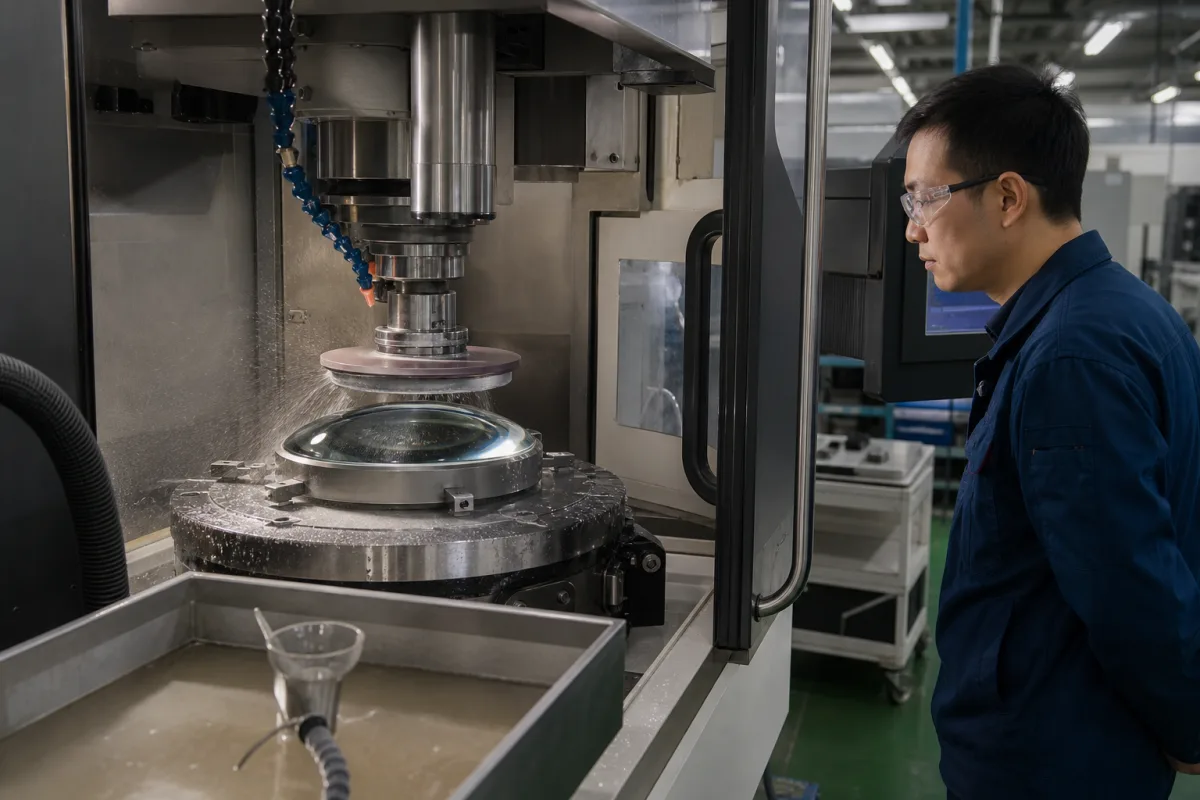
CNC precision optics grinding machines · Pre- and fine grinding of spherical, aspheric, plano and prism optics in brittle hard materials, sized by lens diameter (Ø 5 mm to Ø 500 mm), with direct-driven spindles, cooled axes, polymer-concrete bases, thickness probes and tool changers
A precision optics grinding machine shapes glass and other hard, brittle optical materials into lens surfaces with diamond tools under CNC control, before polishing. Machines are sized by the lens diameters they handle and by the geometries they can grind, from simple spheres to aspheres and prisms. Ask three things first: which diameters, materials and geometries you will grind, which grinding steps one machine must cover, and what accuracy, measurement and automation features the line needs.
CNC grinding (generating) machines for precision optical lenses and prisms, covering pre-grinding, fine grinding and related edging steps. Ophthalmic spectacle-lens generators, polishing machines, centering machines, grinding wheels (see grinding wheel) and surface grinders for metals (see surface grinding machine) are outside this page.
CNFX editorial research · Sources checked October 12, 2026 · 4 sources
Satisloh sizes its precision optics grinders by lens diameter. Its SPM-50 is for small to mid-sized optics from Ø 5 to 50 mm, combining sensitive handling of small lenses with the force needed for larger ones and allowing pre- and fine grinding in one setup with minimal sub-surface damage. Its SPM-150 processes spherical lenses of Ø 10–150 mm, covering pre- and fine grinding, edge grinding, chamfering and diameter reduction, in standard and swivel mode, with optional grinding of rotationally symmetric aspheres in cup-tool mode. [1][2]
For larger and more complex parts, Satisloh's GI is a 5-axis system for pre- and fine grinding, and grinding and polishing, of spheres, aspheres, plano optics, cylinders, prisms, domes and rods in hard, brittle materials up to Ø 500 mm, with limits depending on process, tooling and number of spindles; it has up to two tool spindles and a CAD/CAM post-processor. [3]
Give the supplier the lens diameters and thicknesses, materials, geometries (sphere, asphere, plano, prism, cylinder), radii range, grinding steps required (pre-grind, fine grind, edge, chamfer), batch sizes, target form and surface results, coolant and filtration arrangements, automation and loading needs, and floor space.
02
Check accuracy, measurement and automation features
Satisloh says the SPM-50 keeps a constant processing temperature with improved machine and axis cooling and uses direct-driven linear drives and servo motors for repeat positioning accuracy. The SPM-150 has direct-driven dual spindles for low sub-surface damage, a 360° tool swivel head, crosscut adjustment for form accuracy, optional integrated centre-thickness measurement, and a polymer-concrete base that Satisloh rates at 12 times the vibration absorption of cast iron. [1][2]
The GI adds an integrated probe for centre thickness and workpiece geometry, cooled axes and drives for repeatable form accuracy, a 3D simulation mode, an integrated quality assurance system for spherical processing, and a front-loaded tool changer with 10 slots for multi-step processes without operator intervention, controlled by a Bosch Rexroth MTX controller. [3]
Satisloh lists footprints of 700 × 1,350 × 1,950 mm (SPM-50), 1,100 × 1,660 × 1,930 mm (SPM-150) and 1,670 × 2,660 × 2,530 mm for the GI, which weighs about 6,500 kg depending on configuration. [1][2][3]
Editorial calculation: the SPM-50 floor area is about 0.95 m², the SPM-150 about 1.83 m² and the GI about 4.44 m². [1][2][3]
03
Check fine-grinding data for micro and endoscope optics
OptoTech's data sheet for its SP 6.3 NC, an NC-controlled fine grinding and polishing machine for micro and endoscope optics, shows the working-range data a small-optics grinder is specified by. It has 3 independent work spindles for single lenses or multiple-spot blocks with high aperture, a working range aperture of 80°–175° on the spot block and 80°–150° on the workpiece, a working radius of 0–10 mm, an oscillation amplitude of +5° to −46° and a 20 mm pneumatic upper-spindle stroke with adjustable stop. The tool spindle runs at 10–2,000 rpm and the workpiece spindle at 0–1,000 rpm, both infinitely variable with M5 DIN 58725 interfaces; it needs 5 bar air and 2 kW, measures 735 × 730 mm in plan and 1,650 mm high, and weighs about 250 kg. [4]
Compare with the Satisloh grinders above, which are sized by lens diameter from Ø 5 mm upward; a micro-optics machine is specified instead by aperture angle and radius range. [1][2][3]
Editorial calculation: a 175° aperture is close to a full hemisphere (180°); at 2,000 rpm a 10 mm tool radius runs at about 2.1 m/s surface speed.
OptoTech SP 6.3 NC
Published value
Work spindles
3 independent
Working range aperture
80°–175° (spot block); 80°–150° (workpiece)
Working radius
0–10 mm
Tool spindle speed
10–2,000 rpm
Workpiece spindle speed
0–1,000 rpm
Spindle interface
M5, DIN 58725
Air; power; weight
5 bar; 2 kW; about 250 kg
For small or high-aperture optics, give the supplier the radius, aperture angle and lens or spot-block size, and ask for the working range, spindle speeds and interface standard.
04
Diameter range, spindles, accuracy and sub-surface damage data to ask any grinder supplier for
Ask any supplier for diameter and radius range, geometries supported, axes and spindles, spindle power and speed, positioning and form accuracy, sub-surface damage and roughness achieved on your material, measurement options, tool changer and automation, coolant requirements, footprint, weight and installation conditions.
Three parts carry the accuracy claims Satisloh makes: cooled axes and direct drives for repeat positioning, a polymer-concrete base it rates at 12 times the vibration absorption of cast iron, and a probe for centre thickness. [1][2][3]
Lens diameter, aperture and radius, positioning accuracy, weight and footprint for a grinder quotation
Size the machine by the right measure for your optics: Satisloh's grinders by lens diameter from Ø 5 to 500 mm, OptoTech's micro-optics machine by aperture angle and radius. [3][4]
Field
What it means and published values
Ask the supplier for
Maximum Lens Diameter (mm)
e.g. Ø 50, Ø 150 or up to Ø 500 mm by model. [1][2][3]
Range.
Grinding Wheel Speed (RPM)
Not stated in the reviewed sources.
Spindle speed.
Positioning Accuracy (μm)
Direct linear drives for repeat accuracy; value not stated. [1]
3 companies list this product among what they make. Company figures are quoted from each
company's own website; every card states where the relationship came from.
Explore company information and manufacturing capabilities, then discuss the scope of your project with a relevant supplier.
Share this page
Compiled and source-reviewed by the CNFX editorial team.
Each manufacturer above links to the page on that company's own website where the product is listed, with the date we checked it. How we source and review
· Page last updated 13 October 2026
Buyer questions
What diameters can CNC lens grinders handle?
Satisloh lists Ø 5–50 mm (SPM-50), Ø 10–150 mm (SPM-150) and up to Ø 500 mm (GI). [1][2][3]
Can one machine grind aspheres and prisms?
Satisloh's 5-axis GI grinds spheres, aspheres, prisms and other complex shapes. [3]
Why use a polymer-concrete machine base?
Satisloh rates its SPM-150 base at 12 times the vibration absorption of cast iron. [2]
How are grinders for micro optics specified?
By aperture angle and radius rather than diameter: OptoTech's SP 6.3 NC covers 80°–175° aperture and 0–10 mm radius with 3 spindles at up to 2,000 rpm. [4]
Sources and what still needs a direct check
Sources checked 2026-10-12. Satisloh and OptoTech make precision optics grinding machines and publish data for their own models.