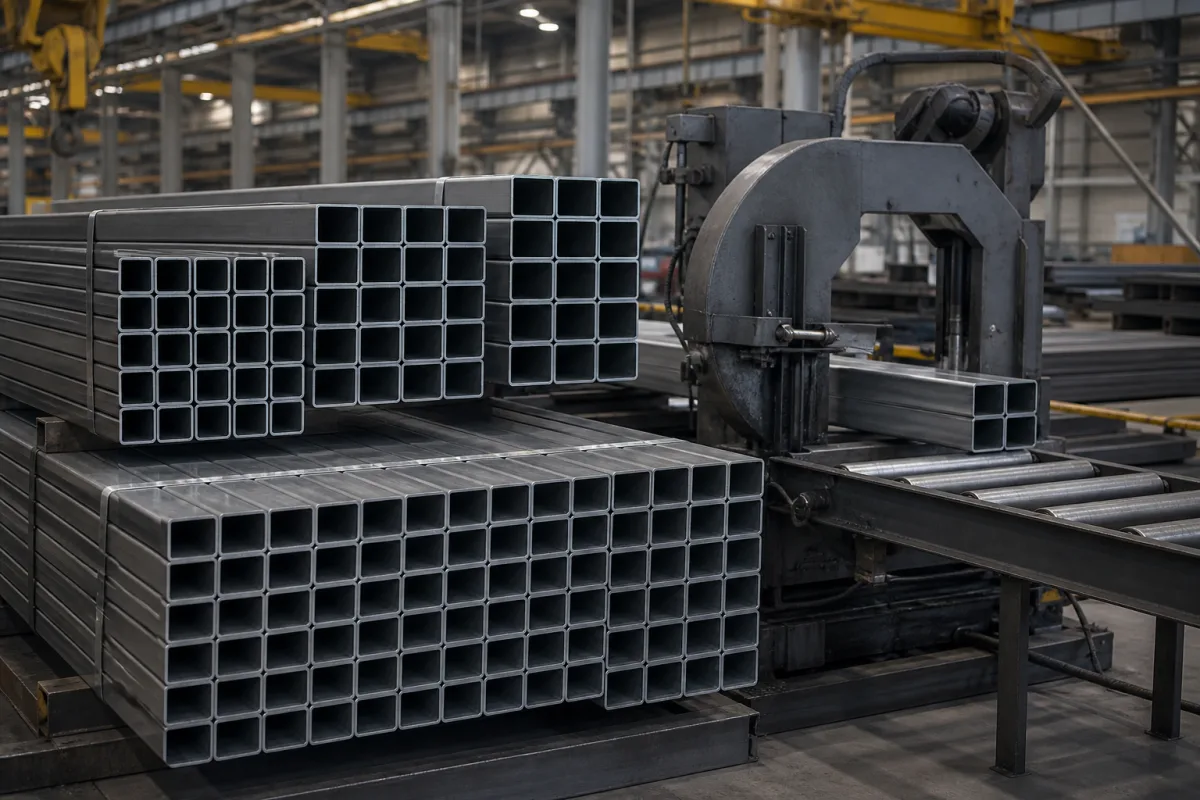
Structural hollow sections (HSS) · Square, rectangular and round cold-formed welded steel tubes to ASTM A500 Grade C or A1085: yield and tensile strength, 88 in perimeter and 1 in wall limits, thickness tolerance and design thickness, corner radius, Charpy toughness and mill lengths
Structural hollow sections (HSS) are square, rectangular or round steel tubes made for columns, beams, trusses and frames, where their closed shape gives good compression and torsional resistance. Ask three things first: which material specification and grade the design assumes, what outside size and wall thickness are needed, and which tolerances, toughness tests and finish the project requires.
Cold-formed welded square, rectangular and round structural hollow sections for buildings, bridges and general structures, mainly to ASTM A500 and A1085. Open sections such as I-beams (see structural steel I-beam) and channels (see structural steel channel section), pressure pipe and mechanical tubing are outside this page.
CNFX editorial research · Sources checked October 12, 2026 · 6 sources
The Steel Tube Institute (STI) says ASTM A500 "covers the majority of the HSS used in construction", in round, rectangular and square shapes made by cold-forming and either electric-resistance welding or a seamless process. Under the 2021 edition, "Grade C is the predominant material available", with 50 ksi yield and 62 ksi tensile strength for all shapes including rounds; "most HSS produced domestically is dual-graded for both grades B and C", and STI recommends Grade C as the default on structural notes. [1]
STI says ASTM A1085 suits cases beyond A500's capabilities: all tubes have a minimum yield of 50 ksi and a maximum of 70 ksi, which lowers the seismic overstrength factor, and a Charpy V-notch test of 25 ft-lb at 40 °F meets the AASHTO Temperature Zone 2 requirement for primary bridge members. STI notes A1085 is produced on demand and not stocked in service centres, so availability should be checked before specifying it. [1]
STI also lists ASTM A1065 for larger shapes from 12 × 12 in up to 200 in perimeter, made from two cold-formed C-halves joined by submerged arc welds, and A847 for improved atmospheric corrosion resistance; it cautions that A53 pipe is intended for mechanical and pressure applications and A513 mechanical tubing has no required physical properties. [1]
Editorial calculation: with 1 ksi = 6.895 MPa, 50 ksi is about 345 MPa, 62 ksi about 427 MPa and 70 ksi about 483 MPa; 25 ft-lb is about 34 J and 40 °F is about 4 °C. [1]
Give the supplier the ASTM specification and grade, shape, outside dimensions, wall thickness, length and quantity per size, any Charpy or seismic requirement, finish (black, galvanised or painted), mill test certificate needs and delivery.
02
Fix the size, wall thickness and tolerances
STI states that A500 covers tubes up to an 88 in total perimeter, so the largest square is 22 × 22 in, and a maximum nominal thickness of 1 in. Because of the 10% thickness tolerance, AISC 360-16 Section B4.2 requires calculations to use 0.93 times nominal thickness. The maximum corner radius for square and rectangular shapes is 3t; slenderness ratios are based on a 1.5t radius and workable flat on 2.25t. [1]
For A1085, STI gives the same 88 in perimeter and 1 in thickness limits but a minimum thickness tolerance of only −5%, so AISC allows full nominal thickness in section properties, together with a −3.5% minimum mass tolerance. [1]
Atlas Tube lists HSS squares from 0.5 to 22 in, rectangles from 1.5 × 1 in to 34 × 10 in and rounds from 0.84 to 28 in, with walls of 0.065 to 1 in and mill cut lengths of 18 to 125 ft, and publishes A500 section property tables for squares, rectangles and rounds. [2][3]
Editorial calculation: 22 in is 558.8 mm, 34 × 10 in is 863.6 × 254 mm, 28 in is 711.2 mm and an 88 in perimeter is 2,235 mm. [1][2]
03
Read the scope limits in the ASTM and EN specifications
ASTM's scope pages set the size limits the Steel Tube Institute summarises. A500/A500M-23 covers "cold-formed welded and seamless carbon steel round, square, rectangular, or special structural tubular shapes" for welded, riveted or bolted bridges, buildings and general structures, with a periphery of 88 in. [2235 mm] or less and a specified wall thickness of 1.000 in. [25.4 mm] or less; Grade D requires heat treatment. A1085/A1085M-22 covers cold-formed welded HSS only, with the same 88 in. periphery limit and a specified nominal wall of 0.148 in. [3.8 mm] or greater and 1.000 in. or less. [4][5]
The European counterpart is EN 10219-1, which specifies technical delivery requirements for cold formed welded structural hollow sections that are not heat treated afterwards, with grades and mechanical properties compatible with EN 10025-2 and EN 10025-3; tolerances and sectional properties are in EN 10219-2 [6]. An order for a European project written to A500 Grade C [1] needs a check that the grade and the tolerance standard match the design code; ask the mill which specification its certificate states.
The A1085 application list includes roll-over and falling object protective structures, offshore platforms and amusement rides [5], and STI notes A1085's tighter mass tolerance of −3.5% [1]. Atlas Tube offers wall thicknesses down to 0.065 in [3], which falls below the A1085 minimum of 0.148 in., so ask which specification thin-wall sizes are certified to.
Editorial calculation: 88 in. is 2,235 mm; for a square section that is a 22 in. (559 mm) side, and the A1085 wall range of 0.148–1.000 in. is 3.8–25.4 mm. [4][5]
Item
ASTM A500/A500M-23
ASTM A1085/A1085M-22
EN 10219-1:2006
Product
Cold-formed welded and seamless carbon steel structural tubing
Cold-formed welded carbon steel HSS
Cold formed welded structural hollow sections, no subsequent heat treatment
Values are from ASTM's scope pages for A500/A500M-23 and A1085/A1085M-22 and the Standard Norge page for NS-EN 10219-1:2006; the full standards were not reviewed.
The companies in the manufacturer list below show this product on their own websites. Confirm the legal seller, factory and scope for your order.
Ask any supplier for the specification and grade on the mill certificate, size and wall range, section property tables, thickness and mass tolerances, corner radius, straightness and twist limits, Charpy results where required, available lengths, coating options and lead time.
05
Trace what each requirement controls
This is a functional reference built from the sources cited; it is not one maker's specification.
Fill the specification fields with values for your order
An HSS quotation needs values for each member size. The table explains each field, gives published values where a reviewed source states them, and says what to obtain from the supplier.
Explore company information and manufacturing capabilities, then discuss the scope of your project with a relevant supplier.
Share this page
Compiled and source-reviewed by the CNFX editorial team.
Published product pages show what a company offers, not tested performance. Confirm the legal seller, factory and scope for your order. How we source and review
· Page last updated 13 October 2026
Buyer questions
What strength is ASTM A500 Grade C HSS?
STI gives 50 ksi yield and 62 ksi tensile for all A500 Grade C shapes, including rounds. [1]
Why do designers use 0.93 times wall thickness?
Because A500 allows a 10% thickness tolerance, AISC 360-16 requires 0.93 times nominal thickness. [1]
What does A1085 add over A500?
A 50–70 ksi yield range, a −5% thickness tolerance and a 25 ft-lb Charpy test at 40 °F. [1]
What size limits do ASTM A500 and A1085 set for HSS?
Both cover sections with a periphery of 88 in. (2235 mm) or less and a wall up to 1.000 in. (25.4 mm); A1085 also sets a minimum nominal wall of 0.148 in. (3.8 mm) and covers welded sections only, while A500 also covers seamless tubing. [4][5]
Sources and what still needs a direct check
Sources checked 2026-10-12. The Steel Tube Institute explains HSS specifications; Atlas Tube makes HSS.