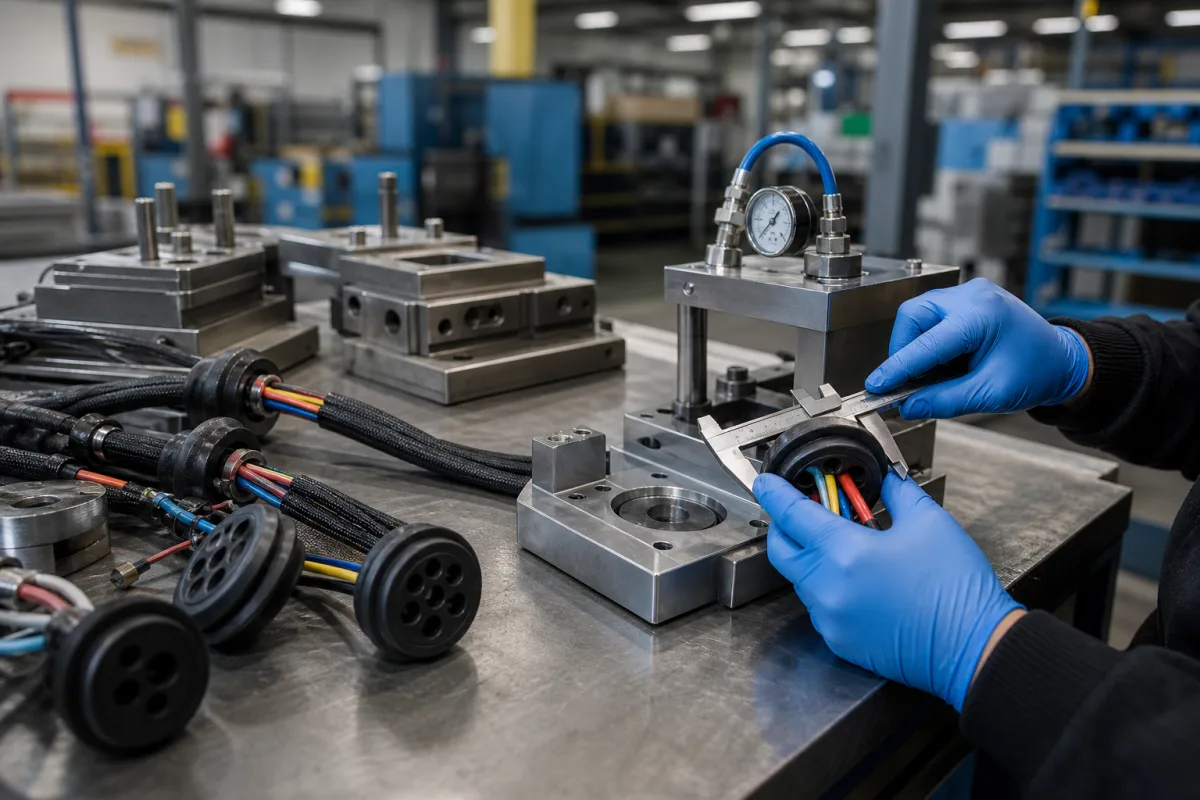
Wire harness sealing grommets for panel pass-throughs · Funnel and tubular designs, panel-groove retention and push-in force, inclined panel burrings and seating, sealing between wires with sealant, EPDM moulding, water, dust and noise sealing
A wire harness sealing grommet is a moulded rubber or elastomer part fitted on a wire harness where it passes through a hole in a panel, such as a vehicle firewall or floor or an equipment enclosure wall, protecting the wires from the hole edge and sealing out water, dust and noise. Ask three things first: what hole, panel thickness and edge shape the grommet must fit and how it is pushed in and retained, what harness diameter and wire count it must grip and seal between, and which elastomer and test requirements the environment demands.
Moulded grommets for wire harnesses and cables passing through panels in vehicles, machinery and enclosures, including funnel, tubular and multi-hole sealing grommets. Cable glands with threaded bodies, wire harness conduit and fittings (see industrial wire harness conduit fitting), edge trim strips and complete harnesses are outside this page except where compared.
CNFX editorial research · Sources checked October 12, 2026 · 5 sources
Sumitomo Wiring Systems' European application EP 1 468 877 A1 (2004) explains that a grommet mounted on the harness running from engine compartment to passenger compartment is inserted into a through-hole in the body panel to protect the harness and keep water, dust and noise out, and that grommets should install with reduced pushing force yet be held firmly afterwards. Its prior-art example has a funnel-shaped portion with a tubular portion at the narrow end and a circular groove near the wide end that engages the rim of the panel hole, the panel being held between two groove walls. [1]
US patent 5,739,475 (Sumitomo Wiring Systems and Inoac, 1998) describes grommets pulled through dash or cowl panel openings and notes that when panels are inclined, the burring around the opening can lean by 0–20° instead of standing perpendicular, leaving a clearance in the grommet's mounting groove through which water leaks; bending the harness sharply at the grommet exit widens that clearance. Its grommet, moulded from ethylene propylene rubber (EPDM), is designed to seat flush on such burrings. [2]
Editorial note: send the supplier the hole drawing — diameter or shape, panel thickness, whether there is a burring and its angle — and the direction of insertion, and ask for push-in and pull-out force figures and how full seating is checked on the line.
Give the supplier the panel hole shape and size, panel thickness and edge (flat, flanged, burred and angle), insertion direction, harness diameter or wire list (count and outside diameters), number of passages, sealing requirement (water, dust, noise; test method), temperature range, fluids exposure, elastomer preference, colour, push-in and retention force limits, tape or clamp interface on the tube, and quantities.
02
Seal the harness and choose the material
US patent 6,402,155 (Sumitomo Wiring Systems, 2002) describes grommets with a small-diameter tube that tightly holds the wire group and a conical enlarged portion with a panel-engagement recess, used on engine-compartment harnesses through the firewall and on floor harnesses. Water can still pass through the gaps between the individual wires and between the tape and the harness, so a sealant is provided between the wires; its method fills the grommet with a low-viscosity, free-flowing sealant that cures on absorbing atmospheric moisture, naming cyanoacrylates and silicones as candidates. [3]
US 5,739,475 adds that EPDM has poor adhesive strength, so its design shapes the medium-diameter portion as an inverted taper to stop a poured filler from falling out. [2]
Editorial calculation: 19 wires of an assumed 2.0 mm outside diameter packed hexagonally lie about 5 wire diameters across, so the bundle is about 10 mm in diameter; size the grommet's small tube for that bundle and ask the supplier how the gaps between the wires will be sealed. [3]
03
Read panel-thickness bands, material and temperature from a grommet catalogue
Heyco, a US maker of wire protection parts, sorts its rubber grommets by panel thickness: grommets for panels up to .063 in (1.6 mm), from .063 in (1.6 mm) to .125 in (3.2 mm) in steps of 1.6, 2.0, 2.4, 2.8 and 3.2 mm, from .125 in (3.2 mm) to .188 in (4.8 mm), and thick-panel versions. It states that these rubber grommets are SBR unless noted, with an operating temperature range of −40 °C to 105 °C, and that SBR grommets “have good water resistant characteristics and are suitable for most moderate chemicals and wet or dry organic acids”. [4] Its UL-listed thermoplastic rubber grommets come in six diameters for panels from 0.8 to 2.0 mm thick and mounting holes from 12.7 to 31.8 mm, are listed under UL file E103541, and are rated 0 °C to 50 °C. [5]
These catalogue grommets fit a single hole and wire bundle; the automotive designs in the Sumitomo patents above add a conical body, panel groove and sealed wire tube for engine-bay pass-throughs, so take sealing and insertion-force data from the harness supplier. [1][2][3]
Editorial calculation: the 1.6–3.2 mm band is covered in five sizes at 0.4 mm steps; a grommet rated −40 to 105 °C covers a span of 145 °C, against 50 °C for the UL-listed TPR line.
Heyco grommet line
Panel thickness
Material and temperature
Rubber grommets
Up to 1.6 mm
SBR, −40 to 105 °C
Rubber grommets
1.6–3.2 mm (1.6/2.0/2.4/2.8/3.2 mm steps)
SBR, −40 to 105 °C
Rubber grommets
3.2–4.8 mm
SBR, −40 to 105 °C
UL-listed thermoplastic rubber grommets
0.8–2.0 mm; holes 12.7–31.8 mm
TPR, UL E103541, 0 to 50 °C
Give the supplier the panel thickness, hole diameter, wire bundle diameter and temperature range, and ask for the material, its temperature rating and any UL or automotive approvals.
04
A moulded-rubber supplier listing wiring-system grommets
Nangong Letu lists wiring-system rubber grommets among its moulded rubber parts; ask it for the panel-groove drawing, push-in and retention forces and the sealing test that the Sumitomo designs above call for. [1]
05
Panel groove, funnel, small tube, sealant fill, lips and elastomer
Three of these features answer the leak paths the patents name: the groove for the hole rim, the lips for inclined burrings and the sealant fill for gaps between wires. [1][2][3]
Hole and panel, burring angle, push-in force, bundle grip, sealant and elastomer for a grommet order
The burring angle and inter-wire sealing rows are the ones a hole diameter alone does not cover: US 5,739,475 traces leaks to burrings leaning 0–20°, and US 6,402,155 to gaps between the wires. [2][3]
1 company lists this product among what they make. Company figures are quoted from each
company's own website; every card states where the relationship came from.
Nangong Letu Automotive Components Co., Ltd.
Manufacturing site to be confirmed for the order
Lists wiring system rubber grommets and rubber grommets and bumpers among its moulded rubber parts.
Explore company information and manufacturing capabilities, then discuss the scope of your project with a relevant supplier.
Share this page
Compiled and source-reviewed by the CNFX editorial team.
Each manufacturer above links to the page on that company's own website where the product is listed, with the date we checked it. How we source and review
· Page last updated 13 October 2026
Buyer questions
What does a wire harness grommet do?
It protects the harness in a panel through-hole and keeps water, dust and noise from passing, for example from engine compartment to cabin. [1]
Why do grommets leak on inclined panels?
A burring leaning by up to 20° leaves a clearance in the mounting groove, and sharp bending of the harness at the exit widens it. [2]
How is water stopped between the wires inside a grommet?
By filling the grommet with a sealant between the wires; one patent uses low-viscosity, moisture-curing sealants. [3]
What temperature can a rubber grommet take?
Heyco rates its SBR rubber grommets from −40 °C to 105 °C and its UL-listed thermoplastic rubber grommets from 0 °C to 50 °C. [4][5]
Sources and what still needs a direct check
Sources checked 2026-10-12. The three patents describe their applicants' grommet designs and the problems they address; Heyco's catalogue pages give its own grommet sizes and ratings. Sealing and force requirements for your application come from your own specification and the supplier's tests.