Piping components · Pressure class, temperature, type, facing and material
A flange's pressure class is not a pressure: what it allows falls as temperature rises. Pick the class from the rating table at your design temperature, the type for the loads and welding, the facing and finish for the gasket, and order the material and marking you can verify.
Forged carbon, alloy and stainless steel pipe flanges to ASME B16.5 and similar standards: weld neck, slip-on, socket weld, lap joint, threaded and blind. Sanitary clamp flanges, vacuum flanges and valve body forgings are outside this page.
CNFX editorial research · Sources checked October 11, 2026 · 8 sources
Choose the pressure class at your design temperature
Wermac explains that ASME B16.5 flanges come in Classes 150, 300, 400, 600, 900, 1500 and 2500, and that the allowable pressure falls as temperature rises. Ratings are maximum allowable working gauge pressures at the metal temperature; linear interpolation between temperatures is permitted but not between classes, and the ratings assume bolting and gaskets within the standard's limits. [2]
Engineering ToolBox tabulates Group 1.1 (ASTM A105) ratings: Class 150 allows 19.6 bar from −29 to 38 °C, 13.8 bar at 200 °C and 6.5 bar at 400 °C; Class 300 allows 51.1, 43.8 and 34.7 bar at the same temperatures. [1]
Editorial calculation from those values: a Class 150 A105 flange at 200 °C allows about 30% less than at ambient, and at 400 °C about a third of its ambient rating. Check the edition of B16.5 your project specifies and the material group of your flange.
Give the supplier the design pressure and temperature, the fluid, the pipe size and schedule, the standard and edition, and the material. Class follows from the rating table, not from the operating pressure alone.
02
Choose the flange type for strength, fatigue and welding
Wermac describes the weld neck flange's long tapered hub as reinforcement for high pressure, sub-zero or elevated temperature and repeated bending, welded with a single full-penetration butt weld and easily radiographed. A slip-on flange's strength under internal pressure is about two-thirds and its fatigue life about one-third of a weld neck's. [3]
Socket weld flanges were developed for small high-pressure piping, with the pipe withdrawn about 1.6 mm from the socket shoulder before welding; the remaining crevice can cause corrosion in some services. Lap joint flanges with stub ends can swivel for bolt alignment, but Wermac puts their fatigue life at about one-tenth of a weld neck's. [3]
03
Choose the facing and finish for the gasket
Wermac explains that raised face (RF) flanges concentrate gasket stress on a smaller area; the raised face is about 1.6 mm high in Classes 150 and 300 and about 6.4 mm in Classes 400 to 2500. Wermac states: “The typical flange face finish for ASME B16.5 RF flanges is 125 to 250 µin Ra (3 to 6 µm Ra).” Flat-face flanges mate with cast flanges and must not be bolted to raised-face flanges. [4]
Ring-type joint (RTJ) flanges, with metal ring gaskets, are, per Wermac, “typically used in high pressure (Class 600 and higher rating) and/or high temperature services above 800°F (427°C)”, and need a finer finish, 63 µin for the ring groove per Wermac. Match the finish to the gasket: Wermac's finish page specifies 125–250 µin AARH for spiral wound gaskets. [4][5]
04
Specify the material and its requirements
Wermac summarises ASTM A105 as covering forged carbon steel piping components for ambient and elevated temperature, up to 4,540 kg per forging, with minimum tensile strength 485 MPa, yield 250 MPa and maximum hardness 197 HBW. Heat treatment is not a mandatory requirement for A105 piping components, with listed exceptions that include B16.5 flanges of Classes 400, 900, 1500 and 2500. [6]
For low temperature, A350 LF2 is the corresponding carbon steel flange grade; for high temperature alloy service, A182 F11, F22 and similar grades. Ask for mill certificates that show heat number, chemistry, mechanical tests and heat treatment, and check the marking on each flange. [6]
05
A105 B16.5 flanges, EN and JIS flanges and heavy open-die forgings on supplier pages
Haihao lists A105 B16.5 forged flanges including blind, lap joint and orifice types; Epower lists flanges to ASME, EN 1092-1, DIN, JIS and other standards; Huixuan lists forged steel flanges among heavy open-die forgings; Longteng lists weld neck, slip-on and socket weld flanges alongside welding consumables. [7][8]
06
Hub, gasket face, bolt circle, flange ring and marking
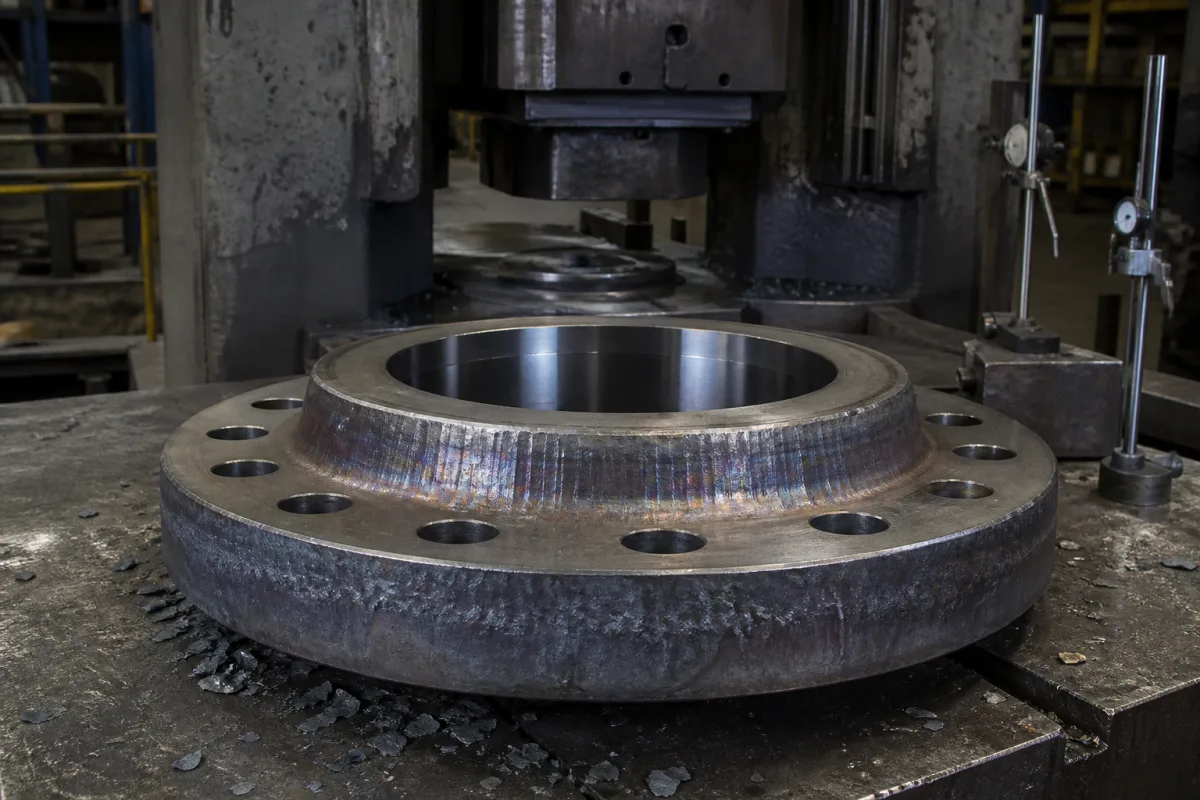
Only the hub changes with flange type: the weld neck's tapered hub is what gives it the strength and fatigue life Wermac credits it with, while the face, bolting and ring follow from class and material. [3]
Feature
Role
Fix in the order
Hub
Reinforces and transitions to pipe wall (weld neck). [3]
Size, class, bolting, face finish and material grade for a flange order
Operating pressure and temperature are read together: an A105 Class 150 flange drops from 19.6 bar at ambient to 13.8 bar at 200 °C in the Group 1.1 table, so fill both rows before choosing the class. [1]
12 companies list this product among what they make. Company figures are quoted from each
company's own website; every card states where the relationship came from.
Hebei Haihao Flange Factory
Manufacturing site to be confirmed for the order
Lists A105 ASME B16.5 forged flanges including blind, lap joint, orifice and plate flanges.
Explore company information and manufacturing capabilities, then discuss the scope of your project with a relevant supplier.
Share this page
Compiled and source-reviewed by the CNFX editorial team.
Each manufacturer above links to the page on that company's own website where the product is listed, with the date we checked it. How we source and review
· Page last updated 13 October 2026
Buyer questions
What pressure can a Class 150 flange take?
It depends on material and temperature; for A105 (Group 1.1), about 19.6 bar up to 38 °C, 13.8 bar at 200 °C and 6.5 bar at 400 °C. [1]
Weld neck or slip-on flange?
Wermac puts slip-on strength at about two-thirds and fatigue life about one-third of a weld neck; weld necks suit high pressure, temperature and cyclic loads. [3]
What surface finish should a raised-face flange have?
Wermac gives 125–250 µin Ra (about 3–6 µm) as “The typical flange face finish for ASME B16.5 RF flanges”; ring-type joints are specified at 63 µin AARH, a finer finish. [4][5]
Sources and what still needs a direct check
Sources checked 2026-10-11. Wermac.org is a long-running piping engineering reference explaining ASME B16.5 flanges. Engineering ToolBox tabulates B16.5 Group 1.1 pressure-temperature ratings. ASME B16.5 itself was not read for this page; use the edition your project specifies. Supplier pages describe their own offers.