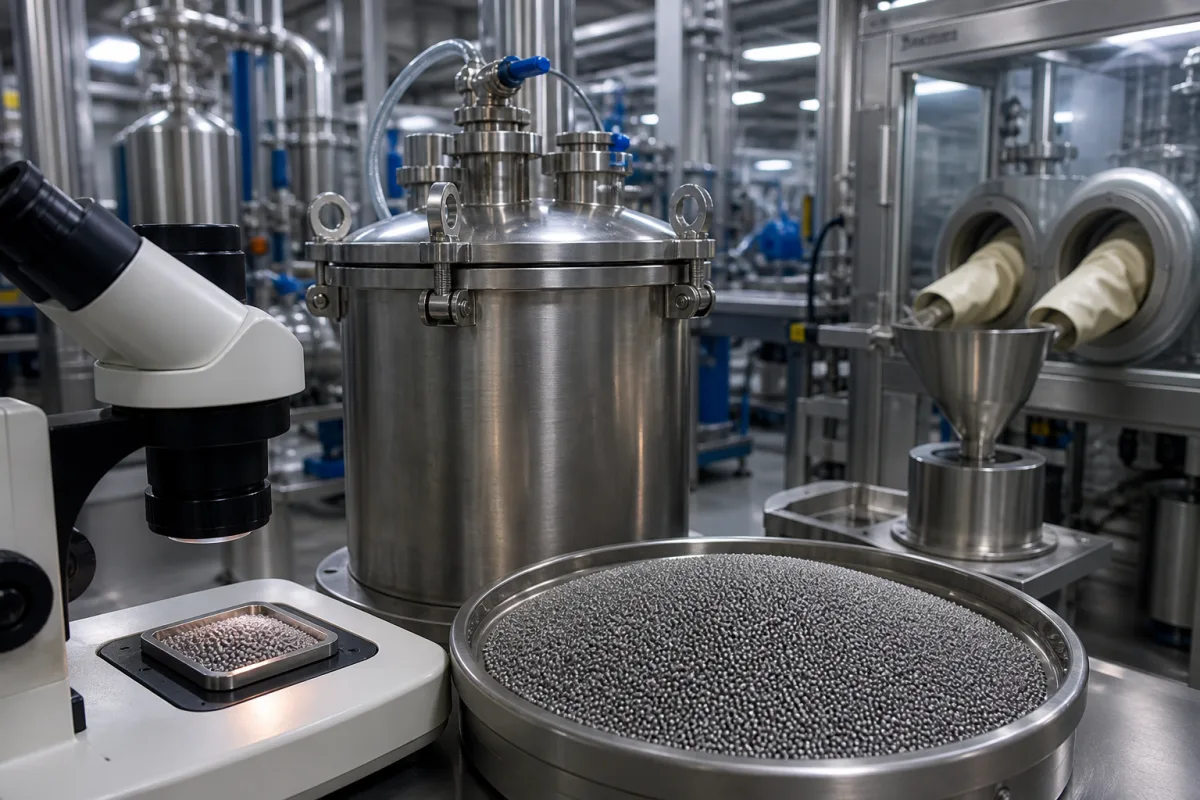
Powder metallurgy nickel superalloy powder for disks · Vacuum induction melted, argon gas-atomized prealloyed powder, sieved (e.g. −270 mesh, −53 µm), canned, outgassed and HIP compacted, then used as-HIP or extruded and isothermally forged, with thermally induced porosity (TIP) control
Forging-grade nickel superalloy powder is prealloyed, gas-atomized powder that is sieved, sealed in metal containers and consolidated by hot isostatic pressing, then used as-HIP or extruded and isothermally forged into parts such as turbine disks. Ask three things first: which alloy and specification, which melting, atomizing and sieve cut the part qualification requires, and how gas content and porosity will be controlled and tested.
Prealloyed nickel-based superalloy powders for HIP, extrusion and isothermal forging of disks and other rotating parts, with their sieving, canning and porosity control. Powders for additive manufacturing or thermal spray, wrought superalloy bar and other powders such as molybdenum disilicide (see high-purity molybdenum disilicide powder) are outside this page.
CNFX editorial research · Sources checked October 11, 2026 · 4 sources
The Superalloys 2008 paper by Honeywell and Rolls-Royce authors describes P/M Alloy 10 as an argon gas-atomized nickel-based superalloy, vacuum induction melted before atomization, sieved to −270 mesh (−53 µm), loaded into mild or stainless steel containers and subsolvus HIP compacted. It states that the industry standard practice for non-contained high-pressure turbine disks is billet extrusion plus isothermal forging, and that its programme also evaluated as-HIP compacts and HIP plus isothermal forging for small engines. [1]
The paper describes the choice of solution heat treatment below the γ′ solvus (subsolvus) for fine-grained disks or above it (supersolvus) for coarse grains with better dwell fatigue crack growth resistance at 700 °C, and dual-microstructure forgings as another option; it also notes that chromium content (studied from 11.0 to 13.5 wt%) was tied to embrittling TCP phase formation. [1]
NASA's 1980 report describes disks made from −80 mesh low-carbon Astroloy powder, loaded in mild steel cans, hot outgassed, sealed and HIP'd in argon for 3 hours at 1,190 or 1,215 °C and 103 MPa. [2]
Give the supplier the alloy and governing specification, melting and atomizing route, sieve cut and particle size distribution, chemical and gas limits (oxygen, nitrogen, argon), container and outgassing requirements, consolidation route (as-HIP, HIP plus forging, extrusion plus isothermal forging), lot size, traceability, and the inspection and TIP testing required.
02
Control gas content and thermally induced porosity
NASA explains that thermally induced porosity (TIP) is "caused by entrapped insoluble gases, principally argon", which expand during heat treatment after HIP. Argon can enter from argon-atomized particles that are hollow bubbles, from adsorbed argon if powder is not outgassed enough before pressing, or from a leaking container in the argon-filled HIP vessel; the last type gives a porosity gradient highest at the leak. [2]
The report says manufacturers' TIP specifications are based on a density change of a few tenths of a percent or on metallographic evaluation after high-temperature exposure, with acceptable pressings showing less than 0.1% spherical porosity and essentially none at grain-boundary triple points. The engine maker's TIP test in the study heated a sample at 1,205 °C for 4 hours before comparative metallography; a rejected pressing showed about 2.6% porosity at the bore against 1.4% near the rim. [2]
Editorial calculation: the bore-to-rim porosity difference in the rejected pressing was 2.6 − 1.4 = 1.2 percentage points, against an acceptance level below 0.1% porosity. [2]
03
Set the consolidation, forging and heat-treatment window
General Electric's US patent 6,521,175 (filed 9 February 1998, granted 18 February 2003, developed under a US Navy contract) describes a powder disk alloy aimed at high-pressure turbine disks operating at up to 1,500 °F (about 816 °C), against an operating limit of 1,200–1,300 °F (about 649–704 °C) it gives for René 88DT, René 95 and IN 100. It notes that alloys with high γ′ solvus temperatures are difficult to process and that some have shown thermally induced porosity. [3]
Its claimed composition is, in weight percent, about 16.0–22.4 cobalt, 6.6–14.3 chromium, 1.4–3.5 tantalum, 1.9–4.0 tungsten, 1.9–3.9 molybdenum, 0.03–0.10 zirconium, 0.9–3.0 niobium, 2.4–4.6 titanium, 2.6–4.8 aluminium, 0–2.5 rhenium, 0.02–0.10 carbon and 0.02–0.10 boron, balance nickel, with a density of about 0.301 lb/in³; higher cobalt lowers the γ′ solvus and widens the window between solvus and solidus for heat treatment. [3]
The patent's route forms powder by gas or vacuum atomization, preferably finer than −60 mesh and preferentially −140 or −270 mesh; consolidates it by extrusion at about 1,850–2,025 °F with a 3:1 to 6:1 extrusion ratio; isothermally forges in strain-controlled mode; then solution treats supersolvus at about 2,100–2,225 °F (or partially subsolvus at 2,000–2,100 °F), quenches by fan air cool, optionally followed by oil, and ages at about 1,350–1,500 °F for about 8 hours. Supersolvus processing targets a grain size of about ASTM 2 to 8, subsolvus about ASTM 9 to 12. [3]
Editorial calculation: 1,850–2,025 °F is about 1,010–1,107 °C and 2,100–2,225 °F about 1,149–1,218 °C, so the patent's supersolvus solution range overlaps the 1,190–1,215 °C HIP temperatures in the NASA study. Ask the powder supplier which consolidation route and sieve cut the alloy has been qualified for. [3][2]
Rolls-Royce's European patent EP 0 803 585 B1 (filed 14 April 1997, granted 9 February 2000) claims a disk alloy of, in weight percent, 15.0–19.0 cobalt, 14.35–15.15 chromium, 4.25–5.25 molybdenum, 1.35–2.15 tantalum, 3.45–4.15 titanium, 2.85–3.15 aluminium, 0.01–0.025 boron, 0.012–0.033 carbon and 0.05–0.07 zirconium, balance nickel. For the powder route it describes billet consolidated by HIP plus extrusion or HIP plus cogging below the γ′ solvus, near-shape isothermal or hot-die forging at up to the γ′ solvus minus 60 °C at strain rates of 1×10⁻⁴ to 1×10⁻² s⁻¹, solution treatment from solvus minus 40 °C to solvus plus 20 °C for 0.5–8 hours, cooling at 0.2–10 °C/s and ageing at 650–900 °C for 10–30 hours, aiming for a grain size of 6–45 µm with 25–35 µm preferred. [4]
The patent's Table II gives its alloys 2 and 3 a γ′ fraction of 45.7 wt% at 725 °C and a γ′ solvus of 1,157 °C, against 43.7 wt% and 1,163 °C for UDIMET 720Li; Table III lists 40–45 hours to 0.1% total plastic strain at 500 MPa and 725 °C and an ultimate tensile strength of 1,550+ MPa at 600 °C, against under 2 hours and 1,143 MPa for Waspaloy. Editorial calculation: with a 1,157 °C solvus, the patent's solution window is about 1,117–1,177 °C and its forging ceiling at strain rates up to 1×10⁻² s⁻¹ is about 1,097 °C, so ask the powder supplier for the measured solvus of each heat before the forger fixes temperatures. [4]
04
Qualification, gas limits, TIP results and canning practice to ask any powder supplier for
Ask any supplier for alloy specification and qualification status, melting and atomizing route, sieve cut and PSD, chemical, oxygen and nitrogen analysis, argon content or TIP results, cleanliness and inclusion screening, container and outgassing practice, lot traceability and capacity.
05
Vacuum induction melting, argon atomization, sieving, canning, HIP, forging and the TIP test
Argon enters at two of these steps and is caught at a third: atomization can leave hollow argon-filled particles, outgassing removes adsorbed gas before the can is sealed, and the TIP test after HIP shows what remains. [2]
Sieve cut, chemistry, γ′ solvus, HIP cycle and gas limits for a superalloy powder order
Seven of the fourteen rows have no published value in the reviewed sources, including D50, oxygen and densities, so the sieve cut, chemistry, HIP cycle and TIP limit are the rows the papers and patents can anchor. [1][2]
1 company lists this product among what they make. Company figures are quoted from each
company's own website; every card states where the relationship came from.
Gaona Aero Material Co., Ltd.
Manufacturing site to be confirmed for the order
Its website lists superalloy powders in different particle sizes, including powder for hot isostatic pressing.
Product scope checked 2026-10-12
Product page on own website · profile compiled by CNFX from public sources
Explore company information and manufacturing capabilities, then discuss the scope of your project with a relevant supplier.
Share this page
Compiled and source-reviewed by the CNFX editorial team.
Each manufacturer above links to the page on that company's own website where the product is listed, with the date we checked it. How we source and review
· Page last updated 13 October 2026
Buyer questions
How is forging-grade superalloy powder made?
For P/M Alloy 10: vacuum induction melted, argon gas atomized, sieved to −270 mesh (−53 µm) and HIP compacted in steel containers. [1]
What causes thermally induced porosity?
NASA states that TIP is "caused by entrapped insoluble gases, principally argon", which expand during heat treatment after HIP. [2]
How are turbine disks made from the powder?
The Alloy 10 paper calls billet extrusion plus isothermal forging the industry standard for non-contained high-pressure turbine disks. [1]
What extrusion conditions are used for superalloy disk powder?
GE's US patent 6,521,175 extrudes the powder at about 1,850–2,025 °F with a 3:1 to 6:1 extrusion ratio before isothermal forging. [3]
How are forging and heat-treatment temperatures set for a powder disk alloy?
Relative to the alloy's γ′ solvus: Rolls-Royce's EP 0 803 585 B1 forges at up to solvus minus 60 °C (slow strain rates) and solution treats from solvus minus 40 °C to solvus plus 20 °C for 0.5–8 hours, then ages at 650–900 °C. [4]
Sources and what still needs a direct check
Sources checked 2026-10-11. TMS published the Superalloys 2008 paper on P/M Alloy 10; NASA published a report on thermally induced porosity in HIP superalloy; General Electric's patent describes its own disk alloy and powder route. Rolls-Royce's European patent EP 0 803 585 B1 describes a second disk alloy family and its powder billet, forging and heat-treatment windows.