Editorial Technical Reference

Forging-Grade Magnesium Alloy Billet

This page explains how Forging-Grade Magnesium Alloy Billet is classified within Metal Forging, Pressing, Stamping. Technical values and manufacturer relationships are research references; confirm the current specification and supplier evidence for each order.

Technical Definition & Core Assembly

Forging-grade magnesium alloy billet is a semi-finished industrial material specifically formulated for metal forming operations including forging, pressing, and stamping.
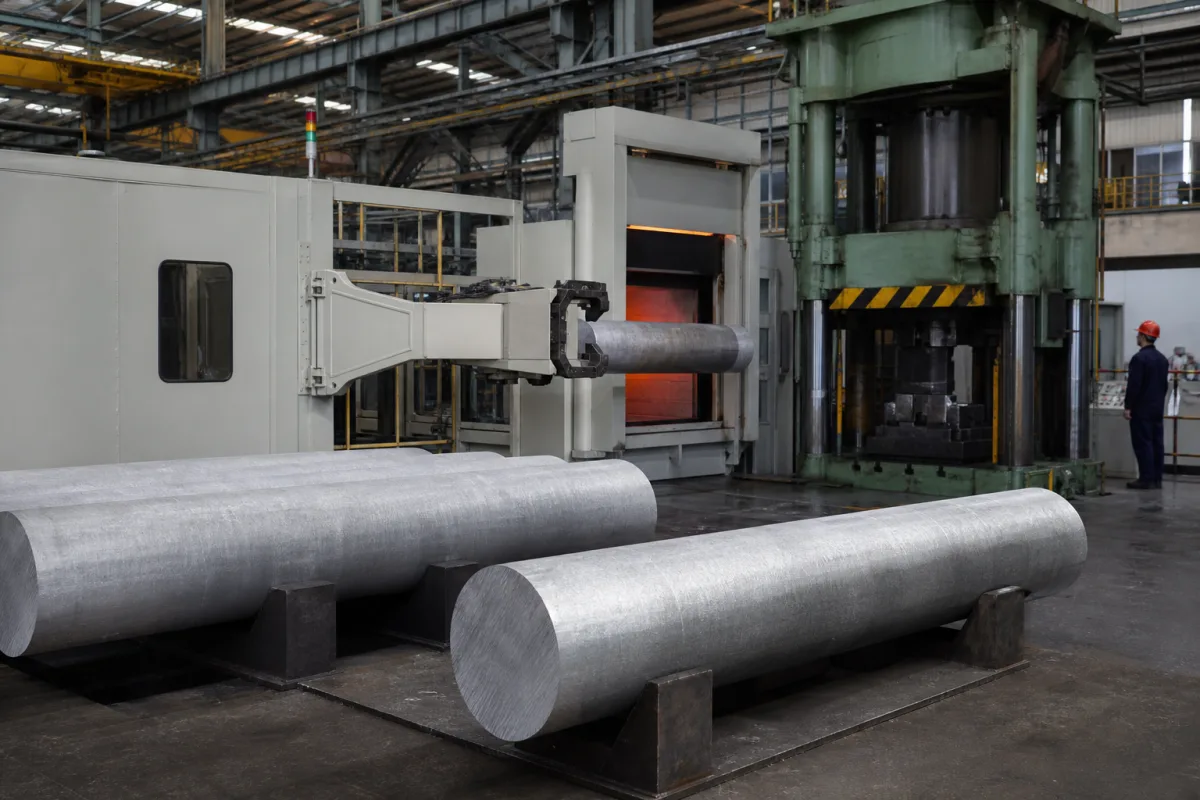
Representative product image. Confirm appearance and specifications with the manufacturer.

Product Specifications

Technical details and manufacturing context for Forging-Grade Magnesium Alloy Billet

Definition
Forging-grade magnesium alloy billet is a semi-finished industrial material specifically formulated for metal forming operations including forging, pressing, and stamping. These billets are produced through casting or extrusion processes to achieve uniform microstructure and mechanical properties suitable for subsequent deformation. They serve as the raw material input for manufacturing lightweight structural components in aerospace, automotive, and consumer electronics industries. The alloy composition is optimized for enhanced forgeability, reduced cracking, and improved mechanical performance in final forged parts.

Typical specifications for this billet include a diameter range of 80–500 mm, length from 500–3000 mm, and common alloy grades such as AZ31B, AZ61A, and ZK60A, referenced to ASTM B107. Mechanical properties at room temperature include yield strength of 200–280 MPa, tensile strength of 250–340 MPa, and Brinell hardness of 50–90 HB, all per ASTM B557 or ASTM E10. Microstructure grain size is 10–50 μm (ASTM E112), and density is 1.74–1.84 g/cm³ at 20°C. For hot forging, the recommended temperature range is 300–450°C. Surface finish is turned or peeled to Ra 1.6–3.2 μm (ISO 1302), and straightness is ≤1.5 mm/m (ISO 1101). Ultrasonic testing is available per ASTM E2375, Class A or B.

These values are reference ranges and must be verified for the specific alloy, temper, and billet dimensions required for your application. Always confirm with the legal manufacturer or supplier that the product meets your process and final part requirements, and that all relevant standards are current and applicable.
Working Principle
The billet is a pre-shaped metal stock that undergoes plastic deformation through applied force to achieve final component geometry. In forging, the billet is heated to a recommended temperature range (300–450°C) to increase ductility and reduce flow stress. It is then placed in a die and subjected to compressive forces, either by hammering, pressing, or stamping, causing the material to flow and fill the die cavity. The uniform microstructure and controlled grain size (10–50 μm) ensure consistent deformation behavior, minimizing cracking and achieving the desired mechanical properties in the forged part. After forging, the component may undergo further heat treatment or machining to meet final specifications.
Common Materials
Magnesium, Aluminum, Zinc, Manganese
Technical Parameters
ParameterTypical rangeNotes & selection driver
DiameterRequired80–500 mmCross-sectional diameter of cylindrical billet
LengthRequired500–3000 mmStandard billet length for processing
Alloy GradeRequiredAZ31B, AZ61A, ZK60A designationStandard alloy designation (e.g., AZ31B, AZ80A)ASTM B107
Yield StrengthRequired200–280 MPaMinimum yield strength at room temperatureASTM B557
Grain Size10–50 μmAverage grain diameter in microstructureASTM E112
Density1.74–1.84 g/cm³Material density at 20°CASTM B557
Tensile Strength250–340 MPaDepends on alloy and temperASTM B557
Hardness50–90 HBBrinell hardnessASTM E10
Forging Temperature300–450 °COptimal range for hot forging
Surface FinishRa 1.6–3.2 µmTurned or peeled surfaceISO 1302
Straightness≤1.5 mm/mEnsures uniform forgingISO 1101
Ultrasonic TestingASTM E2375Class A or B availableASTM E2375

Ranges are indicative industry figures for RFQ preparation, not a supplier commitment. Confirm every value and standard with the legal manufacturer before ordering.

Components / BOM
  • Alloy Matrix Part
    Primary magnesium structure providing base mechanical properties
    Material: Pure magnesium
  • Aluminum Additive Part
    Enhances strength and corrosion resistance through solid solution strengthening
    Material: Aluminum
  • Zinc Additive Part
    Improves strength and castability of the alloy
    Material: Zinc
  • Manganese Additive Part
    Enhances corrosion resistance and refines grain structure
    Material: Manganese

Industry Taxonomies & Aliases

Commonly used trade names and technical identifiers for Forging-Grade Magnesium Alloy Billet.

Industrial Ecosystem & Supply Chain Structure

Complementary Systems
Downstream Applications
Specialized Tooling

Application Fit & Sizing Matrix

Operational Limits
pressure: Up to 100 MPa (typical forging pressure), dependent on alloy grade and process
other spec: Billet diameter tolerance: ±1.5%, length tolerance: ±2%, surface finish: Ra ≤ 6.3 μm, grain size: ASTM 5-8
temperature: 250-450°C (forging range), ambient to 350°C (storage/handling)
Media Compatibility
✓ Automotive structural components ✓ Aerospace lightweight parts ✓ Portable electronics housings
Unsuitable: Marine/saltwater environments (due to corrosion susceptibility)
Sizing Data Required
  • Final part volume + 15-25% forging allowance
  • Required mechanical properties (yield strength, elongation)
  • Available forging equipment capacity (press tonnage, die size)

Reliability & Engineering Risk Analysis

Failure Mode & Root Cause
Stress corrosion cracking
Cause: Exposure to chloride-containing environments (e.g., industrial atmospheres, salt spray) combined with residual tensile stresses from forging processes, leading to crack initiation and propagation along grain boundaries.
Thermal fatigue cracking
Cause: Repeated thermal cycling during forging operations causing differential expansion/contraction, leading to microcrack formation at surface discontinuities or inclusions, exacerbated by magnesium's high thermal expansion coefficient.
Maintenance Indicators
  • Visible white powdery corrosion deposits (magnesium hydroxide) forming on billet surfaces, indicating active corrosion requiring immediate intervention.
  • Audible high-frequency cracking or popping sounds during heating/cooling cycles, suggesting internal stress relief or crack propagation that warrants immediate thermal process evaluation.
Engineering Tips
  • Implement controlled atmosphere protection (argon or SF6 gas shielding) during all thermal processing to prevent surface oxidation and chloride contamination that initiates stress corrosion.
  • Apply shot peening or laser shock peening to introduce compressive surface stresses that counteract tensile stresses, significantly improving fatigue resistance and delaying crack initiation.

Indicative industry ranges for design and RFQ preparation. Confirm the exact figures and applicable standard with the manufacturer before specifying.

Compliance & Manufacturing Standards

Applicable Standards
ASTM B91/B91M - Standard Specification for Magnesium-Alloy Forgings ISO 3116 - Magnesium and magnesium alloys - Wrought magnesium alloys DIN 9715 - Magnesium alloy forgings; technical delivery conditions

Quoted from the published standard.

Manufacturing Precision
  • Diameter tolerance: +/- 0.5% of nominal diameter
  • Length tolerance: +/- 2 mm per 100 mm of length
Quality Inspection
  • Ultrasonic Testing for internal defects
  • Chemical Composition Analysis via Optical Emission Spectrometry

Manufacturers of Forging-Grade Magnesium Alloy Billet

Manufacturer profiles associated with Forging-Grade Magnesium Alloy Billet.

Sourcing Forging-Grade Magnesium Alloy Billet from China?
Tell us your specification and target quantity — we will match it against manufacturer records and come back with the factories that fit.
Request manufacturers We manufacture this

Manufacturer listings support early research and capability understanding. They are not certification, ranking, or transaction guarantees.

Technical documentation
Request current drawings, revision history, and a signed specification sheet.
Manufacturing capability
Verify equipment lists, process limits, capacity, and representative production evidence.
Inspection readiness
Confirm test methods, calibrated equipment, sampling plans, and traceable reports.
Supplier transparency
Check the legal entity, factory address, ownership, certifications, and direct contacts.

CNFX does not score or rank suppliers. Buyers must verify all claims and documents with the legal manufacturer before ordering.

Frequently Asked Questions

What are the typical dimensions of forging-grade magnesium alloy billets?

Reference dimensions are 80–500 mm in diameter and 500–3000 mm in length. However, exact dimensions depend on the specific product and application. Always confirm with the supplier.

Which alloy grades are commonly available?

Common grades include AZ31B, AZ61A, and ZK60A, as referenced in ASTM B107. The suitability of a grade depends on the forging process and final part requirements.

What mechanical properties can be expected?

At room temperature, yield strength is typically 200–280 MPa, tensile strength 250–340 MPa, and hardness 50–90 HB. These are reference ranges and vary with alloy and temper.

What forging temperature is recommended?

The optimal hot forging temperature range is 300–450°C. Heating within this range improves formability and reduces cracking risk. Always follow the supplier's recommendations.

Data Basis

Editorial classification, named public sources where available, and source-reviewed manufacturer records.

Preliminary Technical Classification
This page supports structured research, RFQ preparation, and supplier evaluation. It does not replace buyer-led supplier qualification, standards review, or technical approval.
Buyer enquiry

Request manufacturing insight for Forging-Grade Magnesium Alloy Billet

Ask for use case, specification boundaries, supplier type, and RFQ preparation information for this product.

Where it goes
Straight to the CNFX editorial desk, and to the manufacturer if this product is linked to a claimed profile. Nothing is broadcast to a supplier list.
Your details stay here
We do not sell or rent enquiry data, and we do not add you to a mailing list. Used only to answer this request.
No commission, no middleman
CNFX is a directory. We take no cut of any order and never negotiate on a supplier's behalf.
What we don't claim
A listing is not an endorsement. Qualify every supplier and verify every figure yourself before ordering.

Your business information is used only to process this request.

Thank you! Your message has been sent. We'll respond within 1–3 business days.
Sorry, we couldn't send your message. Please try again, or email us at contact@cnfx.com.

Need to Manufacture Forging-Grade Magnesium Alloy Billet?

Compare manufacturer profiles with relevant product and process capability.

Previous Product
Precision Mechanical Stamping Press
Last Product
Get QuotesChat