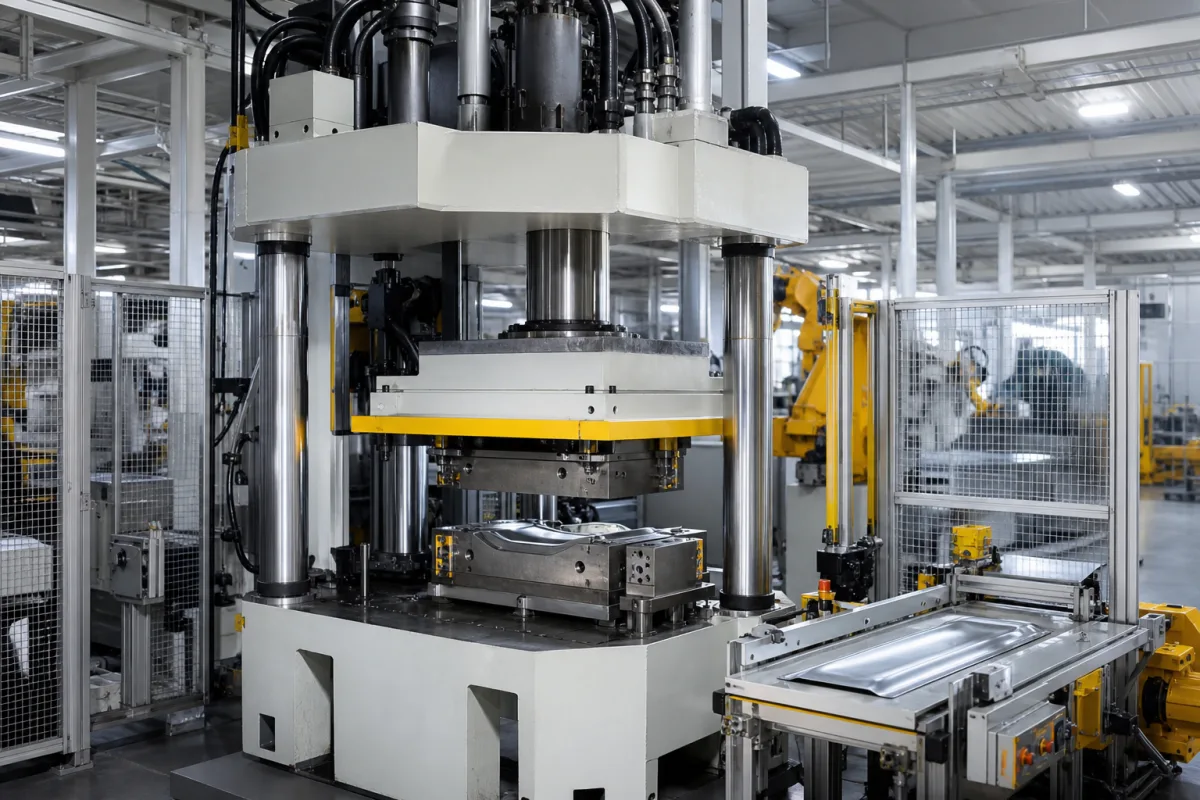
Servo-hydraulic presses for precision stamping · Servo-pump drive versus valve control, overshoot, stroke rate, energy use, slide parallelism and checking the drive type behind a 'hydraulic' label
This page covers hydraulic stamping presses whose pump is driven by a speed-controlled servo motor, used for progressive-die stamping, punching, embossing and deep drawing where stroke control and repeatability matter. Ask three things first: how the drive controls pressure and flow and what overshoot and stroke rate it achieves, how slide parallelism and positioning are held under off-centre load, and what energy use and maintenance the supplier claims against a conventional hydraulic press.
Servo-hydraulic (servo-pump) presses for precision stamping, punching, embossing and deep drawing. General-purpose hydraulic presses in C-frame, H-frame and four-column designs, including conventional valve-controlled presses, are covered on the Hydraulic press page. Mechanical crank and knuckle stamping presses, servo-mechanical presses and press brakes are outside this page.
CNFX editorial research · Sources checked October 12, 2026 · 3 sources
Compare servo-pump drive with valve-controlled hydraulics
In a servo-pump system, pressure and flow rate are controlled by a servomotor's torque and speed rather than by the choking effect of valves, so energy is supplied only when needed at the cylinder. In a project reported by Siemens, press builder Exner Pressentechnologie, which makes hydraulic presses of 200–30,000 kN, converted a press from servo-valve technology to a servo-pump driven through a Sinamics S120 drive: energy consumption fell by 50%, overshoot during adjustment fell from 10–15% on its standard presses to around 1%, and the stroke rate rose from 20 to 40 strokes per minute. [1]
In that installation ram positioning is left to Exner's own control system, which sends a speed set point to the servo-pump instead of driving a proportional valve; the control system uses a Simatic S7-315F failsafe PLC, and Siemens states the system meets safety requirements up to SIL 3 to IEC 61508 and PL e to ISO 13849-1. Less heat transfers into the structure, so less needs to be dissipated. [1]
AP&T states that its Servohydraulic® press consumes half as much energy as a conventional hydraulic press, consumes no energy when idle, has acceleration and deceleration forces 250% higher, and needs about 30% less maintenance; for its version for progressive die stamping, punching, embossing and deep drawing, built with transmission cylinder technology, it gives energy consumption up to 80% lower than a corresponding conventional AP&T hydraulic press on short and medium strokes. [2] Editorial calculation: doubling the stroke rate from 20 to 40 per minute cuts the cycle from 3.0 s to 1.5 s. [1]
Give the supplier the parts and dies (progressive, transfer or single-stage), material and thickness, required force and where in the stroke it is needed, stroke length, strokes per minute, the positioning and parallelism you need, and your energy price and duty cycle.
02
Check precision under load and the drive behind the label
AP&T states that its servo-hydraulic process can be controlled with "a great deal of precision and a high degree of parallelism between the press table and slide", that press force stays consistently high during the entire cycle and can be distributed precisely even over small surfaces, that the cushion can be pre-accelerated for sensitive materials, and that the high parallelism reduces tooling wear. [2]
Editorial note: AP&T gives no numeric parallelism value on that page; ask each supplier for slide-to-bolster parallelism and bottom-dead-centre repeatability as numbers, with the load, position and method used to measure them. [2]
Check the drive behind a 'hydraulic' label. Howfit's DDL-300T is listed as a "High Speed Hydraulic Stamping Press" of 3,000 kN with a 30 mm stroke, 100–450 SPM, 2,300 × 1,000 mm bolster and JIS special-grade accuracy, but the same page describes a crankshaft in NiCrMo alloy steel, a clutch and brake, and hydraulic preloading of the tie-rod frame, which describes a mechanical high-speed press. [3] Ask which component drives the slide before comparing stroke rates.
03
Exner, AP&T and Howfit servo-hydraulic drive results
Results come from different machines and duty cycles; use them to frame questions, not as guarantees.
Explore company information and manufacturing capabilities, then discuss the scope of your project with a relevant supplier.
Share this page
Compiled and source-reviewed by the CNFX editorial team.
Each manufacturer above links to the page on that company's own website where the product is listed, with the date we checked it. How we source and review
· Page last updated 13 October 2026
Buyer questions
What does a servo-pump change on a hydraulic press?
In the Exner–Siemens retrofit, energy use fell by 50%, overshoot fell from 10–15% to about 1%, and stroke rate rose from 20 to 40 per minute. [1]
How much energy can a servo-hydraulic stamping press save?
AP&T states half the energy of a conventional hydraulic press, and up to 80% less for its progressive-die version on short and medium strokes. [2]
How do I tell a hydraulic from a mechanical high-speed press?
Check the drive: Howfit's DDL-300T is labelled hydraulic but lists a crankshaft, clutch and brake and 100–450 SPM. [3]
Sources and what still needs a direct check
Sources checked 2026-10-12. Siemens reports a customer project; AP&T and Howfit describe their own presses.