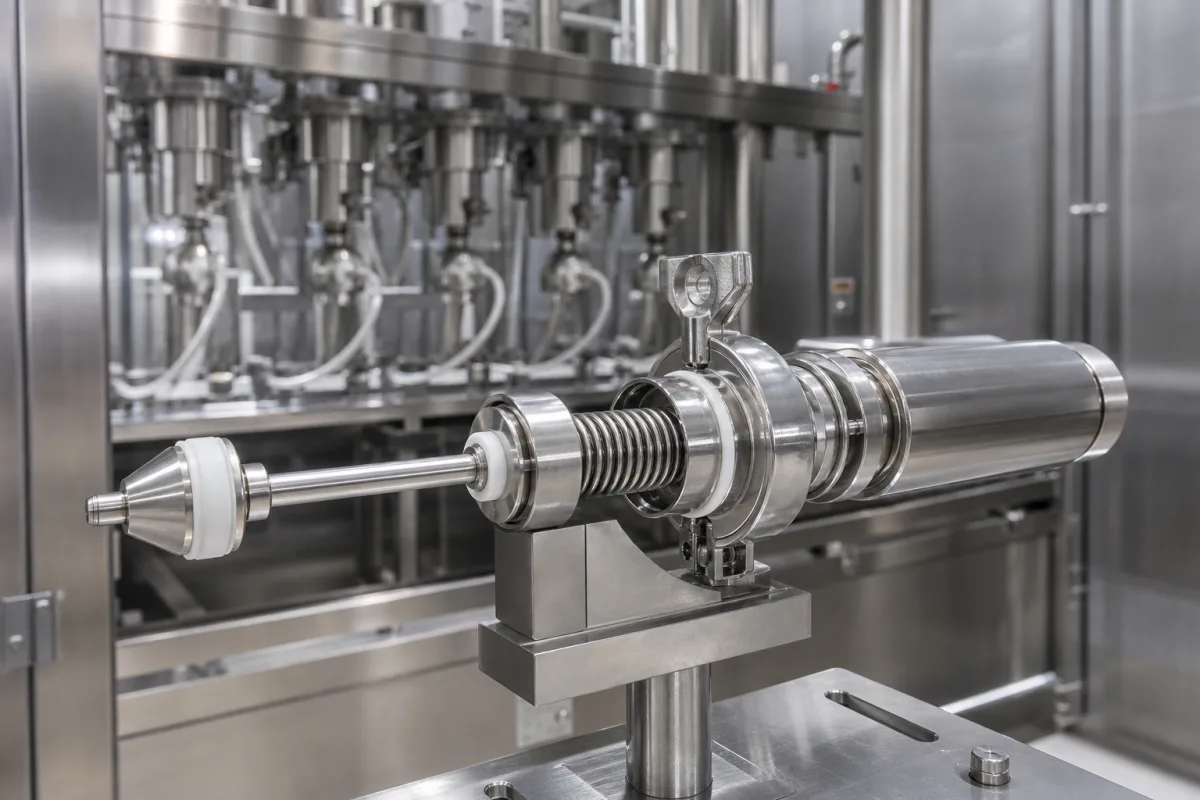
Aseptic beverage filling valve core: the replaceable stem, seal and bellows insert and its cycle life
The replaceable insert of an aseptic filling valve · stem, plug seal and PTFE bellows or P³ diaphragm as one wear unit, rated in switching cycles, and planned for exchange by counting them
Filling valves and filler-feed valves are high-cycle duties, and their moving parts are rated in millions of switching cycles. The valve core is that moving insert: the stem with its plug and seat seal, and the hermetic stem barrier, a PTFE bellows or a diaphragm, that separates the sterile product side from the actuator. It is bought and stocked as a wear unit. The questions for a buyer are which parts the insert contains, which seal materials survive the cleaning and sterilising cycle, and how many switching cycles it can be expected to last at the filler's speed.
Replaceable inner assemblies (valve cores, bellows units, stem and seal sets) of hygienic and aseptic filling and filler-feed valves for beverages and other liquid foods: their parts, materials, cycle ratings and replacement planning. Complete aseptic filling valves as valve units, with their sealing concepts, sterilisation ports and ratings, are covered on the Aseptic filling valve page; complete fillers on the Aseptic filling machine page and complete PET lines on the Aseptic cold-fill PET beverage line page.
CNFX editorial research · Sources checked October 12, 2026 · 3 sources
Stem, plug seal and PTFE bellows or P³ diaphragm packaged as one exchangeable wear unit
Makers offer the stem barrier in two forms, and in at least one design the whole set of product-wetted wear parts comes out as a single unit.
GEA states that maintenance of a VESTA valve is about ten times faster than for conventional membrane valves, that no loose parts are involved and standard tools suffice, and that PTFE bellows showing no wear at routine checks can be reused. [2] Südmo names P³, PEEK and PTFE as the materials chosen for media resistance during CIP and SIP, and states that both product side and actuator side are designed for maintenance. [1]
Editorial note: because the core is the part that is exchanged, ask whether the maker sells it as one pre-assembled unit (stem, plug, seat seal and barrier together) or as separate seals, and whether the actuator must be removed to change it.
Design
Stem barrier and seat sealing
Stated features
Südmo SVP FILL (filling and filler-feed valve)
P³ diaphragm with PEEK disc, PTFE bellows, or P³ diaphragm with PEEK ring [1]
Up to 4 cycles per second depending on pressure and size; more than 24 million cycles in internal tests; optional safety position by preloading spring; EHEDG and 3-A 53-06 compliant [1]
GEA VESTA sterile valves
Single-piece PTFE bellows that seals the stem from the atmosphere and also seals the valve seat [2]
PTFE to FDA 21 CFR 177.1550 and USP Class VI; surface finish Ra ≤ 0.8 µm; a bellows unit includes all product-contact wear parts and the parts needed to exchange it [2]
When ordering cores or spare sets, state the valve type and size, barrier type (PTFE bellows or diaphragm), seat seal and disc material (for example PEEK), the product, CIP chemicals and SIP temperature, and the certificates needed for each product-contact material.
02
Switching cycles: 24 million on test, 8 million for a bellows over a 0.21 in stroke, and what that means at filler speed
Cycle ratings are the main way to plan core exchange, but they come from tests under stated conditions and depend on stroke length.
The Fisher Controls patent describes estimating how much of a seal's life is used by counting operating cycles in bands of stem travel, dividing each count by a tested cycle life for that band and adding the ratios; the tested values can also depend on process temperature and pressure. It notes that seals may fail before scheduled replacement or be replaced long before their life is used up. [3]
Editorial calculation: 24 million cycles at the maximum 4 cycles per second is about 69 days of continuous switching; at one cycle per second it is about 278 days. A 0.21 in stroke is about 5.3 mm. These figures describe the stated test conditions, not a guaranteed service interval.
100,000 cycles per week, with 90% of seal life consumed after 9 weeks [3]
Ask the valve maker for the cycle rating of the core at your stroke, pressure and SIP temperature, how cycles are counted (valve controller or filler PLC), and the recommended inspection and exchange interval; record cycles per valve to set your own interval.
03
Data for ordering aseptic filling valve cores
Paste it into your enquiry below or into an email to a maker, then replace every bracket.
Valve: [maker, type and size; filling or feed valve]
Core: [stem barrier (PTFE bellows or diaphragm); seat seal and disc material; pre-assembled unit or seal set]
Duty: [cycles per container; filler speed; stroke; product pressure]
Cleaning and sterilising: [CIP chemicals; SIP temperature and time]
Documents: [FDA/USP/EU food-contact certificates; cycle test data]
Service: [exchange interval; cycle counting; stock per filler]
Explore company information and manufacturing capabilities, then discuss the scope of your project with a relevant supplier.
Share this page
Compiled and source-reviewed by the CNFX editorial team.
Each manufacturer above links to the page on that company's own website where the product is listed, with the date we checked it. How we source and review
· Page last updated 13 October 2026
Buyer questions
How many cycles does an aseptic filling valve core last?
Südmo reports more than 24 million cycles in internal tests of its SVP FILL; a Fisher Controls patent gives 8 million cycles as a tested bellows-seal life at a 0.21 in stroke. Both are test figures under stated conditions. [1][3]
What is inside a filling valve bellows unit?
GEA states that a VESTA bellows unit includes all product-contact wear parts of the valve and the components needed to exchange it quickly. [2]
How can bellows replacement be planned?
By counting stem cycles in travel bands and dividing by tested cycle lives, as described in a Fisher Controls patent, then projecting remaining life from the cycle rate. [3]
Sources and what still needs a direct check
Sources checked 2026-10-12. Pentair Südmo and GEA describe their own valves; the cycle-counting method and its example figures come from a Fisher Controls International patent.