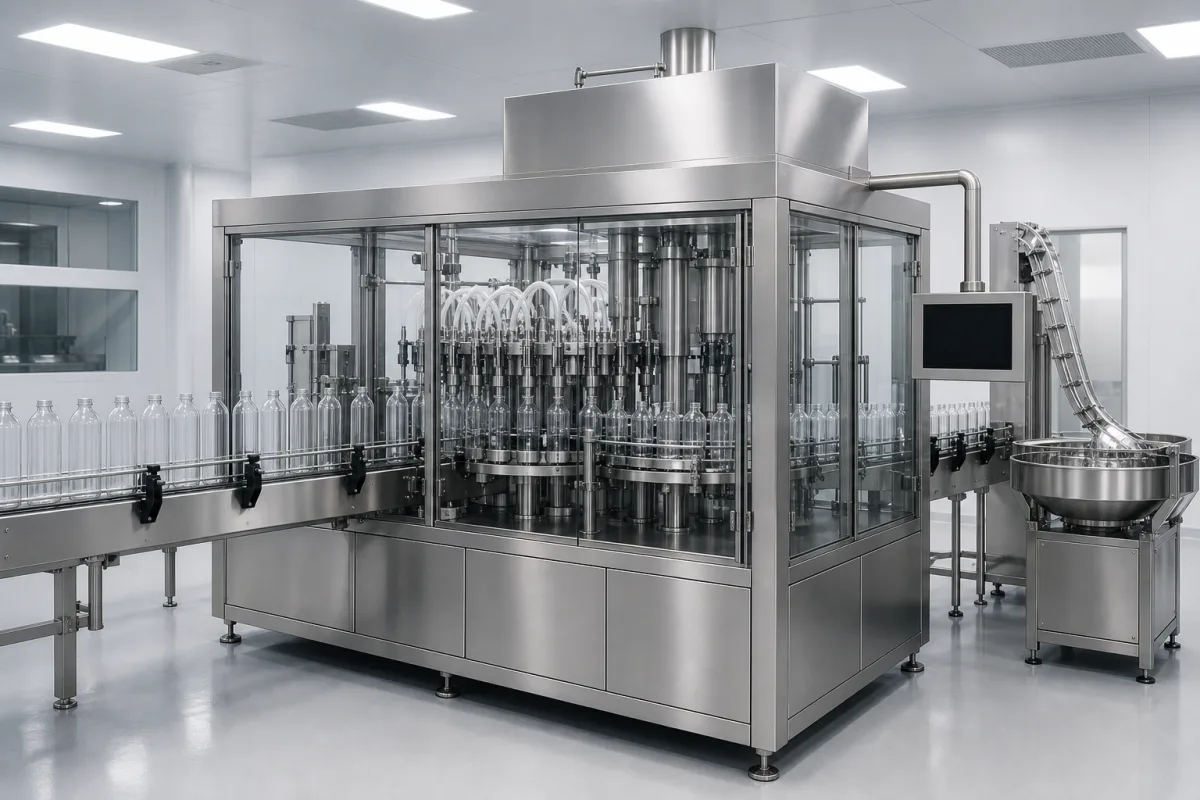
Aseptic packaging · Container sterilization records, loss-of-sterility response, sterile air zones and package formats
An aseptic filling machine fills commercially sterile product into sterilized containers and closes them inside a sterile zone. Ask three things first: how containers, closures and the filling zone are sterilized and recorded, what the machine does when sterility is lost, and which package format, size and speed it handles.
Aseptic filling machines for liquid and semi-liquid foods and beverages: bottles, pouches, sachets, bag-in-box and bag-in-drum fillers. Product sterilizers (UHT), liquid-nitrogen dosers and other accessories, and non-aseptic hot or cold fillers are outside this page.
CNFX editorial research · Sources checked October 12, 2026 · 4 sources
Prove container sterilization and respond to loss of sterility
US regulations for aseptic food processing and packaging (21 CFR 113.40(g)) require the container and closure sterilization system and the filling and closing system to be instrumented to show that sterilization is achieved continuously, with recording of sterilant flow, temperature, concentration or other factors; a timing method for container retention in the sterilant with protection against unauthorized speed changes; and both systems brought to commercial sterility before packaging starts. [1]
If packaging conditions fall below the scheduled process, the system must stop packaging or segregate the product, for example by diverting product away from the filler or stopping containers entering, and must be returned to commercial sterility before restarting. Operating conditions should be recorded at intervals not exceeding 1 hour, critical factors at intervals not exceeding 15 minutes, and incubation tests run on samples from each code. [1]
One maker's bag-in-box aseptic filler (Jiangsu Lazen, single-head BIB) shows how a food filler keeps the filling zone sterile in practice: pre-sterilized aluminium-plastic composite aseptic bags of 1–50 L are uncapped, filled and recapped by a mechanical hand inside an aseptic chamber that is held sterile with steam; the flexible joints of the product pipe carry steam shields, a condensate collector prevents drips, and metering is by weighing or by flow meter. Product-contact construction is SUS304 or 316L stainless steel. [3]
Editorial note: for a steam-barrier filler, ask how steam temperature at the filling head and the shielded joints is measured and recorded, so that the records required for container and filling-zone sterilization can be produced from the machine. [3][1]
Give the supplier the product and its sterilization, package type and size, output, container and closure sterilant and method, sterile-zone design, CIP/SIP, records and data integrity needs, the regulations to meet, and validation support required.
02
Use the sterile-medicine Grade A zone as a reference for clean air
EU GMP Annex 1 (2022) for sterile medicinal products defines Grade A as the critical zone for high-risk operations such as aseptic filling; Annex 1 names localised airflow protection, such as unidirectional airflow workstations within RABS or isolators, as the means of providing these conditions. Grade A allows at most 3,520 particles of 0.5 µm or larger per m³ both at rest and in operation, and unidirectional airflow should give a homogeneous 0.36–0.54 m/s at the working position unless otherwise justified. [2]
Editorial calculation: 3,520 particles per m³ is about 3.5 particles per litre of air, and 0.36–0.54 m/s over 1 m² of filling zone moves about 1,300–1,940 m³ of filtered air per hour. [2] Food fillers are governed by their own rules and scheduled process; ask the supplier which air class and airflow the sterile zone is designed and qualified to.
03
Compare packaging-material sterilants by log reduction
US patent 4,494,357 A, assigned to International Paper Co (priority 1981), challenged polyethylene-coated paperboard with a 10⁸ Bacillus subtilis var. niger spore inoculum per site and measured log reductions for the sterilants used on aseptic packaging material. Immersion for 10 s in 30% hydrogen peroxide alone gave a 0.7 log reduction and heat alone 0.9; peroxide followed by heating for 9 s to below 100 °C, a limit set to avoid melting the polyethylene layer, gave 5.8. High-intensity UV-C at 254 nm gave 2.9–3.4 log, and the patent's method, 15 s of 20 kHz sonication at 6.5–7 W followed by 15 s of UV-C at 6 in from the lamp, gave 5.3–5.4, averaging 5.1 over five days. Reversing the order, UV then sonication, gave 2.8. [4]
Editorial calculation: a 5.8 log reduction leaves about 1.6 survivors per million spores on the surface, and 5.1 log about 7.9 per million. The patent's tables show final loads of 8.71 × 10² and 8.24 × 10² spores for these two treatments, so neither reached zero survivors. The order of steps mattered as much as the agents: sonication before UV-C gave 2.5–2.6 log more than after it. [4]
Editorial note: ask the filler supplier which sterilant, concentration, temperature and contact time it uses on your packaging material, which test organism and challenge level it validated against, and the log reduction achieved, so the figures can be tied to the records required under 21 CFR 113.40(g). [4][1]
Beverage lines, bag-in-box, pouch and sachet fillers
Tech-Long and Victorystar list bottled-beverage aseptic lines, Lazen lists bag-in-box and bag-in-drum fillers, and Mingjia and Zhongrui list pouch and sachet fillers.
Tech-Long lists aseptic filling lines for bottled beverages; Victorystar lists double-head aseptic fillers with UHT sterilizers; Lazen lists bag-in-box and bag-in-drum aseptic fillers; ZenoPack, Jump, Triowin and Golden Feedmill list aseptic fillers with fruit and food processing lines; Mingjia lists aseptic and spout-pouch fillers; Zhongrui lists dual-channel aseptic fillers for sachets.
05
Sterilizer, sterile zone, filling valves, speed lock and divert logic
Three of the five rows come straight from 21 CFR 113.40(g); the sterile zone row draws on Annex 1 and the Lazen bag filler.
Package size, speed, accuracy and sterilization conditions for the quotation
Product, package and output come from your line. Only the package size, accuracy and sterilization rows carry published references here; the rest must come from the supplier.
Field
What it means and published values
Ask the supplier for
Filling capacity (mL)
Package size range; e.g. 1–50 L aseptic bags on one bag-in-box filler. [3]
Sizes and change parts.
Filling speed (containers/h)
Rated output.
Output per format.
Filling accuracy (%)
Fill weight or volume; weighing or flow-meter metering on one filler. [3]
Accuracy and method.
Operating pressure (MPa)
Utilities and zone pressure.
Pressures.
Sterilization temperature (°C)
Sterilant or steam conditions, recorded; steam-held chamber on one filler. [1][3]
Conditions and records.
Electrical supply (V AC)
Site supply.
Voltage.
Power consumption (kW)
Machine load.
Power.
Ingress protection
Wash-down.
Rating.
Machine weight (kg)
Floor loading.
Mass.
Footprint (L×W×H) (mm)
Layout.
Dimensions.
07
Send the product, package and sterility data together
Paste it into your enquiry below or into an email to a maker, then replace every bracket.
Product: [type; viscosity; particulates; sterilization method]
Package: [bottle, pouch, bag-in-box or drum; size; closure]
Output: [containers per hour]
Sterility: [container sterilant; zone design; CIP/SIP]
Records: [sterilant flow, temperature, concentration; data logging]
Compliance: [regulations; validation support]
9 companies list this product among what they make. Company figures are quoted from each
company's own website; every card states where the relationship came from.
Explore company information and manufacturing capabilities, then discuss the scope of your project with a relevant supplier.
Share this page
Compiled and source-reviewed by the CNFX editorial team.
Each manufacturer above links to the page on that company's own website where the product is listed, with the date we checked it. How we source and review
· Page last updated 13 October 2026
Buyer questions
What must an aseptic filler record?
Under 21 CFR 113.40(g), sterilant flow, temperature, concentration or other factors, container rates through the sterilizer, and operating conditions at intervals not exceeding 1 hour. [1]
What happens if sterility is lost during filling?
The system must stop packaging or segregate product, then return to commercial sterility before restarting. [1]
How clean is a Grade A filling zone?
For sterile medicines, Annex 1 allows at most 3,520 particles ≥0.5 µm per m³, with 0.36–0.54 m/s unidirectional airflow as guidance. [2]
How does a bag-in-box aseptic filler keep the filling zone sterile?
One maker's filler opens, fills and recaps pre-sterilized 1–50 L bags inside a steam-held aseptic chamber, with steam shields on the product pipe joints. [3]
How effective is hydrogen peroxide on aseptic packaging material?
In International Paper's US patent 4,494,357 A, 30% hydrogen peroxide alone gave a 0.7 log reduction of Bacillus subtilis spores on coated paperboard, but peroxide followed by 9 s of heating below 100 °C gave 5.8. [4]
Sources and what still needs a direct check
Sources checked 2026-10-12. 21 CFR 113 is a US Food and Drug Administration regulation; EU GMP Annex 1 is European guidance for sterile medicinal products, used here as a reference for clean-air zones; International Paper's US patent 4,494,357 A reports spore log reductions for packaging-material sterilants.