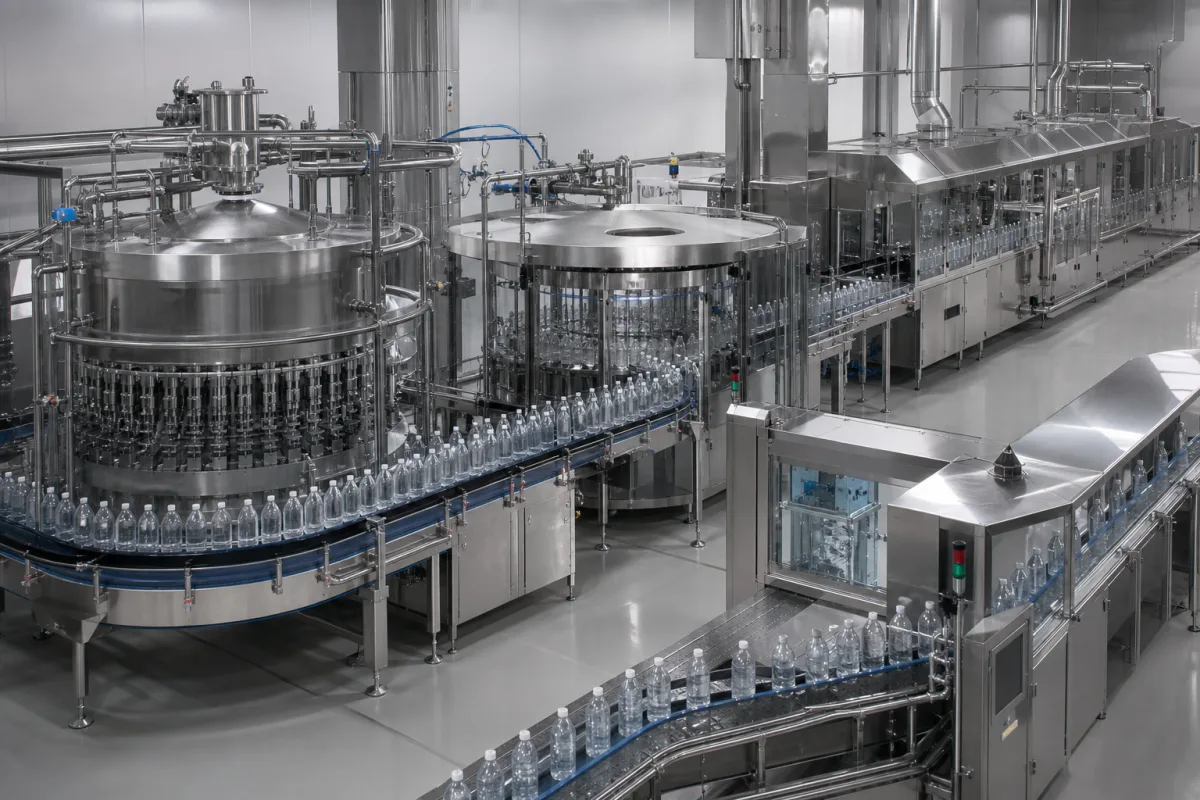
Aseptic cold-fill PET beverage line (complete production system)
Complete PET bottle lines · Preform and bottle decontamination, H₂O₂ residue limit, product sterilizer sizing, run length and media-fill evidence
An aseptic cold-fill (ACF) beverage production system is the complete PET bottling line that keeps a commercially sterile drink sterile all the way into a sealed bottle without hot filling: a product sterilizer and cooler, a sterile buffer, preform or bottle decontamination, an aseptic filler and capper inside an isolator, sterile air, and CIP/SIP for the product path. Ask three things first: where and how the line decontaminates preforms, bottles and caps, how large the product sterilizer must be for the bottle rate and size, and what media-fill and run-length evidence the supplier can show.
Complete aseptic cold-fill lines for still beverages in PET bottles, from the product sterilizer to the capped bottle, including preform or bottle decontamination, the isolator and its utilities. Stand-alone aseptic filling machines, including pouch, bag-in-box and bag-in-drum fillers, are covered on the Aseptic filling machine page. Hot-fill lines, pharmaceutical aseptic syringe and vial lines, and carton aseptic systems are outside this page. Bought as a separate machine, the peroxide sterilizer that treats empty bottles or preforms ahead of the filler has its own page, Hydrogen peroxide bottle sterilizer for aseptic PET filling.
CNFX editorial research · Sources checked October 12, 2026 · 5 sources
Choose where the line decontaminates containers: preform, bottle or both
A PET cold-fill line can sterilize the preform before blow moulding, the blown bottle, or both. Tech-Long's product range separates bottle chemical wet sterilization, preform chemical dry sterilization, bottle physical dry sterilization and combined dry-and-wet sterilization as distinct modules. [3] DNP's Two-Step Sterilization decontaminates both the preform and the bottle with dry hydrogen peroxide, uses residual heat from blow moulding, and is listed at up to 72,000 bottles per hour. [2]
Where hydrogen peroxide is the sterilant in the United States, FDA's 21 CFR 178.1005 defines the solution as not more than 35% hydrogen peroxide by weight, lists polyethylene terephthalate polymers complying with § 177.1630 among the food-contact surfaces it may treat, and requires the treatment to reach commercial sterility at least equivalent to thermal processing of metal containers under part 113. [1]
The same section sets the residue limit: use is not in compliance if more than 0.5 part per million of hydrogen peroxide can be determined in distilled water packaged under production conditions, with the assay performed immediately after packaging. [1] Suncrown's dry aseptic cold-fill system sterilizes bottles and caps with hydrogen peroxide dry mist and lists its sterilization efficiency as ≥6. [4] Editorial note: ask which log reduction, which test organism and which container zones that figure refers to.
Give the supplier the beverages (pH, pulp or particles, low- or high-acid), bottle sizes and neck finishes, preform weight, target bottles per hour, cap type, sterilant preference (wet, dry H₂O₂, or physical), target markets and the regulatory filings the line must support.
02
Size the product side and ask for run-length and media-fill evidence
The product sterilizer and sterile buffer must keep up with the filler. In a DNP case study, Asahi Breweries' Nagoya line uses H₂O₂ gas for bottles and a UHT sterilizer supplying product for filling at up to 54,000 bottles per hour of 500 ml; media-fill tests of over 30,000 bottles confirmed sterility, and DNP's combined CIP/SIP runs in under two hours. [2]
Editorial calculation: 54,000 bottles/h × 0.5 L = 27,000 L/h of sterile product delivered to the filler, before rinse losses or start-up volumes; at 36,000 bottles/h of 500 ml the figure is 18,000 L/h.
DNP's tea case shows a different product route: concentrated tea extract is sterilized in a compact UHT unit and diluted with sterile water produced without heat by UV lamps and filters, filling 500 ml bottles at 36,000 bottles per hour; media-fill tests of over 10,000 bottles showed zero spoilage, and DNP reports roughly 80% lower energy use and CO₂ emissions. [2]
Run length is a property of the isolator design: Tech-Long states that its aseptic isolation design can run low-acid products continuously for more than 96 hours. [3] Suncrown states that its filling zone is held at Class 100 with HEPA-filtered air [4], and Best Crown keeps the filling environment at positive pressure with aseptic compressed air and cleans the product pipework by CIP and SIP. [5]
03
Compare line sizes suppliers publish
Published line ratings are tied to a stated bottle size; compare them at the same volume.
Editorial calculation: the GWJX36/9 moves 20,000 × 0.5 = 10,000 L/h at 500 ml but 3,500 × 1.5 = 5,250 L/h at 1,500 ml, so check the rating at your largest bottle, not only the headline rate.
Sterilization is where these lines differ: one sterilizes, fills and caps PET bottles inside an aseptic isolator at ambient temperature, one uses H₂O₂ dry sterilization, and one pairs its aseptic cold filling line with CIP/SIP.
Guangzhou Tech-Long Packaging Machinery Co., Ltd.
Manufacturing site to be confirmed for the order
Lists aseptic filling lines for PET bottles at ambient temperature, with bottle sterilization, filling and capping in an aseptic isolator.
Explore company information and manufacturing capabilities, then discuss the scope of your project with a relevant supplier.
Share this page
Compiled and source-reviewed by the CNFX editorial team.
Each manufacturer above links to the page on that company's own website where the product is listed, with the date we checked it. How we source and review
· Page last updated 13 October 2026
Buyer questions
How much hydrogen peroxide may remain in a bottle?
Under FDA's 21 CFR 178.1005, not more than 0.5 ppm in distilled water packaged under production conditions, assayed immediately after packaging. [1]
How fast are aseptic cold-fill PET lines?
Published ratings include 18,000 to 56,000 bottles per hour (Suncrown) and up to 72,000 (DNP), each at a stated bottle size. [4][2]
How long can such a line run between sterilizations?
Tech-Long states more than 96 hours on low-acid products for its isolator design; ask each supplier for its own figure. [3]
Sources and what still needs a direct check
Sources checked 2026-10-12. FDA's regulation sets the hydrogen peroxide limits for packaging sterilization in the United States. DNP, Tech-Long, Suncrown and Best Crown are line builders describing their own systems.