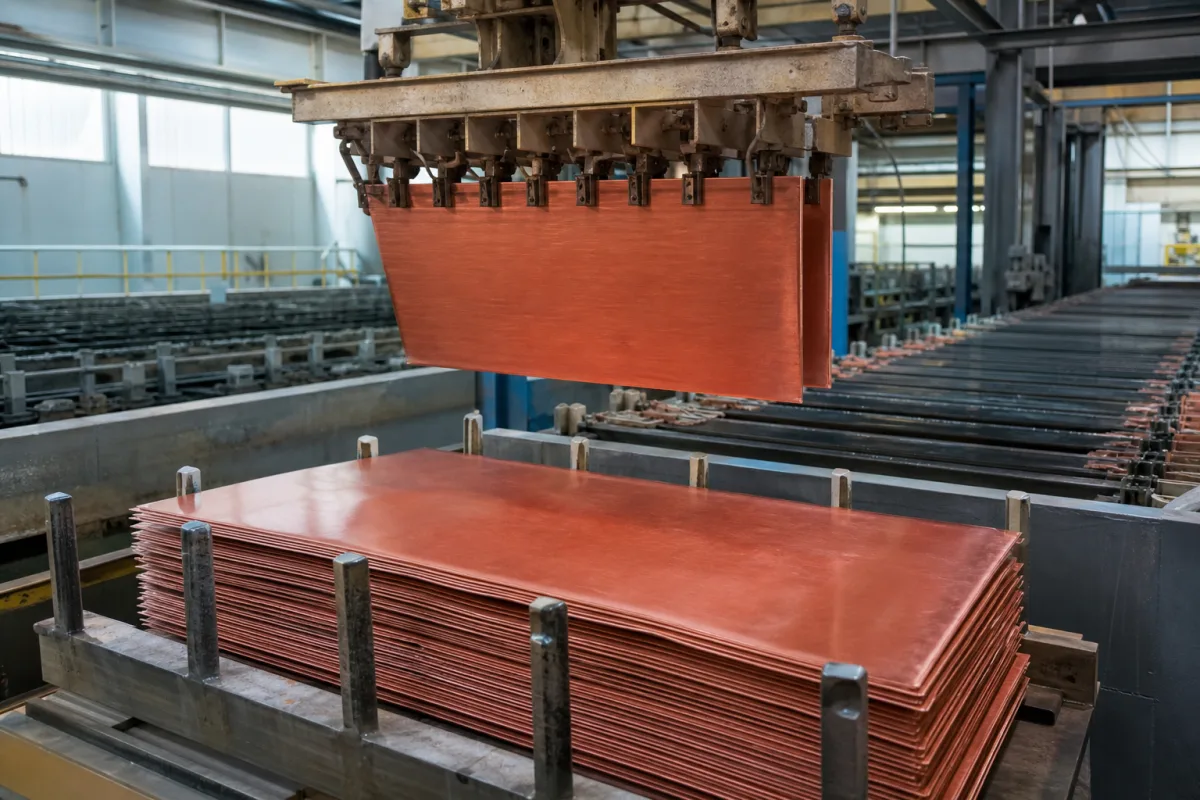
Electrolytic copper cathode as traded refined copper · Electrorefining of fire-refined anodes or electrowinning after solvent extraction, cathode purity, exchange grades and prices, US supply and tariff lines, and what to check in each lot
Copper cathode is the plate of refined copper produced by electrolysis, either by electrorefining anodes cast from smelted and fire-refined copper or by electrowinning copper from leach solutions. It is the standard traded form of refined copper and the feed for rod, wire, tube and alloy mills. Ask three things first: which production route and grade the cathode is, how its purity and impurities are certified for each lot, and which exchange or contract terms set price and acceptance.
Electrolytic copper cathode (electrorefined and electrowon) traded as refined copper for melting into rod, wire, tube, sheet and alloys. Copper anodes, blister copper, copper scrap, copper rod (see copper rods) and copper master alloys are outside this page except where compared.
CNFX editorial research · Sources checked October 12, 2026 · 4 sources
EPA's background report for AP-42 Section 12.3 (Primary Copper Smelting) states that smelting produces blister copper of 97 to 98.5% purity, which is purified by fire refining and electrolytic refining. In fire refining, blister copper with flux is held at 1100°C, air is blown through to oxidise impurities into slag, the copper oxide is then reduced, and the copper is cast into anodes. In electrolytic refining the anode dissolves in a copper sulfate and sulfuric acid electrolyte and copper deposits at the cathode, while metallic impurities fall as sludge; cathode copper of 99.95 to 99.96% purity is then cast into bars, ingots or slabs. [1] Editorial note: that 99.95–99.96% is EPA's description of what the industry's electrolytic refining produces, not a contract limit; the LME Grade A rules below are a delivery standard that caps impurities instead, at 0.0065% in total for the elements listed. [3]
The same report describes solvent extraction/electrowinning (SX-EW) as an increasingly important alternative: dilute sulfuric acid is percolated through copper-bearing ore, the copper is concentrated by solvent extraction and recovered by plating onto a starter cathode. It lists gold, silver, antimony, arsenic, bismuth, iron, lead, nickel, selenium, sulfur, tellurium, tin and zinc among the impurities in blister copper. [1]
Editorial note: ask for the cathode's grade designation and a certificate of analysis listing copper and the impurity elements your product is sensitive to, for each lot.
Give the supplier the grade and standard or exchange specification required, production route (electrorefined or electrowon) if it matters, impurity limits critical to your product (for example for wire drawing or alloying), lot size, cathode format and bundling, certificate of analysis contents, weighing and sampling method, packing and marking, delivery terms and pricing basis.
02
Check market references, supply and tariff
USGS's Mineral Commodity Summaries 2025 (copper) reports that in 2024 US copper was processed at 2 primary electrolytic refineries and 14 electrowon refineries, with primary refinery production of about 850,000 t and secondary of about 40,000 t; refined copper made up 88% of unmanufactured copper imports, and USGS gives its import sources for 2020–23 as Chile (65%), Canada (17%), Mexico (9%), Peru (6%) and other (3%). It lists annual average prices for the US producer cathode (COMEX + premium, 430 cents/lb), COMEX high grade (420) and LME grade A cash (420) for 2024, and a 1% ad valorem tariff on refined copper and alloys, unwrought (HTS 7403.00.0000), with unrefined anodes duty-free. [2]
Editorial calculation: 420 cents per pound is 4.20 × 2,204.62 ≈ US$9,260 per tonne, and the US producer cathode price of 430 cents/lb is about US$9,480 per tonne; the USGS producer cathode series is quoted as COMEX plus a premium, so ask how the premium in your contract is set. [2]
03
Write the Grade A impurity limits into the purchase contract
The London Metal Exchange's Special Contract Rules for Copper Grade A give chemistry tables for three cathode standards: BS EN 1978:2022 (grade Cu-CATH-1), GB/T 467-2010 (Cu-CATH-1) and ASTM B115-10 (2021) cathode Grade 1. Each table sets maximum impurity levels and gives no separate copper figure. Under the BS EN 1978 table, the elements other than copper may total no more than 0.0065%. Editorial calculation: 100 − 0.0065 = 99.9935% copper if no element outside the table is present. That is not comparable one-for-one with EPA's 99.95–99.96% [1]: EPA describes the industry's refined product, while the LME figure is a ceiling on listed impurities for exchange delivery. Individual caps include silver 0.0025%, sulfur 0.0015%, iron 0.0010%, lead 0.0005%, arsenic 0.0005% and antimony 0.0004%, and bismuth, selenium and tellurium are each held to 0.00020%. The LME notes that sulfur shall be determined on a cast sample. [3]
The LME rules also set group limits. (As + Cd + Cr + Mn + P + Sb) may total no more than 0.0015%, (Bi + Se + Te) no more than 0.0003%, and (Co + Fe + Ni + Si + Sn + Zn) no more than 0.0020%. The ASTM B115 Grade 1 table reproduced by the LME is tighter on bismuth (0.00010%) and also names nickel (0.0010%) and tin (0.0005%) individually, with the same 0.0065% allowable total. [3] Editorial note: name the standard and edition in the contract, and ask for a certificate of analysis that reports every element in the chosen table, including the group sums.
Aurubis publishes the format and analysis of its LME-registered cathode brands NA-ESN, HK, OLEN and PIRDOP, which it states comply with ASTM B115 Grade 1, EN 1978 and Cu-CATH-1. Each cathode is about 906 to 1,020 mm wide, 965 to 1,060 mm long and 5 to 10 mm thick, and weighs 50 to 70 kg (50 to 80 kg for PIRDOP). Its published analysis in ppm is Ag 10–17, S <5, Fe <2, Pb <1, Bi <0.5, As 1, Sb 1, Ni 1, Se <0.5 and Te <0.5. Editorial calculation: against the LME Grade A limits above, 0.0025% Ag is 25 ppm, 0.0015% S is 15 ppm, 0.0010% Fe is 10 ppm and 0.0005% Pb is 5 ppm, so each published Aurubis value sits below the corresponding limit. [4]
Route, purity, impurities, exchange grade, price basis and tariff line
The first three rows come from EPA's account of how cathode is made; the last three come from USGS's market data, where the price basis is an exchange quote plus a premium. [1][2]
Purity, conductivity, oxygen, sheet size and impurity totals for a cathode purchase
Sheet thickness, weight and dimensions use Aurubis's published cathode format as the example; conductivity, oxygen content and flatness have no figure in the reviewed sources and need the supplier's test certificate. [4]
Field
What it means and published values
Ask the supplier for
Copper Purity (%)
99.95–99.96% electrorefined, EPA's description of the industry's product. [1] LME Grade A gives no copper figure, only listed impurities ≤0.0065% in total; Editorial calculation: ≥99.9935% Cu if no unlisted element is present. [3]
1 company lists this product among what they make. Company figures are quoted from each
company's own website; every card states where the relationship came from.
Henan Zhongyuan Gold Smelter Co., Ltd.
Manufacturing site to be confirmed for the order
Lists high-purity cathode copper to GB/T 467-2010, plates of 1,040 × 1,010 × 7 mm weighing about 80 kg each.
Explore company information and manufacturing capabilities, then discuss the scope of your project with a relevant supplier.
Share this page
Compiled and source-reviewed by the CNFX editorial team.
Each manufacturer above links to the page on that company's own website where the product is listed, with the date we checked it. How we source and review
· Page last updated 13 October 2026
Buyer questions
How pure is copper cathode?
EPA's copper smelting background report describes electrorefined cathode copper as 99.95 to 99.96% pure; that is a description of the industry's product. The LME Grade A delivery standard sets no copper figure and instead caps the listed impurities at 0.0065% in total (Editorial calculation: 100 − 0.0065 = 99.9935% copper if no unlisted element is present). [1][3]
What is SX-EW copper?
Copper leached from ore with dilute sulfuric acid, concentrated by solvent extraction and plated onto starter cathodes by electrowinning (EPA). [1]
What did copper cathode cost in 2024?
USGS lists 2024 averages of 430 cents/lb for US producer cathode and 420 cents/lb for COMEX high grade and LME grade A. [2]
Which impurity limits apply to LME Grade A copper cathode?
The London Metal Exchange's Grade A rules list BS EN 1978:2022 Cu-CATH-1, GB/T 467-2010 Cu-CATH-1 or ASTM B115-10 (2021) Grade 1; under the BS EN table, elements other than copper may total no more than 0.0065%, with silver capped at 0.0025% and sulfur at 0.0015%. [3]
How big and heavy is a copper cathode sheet?
Aurubis lists its LME-registered cathodes at about 965–1,060 mm long, 906–1,020 mm wide and 5–10 mm thick, weighing 50–70 kg each (50–80 kg for its PIRDOP brand). [4]
Sources and what still needs a direct check
Sources checked 2026-10-12. Both sources are US government publications: an EPA background report on primary copper smelting (prepared for AP-42) and the USGS Mineral Commodity Summaries 2025 (2024 values partly estimated).