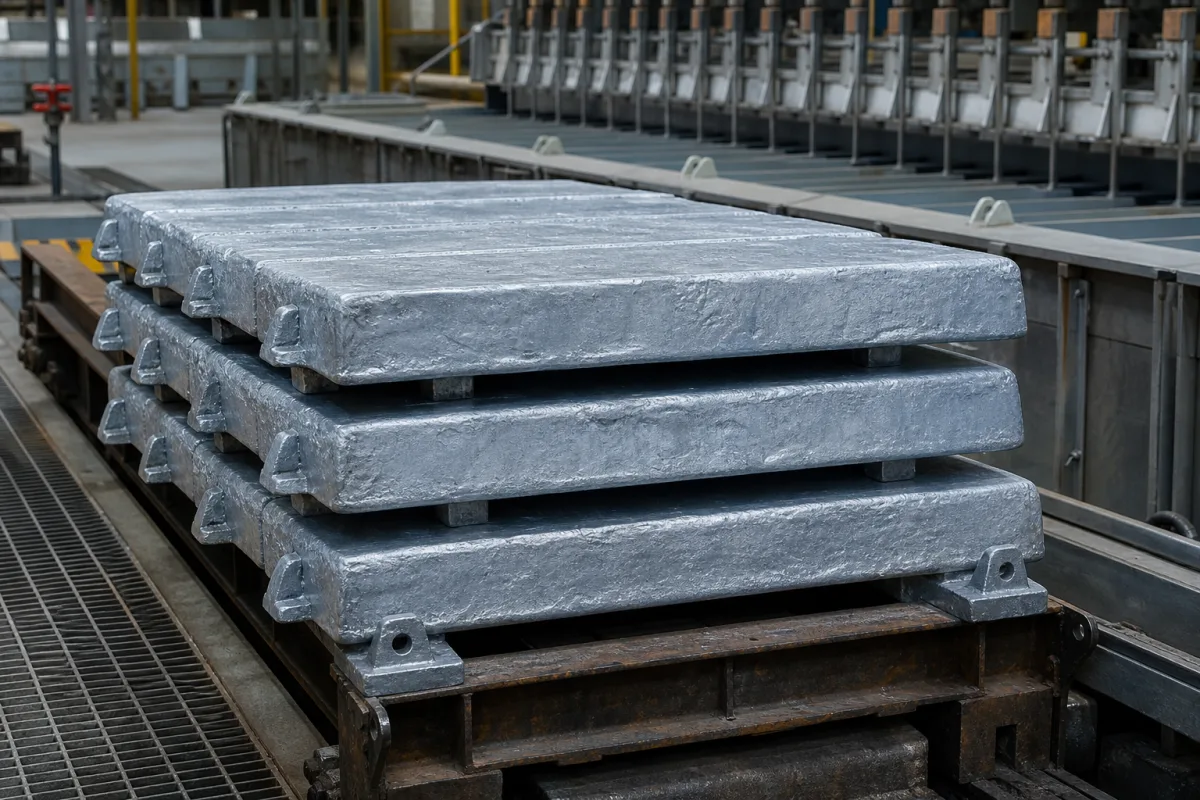
Zinc anode slabs · Zinc grade and impurity limits, which specification applies (slab zinc or galvanic anode), sampling and surface condition, slab size and hanging lugs
A zinc anode slab is a cast plate of zinc, with lugs or hooks where it is hung, in a tank where it dissolves to supply zinc ions — in plating or refining cells — or, for cathodic protection, corrodes in place of the steel it protects. Fix three things before ordering: the zinc grade and impurity limits that the bath or the protection system requires, the specification that applies to that use, and the slab size, weight, lugs and surface condition that fit your tank or structure.
Cast zinc anode slabs and plates for electrolytic baths and galvanic (sacrificial) protection, and the slab zinc they are cast from. Zinc alloy die-casting ingot, zinc powder and dust, zinc-coated steel and other anode metals are outside this page; zinc die casting has its own page.
CNFX editorial research · Sources checked October 11, 2026 · 4 sources
Choose the zinc grade and the specification for the use
ASTM B6 covers zinc metal produced from ore or other material by distillation or electrolysis in five grades — LME grade, special high grade, high grade, intermediate grade and prime western grade — each with limits on lead, iron, cadmium, aluminium, copper, tin and total non-zinc metals. The metal must be free of surface corrosion and adhering foreign matter, and samples are taken from the molten metal during casting and may be cast into shapes for spectrochemical analysis. B6 notes that continuous-galvanizing and controlled-lead grades are covered by other specifications or purchaser documents. [1]
ASTM B418 covers cast and wrought galvanic zinc anodes for the cathodic protection of more noble metals in sea water, brackish water and other saline or corrosive environments, with chemical limits for aluminium, cadmium, iron, lead, copper and zinc. Its Type I composition meets MIL-A-18001K and is described for saline service; Type II is described for other waters, electrolytes, backfills and soils where experience shows it is efficient. [2]
Editorial note: name the specification and grade or type on the order — for example ASTM B6 with a named grade, or ASTM B418 Type I or Type II — because the two specifications control different impurities for different purposes. [1][2]
Give the supplier the specification and grade or type, maximum lead, iron, cadmium, aluminium, copper and tin, slab dimensions and weight, lug or hook design, core or insert if any, surface condition, sampling and analysis method, certificate, packing and quantity.
02
Set size, lugs, sampling and trade paperwork
The US tariff lines quoted in the USGS 2025 zinc summary classify unwrought, unalloyed zinc as containing 99.99% or more zinc (7901.11.0000, 1.5% ad valorem) or less than 99.99% (casting grade 7901.12.1000 at 3%, other 7901.12.5000 at 1.5%), with zinc alloys under 7901.20.0000 at 3%. [3]
USGS reports that galvanized steel was the leading use of refined zinc in the United States and that 2020–23 refined zinc imports came from Canada (59%), Mexico (16%), the Republic of Korea (7%), Peru (7%) and others (11%). [3]
Editorial note: slab dimensions, weight and lug design are not set by B6; agree them on a drawing, together with how the sample for the certificate is taken (from the melt, per B6, or from the finished slab). [1]
03
Find suppliers
The companies in the manufacturer list below show this product on their own websites. Confirm the legal seller, factory and scope for your order.
Ask any supplier for the grade certificate with full impurity analysis to B6 or B418 and the slab drawing. [1][2]
04
Check zinc anode chemistry and capacity for cathodic protection
Deepwater, which supplies zinc and aluminium anodes for offshore cathodic protection, publishes the chemistry and electrochemical values it works to for zinc anodes to MIL-A-18001-K, the military specification that ASTM B418 Type I is described as meeting. [4][2] Its table requires aluminium of 0.1–0.5% and cadmium of 0.025–0.07%, limits iron to 0.005%, copper to 0.005%, lead to 0.006% and other elements to 0.10% each, with zinc as the remainder. It gives a potential of -1.05 V against Ag/AgCl and a nominal current capacity of 780 A·h/kg. [4]
Editorial calculation: at 780 A·h/kg, an anode delivering a mean 1 A for one year (8,760 h) consumes about 11.2 kg of zinc before any utilisation or efficiency allowance (8,760 ÷ 780). Ask the supplier which test method and electrolyte the capacity and potential figures come from, and for the analysis of the heat poured. [4]
Editorial note: a slab for a plating or refining tank is ordered against an ASTM B6 grade, while a sacrificial anode is ordered against B418 or MIL-A-18001-K chemistry; name the use and the specification on the order. [1][2]
Fill the specification fields with values for your bath
A zinc anode quotation needs values for your bath or structure. The table explains each field, gives published values where a reviewed source states them, and says what to obtain from the supplier.
Explore company information and manufacturing capabilities, then discuss the scope of your project with a relevant supplier.
Share this page
Compiled and source-reviewed by the CNFX editorial team.
Published specifications describe requirements, not a supplier's tested output. Confirm the legal seller, producer and certificates for your order. How we source and review
· Page last updated 13 October 2026
Buyer questions
What grades of zinc does ASTM B6 cover?
LME, special high grade, high grade, intermediate grade and prime western grade. [1]
Which standard covers sacrificial zinc anodes?
ASTM B418 covers cast and wrought galvanic zinc anodes; its Type I meets MIL-A-18001K. [2]
Which impurities are limited in slab zinc?
B6 limits lead, iron, cadmium, aluminium, copper, tin and total non-zinc metals. [1]
How is high-purity zinc classified for US import?
USGS lists HTS 7901.11 for unwrought zinc containing 99.99% or more zinc. [3]
What capacity does a MIL-A-18001-K zinc anode deliver?
Deepwater lists a nominal current capacity of 780 A·h/kg and a potential of -1.05 V against Ag/AgCl for its MIL-A-18001-K zinc alloy. [4]
Sources and what still needs a direct check
Sources checked 2026-10-11. ASTM B6 covers slab zinc grades and ASTM B418 galvanic zinc anodes; the USGS 2025 zinc summary gives trade data and tariff lines.