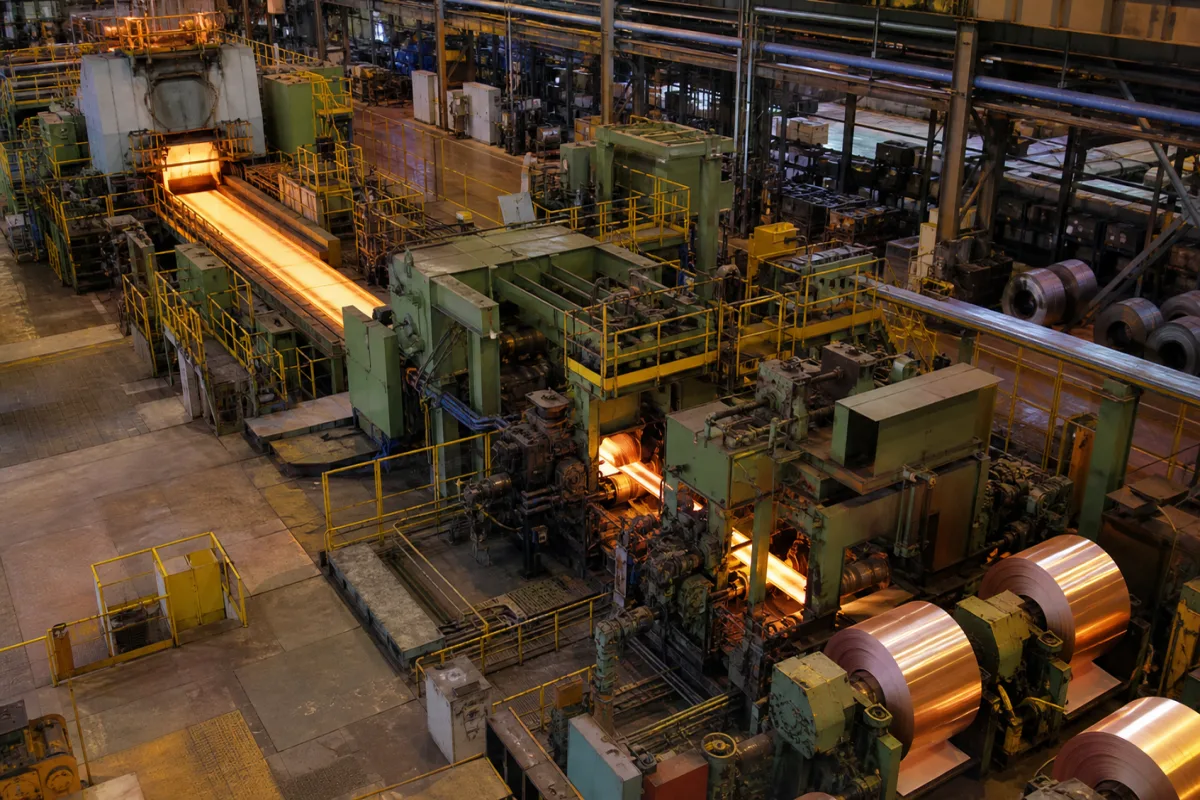
Non-ferrous strip continuous casting and rolling line (twin-roll and twin-belt casters with in-line rolling)
Strip casting plus in-line rolling · twin-roll and twin-belt casters for aluminium and copper strip, coiled without a separate hot mill
A non-ferrous strip continuous casting and rolling line pours molten aluminium, copper or brass straight into a strip-shaped mould, a pair of water-cooled rolls or two moving steel belts, and passes the cast strip through one or more rolling stands and a coiler in the same line, replacing ingot casting, reheating and breakdown hot rolling. Decide three things first: which caster type suits the alloy and output, how thick and wide the cast strip will be, and whether the strip is hot rolled in line while it still holds its casting heat.
Integrated lines that cast non-ferrous metals as strip or thin slab and roll them in line: twin-roll casters, twin-belt casters, in-line hot or skin-pass rolling stands, shears and coilers for aluminium, copper and brass strip. Vertical direct chill casters and wheel-and-band casters feeding rod rolling mills are covered on the Continuous casting machine for non-ferrous metals page; copper rod lines, steel strip casting and cold rolling mills are outside this page.
CNFX editorial research · Sources checked October 12, 2026 · 5 sources
Choose a twin-roll or twin-belt caster for the strip
Larex AG's European patent EP0233147B1 on continuous twin-roll casting describes installed plants producing strip between 3 and 15 mm thick and 0.25 to 2 m wide at casting speeds of 0.75 to 1.4 m/min, with the strip leaving the rolls at 350 to 400 °C. With a roll diameter of 600 mm and a 12 mm distance between nozzle exit and roll exit, it calculates a mean rolling reduction of 7.4% after full solidification in the roll gap. [1]
A twin-belt caster solidifies the metal between two moving, water-cooled steel belts. Hazelett, which builds these machines, states that solidification is complete approximately 70% to 80% of the way down the mould length, and that copper and other high-temperature metals are fed from a tundish into an open pool whose level is regulated by a laser sensor. [4]
Hazelett lists its CS1500 copper strip caster, used in the Conti-M process developed with Mansfelder Kupfer und Messing, at a maximum width of 1500 mm, a casting rate of 38 kg per mm of width per hour (38 tonnes per metre of width) and production capacity of 20,000 to 200,000 tonnes per year, and claims 40% less energy and 75% shorter throughput time than the conventional process. [3] Editorial calculation: at the full 1500 mm width, 38 tonnes per metre per hour is 57 tonnes per hour.
Alcan's patent EP1307307B1 on belt cooling for twin-belt casting notes difficulties when producing thinner strip of 4 to 10 mm, compared with 10 to 30 mm for conventional belt castings, and with alloys of freezing range 40 to 50 °C rather than up to 20 °C, which must be cooled much more quickly. [2]
Give the line builder the alloys and their freezing ranges, the cast strip thickness and width, the finished gauge after in-line rolling, annual output, melting and holding furnace capacity, coil weight and inner diameter, and the downstream cold rolling or annealing steps.
02
Roll the strip in line while it holds its casting heat
Haga and Furukawa of Osaka Institute of Technology, writing in Materials in 2024, state that a conventional twin-roll caster for aluminium alloys casts at less than 2 m/min, about 1 m/min, while their unequal-diameter twin-roll caster casts at 10 to 60 m/min; at 30 m/min against 1 m/min its productivity is 30 times greater. [5]
Assuming 20 m between caster and mill for conveying and temperature control, they note that strip from a conventional caster at 1 m/min would take 20 min to reach the hot mill, while their strip at 30 m/min arrives in 40 s; the measured temperature of 3.7 mm Al-5%Mg strip after 40 s was 483 °C, above the 350 °C they give for hot rolling aluminium alloys. [5]
Their caster used copper rolls of 300 and 1000 mm diameter, 100 mm wide, at 30 m/min with a load of 13 N/mm, pouring at 720 °C. In-line hot rolling at 350 or 450 °C with reductions of 19, 27 or 36% reduced surface cracking and the anisotropy of elongation in the strip after cold rolling to 0.5 or 1.0 mm and annealing at 360 °C for 90 min. [5]
Editorial note: these are laboratory results on 100 mm wide strip of one alloy; ask a line builder for in-line rolling temperatures and reductions demonstrated on your alloy and width.
03
Strip casters are not rod casting lines
No manufacturer listing linked to this page has been confirmed to offer strip casting and rolling lines; the companies reviewed list copper and aluminium rod casting and rolling lines, which are a different product.
When comparing line builders, ask for the caster type, the strip thickness and width range demonstrated, reference lines running the same alloy family, and whether in-line rolling stands, shears and coilers are included.
04
From tundish nozzle through caster and rolling stands to the coiler
Unit
Role
Fix in the order
Metal feed (tundish and nozzle)
Delivers melt across the mould width; open pool with laser level control for copper. [4]
Feed system and level control.
Twin-roll caster
Water-cooled rolls solidify and lightly reduce the strip. [1][5]
Roll diameter, width, material.
Twin-belt caster
Moving steel belts cool the strip; belt cooling sets the strip limits. [2]
Belt width, cooling, coating.
Temperature control zone
Keeps the strip in the hot-working range before the mill. [5]
Explore company information and manufacturing capabilities, then discuss the scope of your project with a relevant supplier.
Share this page
Compiled and source-reviewed by the CNFX editorial team.
Each manufacturer above links to the page on that company's own website where the product is listed, with the date we checked it. How we source and review
· Page last updated 13 October 2026
Buyer questions
How fast does a twin-roll caster cast aluminium strip?
A twin-roll casting patent gives 0.75 to 1.4 m/min for installed plants, while an unequal-diameter laboratory caster ran at 30 m/min. [1][5]
Can cast strip be hot rolled without reheating?
In one study, 3.7 mm Al-5%Mg strip was still at 483 °C after 40 s and 20 m at 30 m/min, above the 350 °C hot-rolling threshold the authors give. [5]
How much copper strip can a twin-belt caster produce?
Hazelett lists 38 tonnes per metre of width per hour for its CS1500, up to 1500 mm wide. [3]
Sources and what still needs a direct check
Sources checked 2026-10-12. Two European patents (Larex AG, Alcan) and Hazelett describe twin-roll and twin-belt strip casting in their own words; the Materials article reports laboratory trials of in-line hot rolling. Figures belong to the plants, alloys and conditions named.