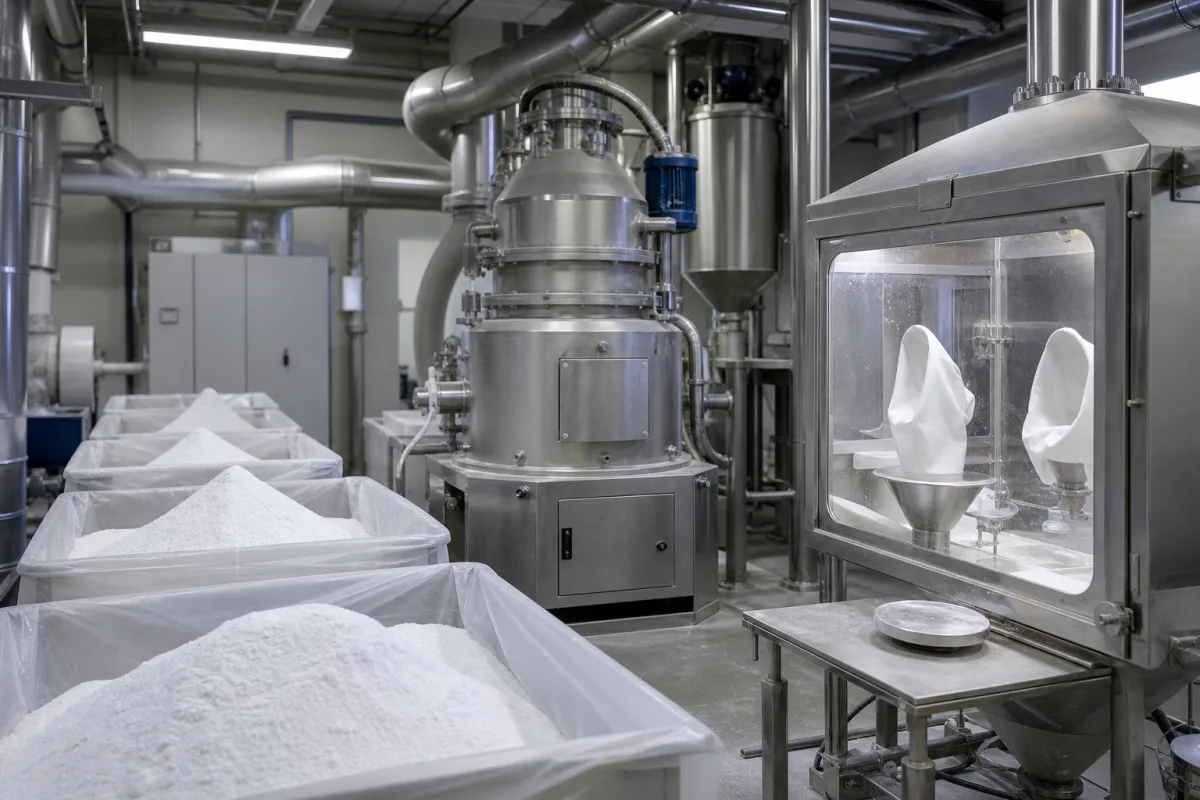
Fused silica (fused quartz) powder · Amorphous SiO2 made by melting high-purity silica and grinding or spheroidizing it, specified by purity, particle size distribution and shape, for investment casting shells, ceramics, crucibles and spherical fillers in semiconductor encapsulants
Fused silica powder is amorphous (glassy) silicon dioxide made by melting high-purity silica and then grinding it to angular particles or forming spherical particles. It is chosen for very low thermal expansion, chemical stability and electrical insulation. Ask three things first: what it is for, which purity and impurity limits apply, and what particle shape and size distribution the process needs.
Fused (amorphous) silica and fused quartz powders, angular or spherical, for investment casting, refractories, technical ceramics, crucibles and resin fillers. Crystalline quartz sand and flour, precipitated or fumed silica, and silica glass parts are outside this page.
CNFX editorial research · Sources checked October 12, 2026 · 4 sources
Goodfellow describes fused quartz powder as high-purity silica produced by controlled melting, grinding and purification, used in precision investment casting (including shells that replace zircon with quartz), functional quartz ceramics, and composite quartz crucibles for polysilicon production, and to control slurry rheology. [1]
Denka describes its fused silica as amorphous, spherically shaped silica made by melting high-quality pure silica at high temperature, used as filler for semiconductor encapsulating materials and other resins. It cites high electrical insulation resistance, a low dielectric constant, flowability, adaptability to varied particle distributions and high filling content in resins with good moldability, and claims fused silica has the lowest thermal expansion of all industrial materials. [2]
Give the supplier the end use, required SiO2 purity and limits on Fe2O3, Al2O3, alkali and other impurities, particle shape (angular or spherical), D10/D50/D90 and top size, surface treatment if any, moisture limit, packaging and lot size, and the certificate required.
02
Set purity, particle size and the properties to verify
Goodfellow states SiO2 purities exceeding 99.9% for its fused quartz powder, sold with nominal mean, minimum and maximum particle sizes and D10, D50 and D90 values per option. [1]
For fused quartz material, Goodfellow lists density 2.2 g/cm³, zero apparent porosity and water absorption, melting point 1,715 °C, upper continuous use temperature 1,100–1,400 °C, thermal conductivity 1.46 W/m·K at 20 °C, thermal expansion 0.54×10⁻⁶ K⁻¹ from 20 to 1,000 °C, dielectric constant 3.8, dielectric strength 25–40 kV/mm, volume resistivity 10¹⁸ Ω·cm at 25 °C, refractive index 1.46 and Vickers hardness 1,000 kgf/mm². These describe the bulk material; ask for powder-specific data such as bulk density and specific surface area. [1]
Editorial calculation: 0.54×10⁻⁶ K⁻¹ is 5.4×10⁻⁷/°C. [1]
Admatechs' product list for its ADMAFUSE spherical fused silica shows the fields an electronics-grade filler is specified by. Its series run from a median diameter of about 8 µm (specific surface area about 2.0 m²/g, circularity 0.98) to about 15, 25 and 35 µm (circularity 0.98–0.97). Its low-alpha grade lists SiO₂ above 99.9%, moisture below 0.1%, Fe below 300 ppm, Al below 100 ppm, uranium below 1.0 ppb, Na⁺ and K⁺ each below 1.0 ppm, Cl⁻ below 2.0 ppm, extract conductivity below 6.0 µS/cm and extract pH 4.0–7.0. The maker marks all these figures (typ.), not guaranteed, with particle sizes measured by laser diffraction. [3]
Editorial note: for encapsulant filler, ask for the ionic impurities, uranium content and extract conductivity on each lot certificate, not only SiO₂ purity, since the maker reports these separately from the bulk analysis. [3]
03
Compare fused and crystalline silica in a moulding compound
Linec and Mušič (Kolektor Group with the Nanotesla Institute, Materials 2019) made epoxy moulding compounds (EMCs) with 22.0 wt.% of four SiO₂-bearing fillers and kept every other ingredient constant. They describe fused silica as made by melting crystalline silica at 1900–2500 °C, then crushing and pulverising after re-solidification, giving an amorphous powder with lower density and a smaller thermal expansion coefficient than crystalline silica. [4] The table sets their crystalline and fused silica results side by side.
The authors rank spiral flow length as fused silica > foundry sand > crystalline silica > glass beads, and explain that at equal weight the low-bulk-density fused silica fills a larger volume of the compound; they report the tensile strength of the fused-silica EMC as about 15% lower than the others. [4] Editorial note: the fused silica in this study was a crushed, angular powder, so spherical grades such as those Denka and Admatechs describe need their own flow data; ask for bulk density and BET surface area alongside D50, since both changed the results here. [2][3]
Lot certificate items to ask any fused silica supplier for
Ask any supplier for a data sheet and lot certificate showing SiO2 and impurity analysis, particle size distribution and method, particle shape, specific surface area, bulk density, moisture, crystalline silica content, packaging, and lead time and minimum order.
Shape and ionic purity separate an encapsulant filler from casting flour: Denka's and Admatechs' spherical grades are specified for flow and filling in resins, and the low-alpha grade adds sodium, potassium, chloride and uranium limits. [2][3]
Low-alpha grades for memory chips; e.g. Na⁺, K⁺ <1 ppm, U <1 ppb. [3]
Limits; lot data.
06
SiO₂ purity, D50, surface area, thermal expansion, dielectric data and moisture for a fused silica order
Three rows quote the bulk material rather than the powder: Goodfellow's 2.2 g/cm³ density, 3.8 dielectric constant and 0.54×10⁻⁶ K⁻¹ expansion describe fused quartz itself, so ask separately for powder bulk density and lot data. [1]
Field
What it means and published values
Ask the supplier for
SiO₂ Purity (%)
e.g. exceeding 99.9%; Fe <300 ppm, Al <100 ppm in one spherical grade. [1][3]
Lot analysis.
Particle Size D50 (μm)
Nominal D50 given per option; e.g. spherical series at about 8, 15, 25 and 35 µm. [1][3]
D50; method.
Bulk Density (g/cm³)
Material density 2.2 g/cm³; powder bulk density not stated. [1]
2 companies list this product among what they make. Company figures are quoted from each
company's own website; every card states where the relationship came from.
JIANGSU KAMROLLER SPECIAL CERAMICS CO.,LTD
Manufacturing site to be confirmed for the order
Its website has a product page for high-purity fused silica powder.
Explore company information and manufacturing capabilities, then discuss the scope of your project with a relevant supplier.
Share this page
Compiled and source-reviewed by the CNFX editorial team.
Each manufacturer above links to the page on that company's own website where the product is listed, with the date we checked it. How we source and review
· Page last updated 13 October 2026
Buyer questions
How pure is fused quartz powder?
Goodfellow states SiO2 purities exceeding 99.9% for its fused quartz powder. [1]
Why is spherical fused silica used in chip encapsulants?
Denka cites low thermal expansion, insulation, low dielectric constant, flowability and high filling in resins. [2]
What is the thermal expansion of fused quartz?
Goodfellow lists 0.54×10⁻⁶ K⁻¹ from 20 to 1,000 °C. [1]
Which impurities matter for silica filler in chip packaging?
One maker's low-alpha spherical fused silica lists Fe <300 ppm, Al <100 ppm, Na⁺ and K⁺ <1 ppm, Cl⁻ <2 ppm and uranium <1 ppb, all (typ.), not guaranteed. [3]
How does fused silica filler change epoxy moulding compound flow?
In a 22 wt.% filler study, the fused-silica EMC had 24.4 inch spiral flow against 21.1 inch for crystalline silica, with about 15% lower tensile strength. [4]
Sources and what still needs a direct check
Sources checked 2026-10-12. Goodfellow sells fused quartz powder; Denka and Admatechs make spherical fused silica filler; a 2019 peer-reviewed study (Materials, open access in PMC) measured fused and crystalline silica fillers in an epoxy moulding compound.