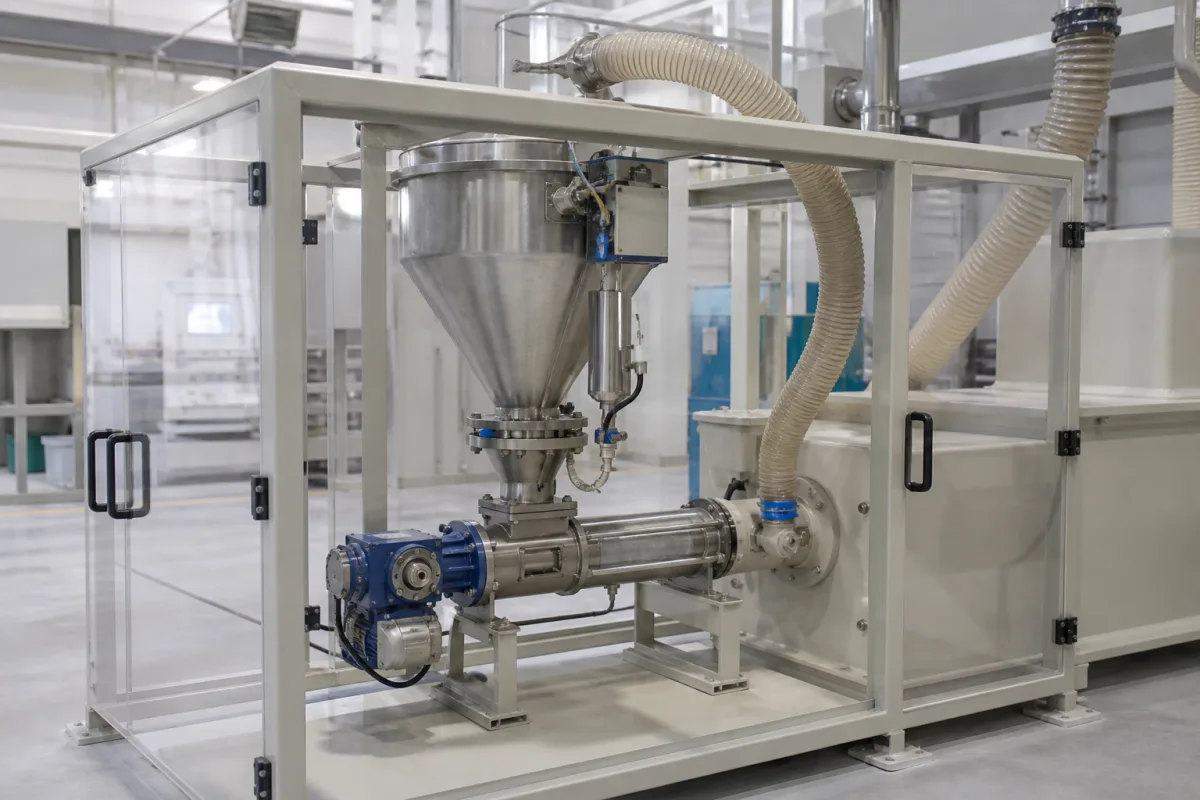
Powder feeder with loss-in-weight control: a feed screw on a weigh hopper that meters powder by weight and is refilled without stopping
Loss-in-weight powder feeders with automatic refill · Weigh hopper, feed screw and controller sampling about every 50 ms, volumetric control during refill, compaction error and learned scale factors, scale stabilisation, and accuracy as % of sample at 2 sigma
This page covers loss-in-weight (gravimetric) powder feeders: a feed screw or tray mounted with its hopper on a scale, a controller that compares the weight lost over time with the set point and adjusts the drive, and a refill device such as a vacuum conveyor, screw conveyor or valve that tops up the hopper. Ask three things first: the feed rate and the accuracy statement and sample size behind it, how long the feeder spends in volumetric control during each refill, and how the hopper size, refill device and scale stabilisation are matched.
Loss-in-weight (gravimetric) powder feeders with weigh hoppers, feed screws or trays, controllers and refill devices, for continuous dosing of powders such as ceramic and mineral powders. Screw feeders as a family, including screw design and volumetric feeding, are covered on the Screw feeder page, powder-coating fluidising hoppers on the Powder feed hopper page, and bag-tipping and ingredient hoppers on their own pages. Vacuum conveyors sold alone, powder filling machines and laser-cladding powder feeders are outside this page.
CNFX editorial research · Sources checked October 12, 2026 · 3 sources
Scale, feed screw and weigh hopper under one controller, sampling about every 50 ms
Andy Kovats of Brabender Technologie, writing in Powder & Bulk Solids, describes a loss-in-weight feeder as a scale with a dedicated controller, a feed mechanism (screw, vibrating tray or similar) with a variable-speed drive, and an integral weigh hopper; the controller measures the weight lost over time and raises or lowers the feed output to hold the set point, sampling weight about every 50 milliseconds. He cites continuous accuracies down to 0.2% of sample size at a 2-sigma confidence level, depending on the material, and lists screw conveyors, bin activators, pneumatic conveyors, slide gate valves and rotary valves as refill devices. [1]
Editorial calculation: sampling every 50 ms is 20 weight readings per second; in Kovats's example, a feeder set at 100 lb/h that lost 98 lb in an hour was 2% below set point and would raise its screw speed. [1]
Give the supplier the powder, its bulk density, flowability and any tendency to pack or flood, the feed rate range, the accuracy needed and over what sample time, how the hopper will be refilled, the headroom available, and what happens downstream if the feed rate drifts.
02
Refill: volumetric control at a held speed, and the compaction error that follows
Kovats explains that a feeder cannot control by weight while its scale is gaining weight, so modern controllers run the feed screw at a constant speed during refill, set by averaging drive tachometer readings just before refill; during that period the feeder does not respond to changes in humidity, temperature, bulk density or screw filling, so refill time should be as short as possible and repeatable, for example 15 seconds every time rather than anywhere from 5 to 45. [1] K-Tron's US patents 4,524,886 and 4,635,819 attribute the refill error to compaction: material near the bottom of the hopper compacts as material is added, raising effective density and mass flow. Their control divides the hopper's weight range into increments, stores a density-related scale factor for each increment during discharge, and during refill drives the screw at speeds set by the stored factors. [2][3]
Editorial note: ask the supplier whether its controller holds a single averaged speed during refill or adjusts speed from stored density data, and for test data on feed rate deviation through a refill with your powder.
03
Accuracy as a percentage of sample at 2 sigma, and the 90% gravimetric-time assumption behind it
Kovats gives an example accuracy statement as repeatability in percent of sample size at a stated confidence: 0.5% at 2 sigma means that at 6,000 lb/h, 95% of consecutive one-minute samples weigh between 99.5 and 100.5 lb, assuming perfect linearity. In his example the statement holds only if the feeder is under gravimetric control for at least 90% of its cycle, where time in volumetric mode is refill time plus scale stabilisation time; high-displacement load cells can take longer to settle than low-displacement cells, and floodable powders can take longer while entrained air escapes. [1]
Kovats states that with 30 refills an hour and 5 seconds of scale stabilisation, only 7 seconds are left for each refill, and that spreading volumetric time over a larger number of short refills, such as 20 of 10 seconds rather than one of three minutes, limits its effect on the process; he asks manufacturers to quote and demonstrate scale stabilisation time. [1] Editorial calculation: 30 refills an hour is a 120-second cycle; 90% gravimetric leaves 12 seconds volumetric, and 12 − 5 = 7 seconds of refill, matching his figure. [1]
Explore company information and manufacturing capabilities, then discuss the scope of your project with a relevant supplier.
Share this page
Compiled and source-reviewed by the CNFX editorial team.
Each manufacturer above links to the page on that company's own website where the product is listed, with the date we checked it. How we source and review
· Page last updated 13 October 2026
Buyer questions
How accurate is a loss-in-weight feeder?
A Powder & Bulk Solids article by a Brabender engineer cites accuracies down to 0.2% of sample size at 2 sigma, depending on the material, with the statement assuming at least 90% of the cycle under gravimetric control. [1]
What happens to feeding accuracy during refill?
The feeder runs volumetrically at a held speed; K-Tron patents note that compaction raises density and mass flow, and correct it with stored density factors. [1][2]
How long can a refill take?
In the article's example, 30 refills an hour with 5 seconds of scale stabilisation leave only 7 seconds per refill. [1]
Sources and what still needs a direct check
Sources checked 2026-10-12. A Powder & Bulk Solids article by a Brabender Technologie engineer explains refill and accuracy; two K-Tron US patents describe refill control.