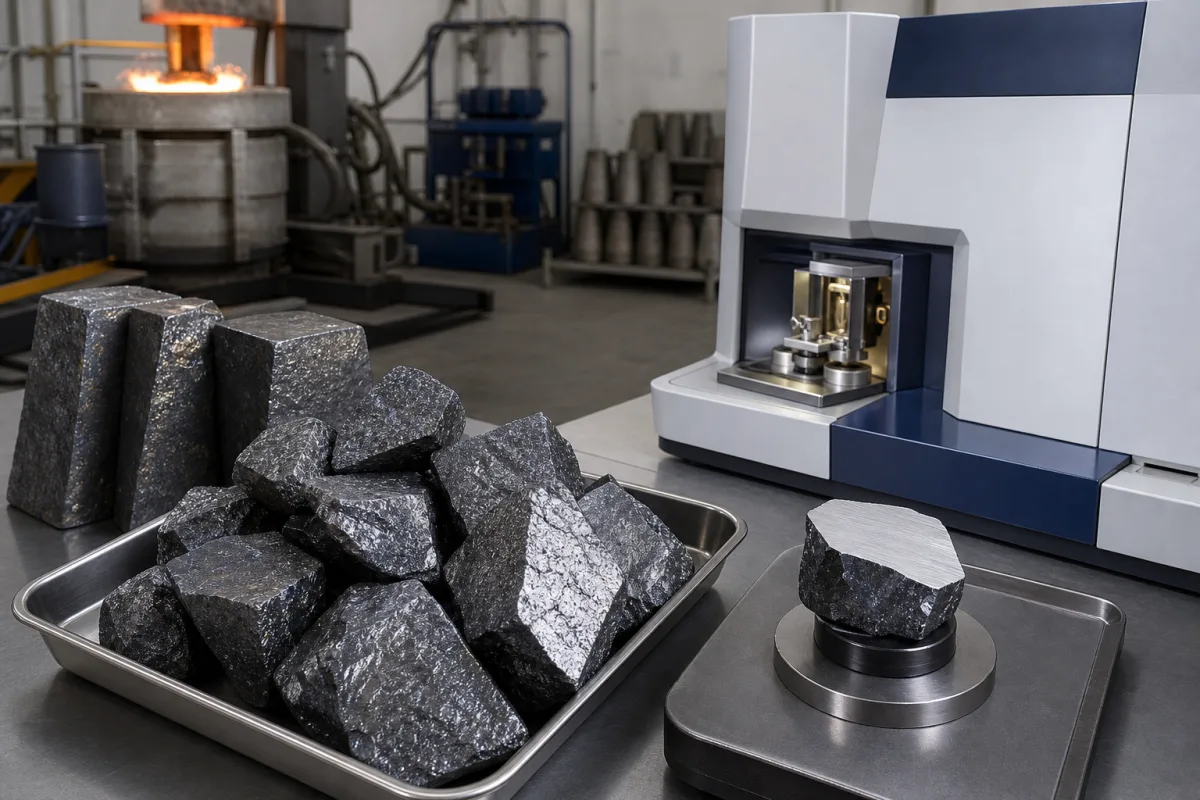
Ferroboron (FeB) for boron-treated steels · high-carbon and low-carbon grades, B bands from 10% to over 20%, C, Si and Al ceilings, S and P on supplier sheets, lump and fines sizes, addition after Al and Ti, published boron recovery ranges
Ferroboron is an iron–boron alloy used to put boron into steel — at about 0.0008% to 0.0030% — to raise hardenability. The boron only works while it stays dissolved and unbound, so the alloy's grade and the moment it goes into the ladle both decide how much of it ends up useful. Before quoting, fix the boron band and whether you need a low-carbon or a low-aluminium grade, the size range for your addition method, and the sulphur and phosphorus ceilings, which the national standard does not set.
Ferroboron (FeB) lumps, crushed sizes and fines for alloying steel and iron with boron, including high-carbon and low-carbon grades and material sold as ferroboron master alloy. Boron cored wire, ferrosilicon-boron, nickel-boron, borax, pure crystalline boron and amorphous-ribbon alloys are outside this page except where compared.
CNFX editorial research · Sources checked October 11, 2026 · 5 sources
IS 3013:1991 defines ferroboron as an iron–boron master alloy carrying at least 10 percent boron by mass with limited silicon and aluminium, and splits it into two families of three grades. High-carbon ferroboron — 2 FeB 12 (B 10.0–15.0%), 2 FeB 17 (B over 15.0 up to 20.0%) and 2 FeB 20 (B over 20.0%) — allows 2.0% C, 4.0% Si and 0.50% Al at most. Low-carbon ferroboron — 05 FeB 16 (B 15.0–17.0%), 05 FeB 18 (B over 17.0 up to 19.0%) and 05 FeB 20 (B over 19.0%) — cuts carbon to 0.50% max and keeps Si at 4.0% max, but allows aluminium up to 6.0%. In a graded lot the boron content of the melts may not differ by more than 3 percent absolute. [1]
The trade-off matters: under IS 3013 a buyer who asks only for "low-carbon" ferroboron can receive material with far more aluminium than the high-carbon grades allow. Editorial calculation: 6.0% ÷ 0.50% = 12, so the low-carbon aluminium ceiling is twelve times the high-carbon one. A supplier sheet shows that tighter combined limits are offered: Cometal lists Ferro Boron 18-20 at B 18–20% with Si 1.5%, S 0.01%, Al 0.50%, C 0.50% and P 0.05% maxima, and Ferro Boron 14-18 at B 14–18% with the same Si, Al, C and P maxima and S printed as 0.20% max. [3]
ASTM A323 is the US specification for ferroboron; its public abstract says it covers more than one grade, with chemical requirements for boron, carbon, silicon and aluminium, details various sizes and requires chemical analysis. The grade limits themselves are in the purchased text and are not quoted here. [2]
State the boron band (minimum and maximum), carbon, silicon and aluminium maxima together, plus sulphur and phosphorus maxima, the size range, whether a certificate per melt is needed, and the standard or grade designation you are buying against.
02
Time the addition and estimate boron recovery
US patent 4,251,268 explains why the order of additions decides the result. Boron is added to steel at about 0.0008 to 0.0030%, and it raises hardenability only while present as metal rather than bound as oxide or nitride, so oxygen and nitrogen must be tied up first. The patented ladle sequence pre-deoxidises with manganese, silicon and aluminium to roughly 0.010 to 0.020% metallic aluminium, injects calcium (for example CaSi) to lower dissolved oxygen, then injects a nitride former such as titanium or zirconium, and only then injects boron, borax or ferroboron as dosed powder; the casting streams are shielded from air. The patent also notes that wire-feeding boron into the mould loses an unpredictable share to oxygen and nitrogen. [4]
Chinese patent CN101045948A defines boron recovery as (tapped steel mass × boron in steel) ÷ boron added × 100%, and cites plant results showing how wide it can swing: 10%–65% for ferroboron in an electric-furnace 40MnB steel, 7.5%–87.5% (mean 43.4%) for ladle-added FeB and 23.5%–71.5% (mean 50.9%) for FeB cored wire in 40MnBH steel. Its own converter route adds aluminium after refining, then ferrotitanium, and ferroboron last; one example added 16 kg of ferroboron (B 23.0%) after 33 kg of aluminium and 130 kg of ferrotitanium (Ti 40%), lifting steel boron from 0.0001% to 0.0019% at a 69.4% recovery, with 69.4%–91.8% reported across its examples. [5]
Editorial calculation: 16 kg of ferroboron at 23.0% B carries 16 × 0.230 = 3.68 kg of boron, so at the 69.4% recovery reported for that heat about 2.55 kg ended up dissolved in the steel. [5]
Recovery is a property of the shop's practice, not of the alloy alone; ask suppliers for analysis and size data, and judge recovery from your own heats under a fixed Al–Ti–B order.
03
Lining up ferroboron offers by B band, carbon class, Al and Si ceilings, S and P, and size
Line up each offer's boron band, carbon class, aluminium and silicon ceilings, sulphur and phosphorus limits, size range and packing, and request a melt analysis certificate before committing a heat plan to a new source.
04
Read each element in the grade table
Aluminium separates IS 3013's two families twelvefold: 0.50% max in the high-carbon grades against 6.0% in the low-carbon ones. [1]
Element
Published limit
What it changes
Boron
10.0% minimum up to over 20.0% across six IS grades. [1]
Alloy needed per heat.
Carbon
2.0% max (high-carbon), 0.50% max (low-carbon). [1]
Carbon pick-up.
Aluminium
0.50% max (high-carbon), 6.0% max (low-carbon). [1]
Extra Al in the steel.
Silicon
4.0% max (IS); 1.5% max on one supplier sheet. [1][3]
Residual Si.
Sulphur, phosphorus
Not set by IS 3013; S 0.01–0.20%, P 0.05% max on one supplier sheet. [3]
Must be stated by the buyer.
05
Boron band, size, carbon, aluminium, sulphur and phosphorus for a ferroboron order
Sulphur and phosphorus limits appear only on the Cometal sheet, not in IS 3013, so write their maxima into the order; iron, density, melting point and moisture are not stated in any reviewed source. [3][1]
Field
What it means and published values
Ask the supplier for
Boron Content
IS bands 10.0–15.0, 15.0–20.0, over 20.0 (high-C); 15.0–17.0, 17.0–19.0, over 19.0 (low-C); supplier 14–18 and 18–20%. [1][3]
Min–max B.
Iron Content
Not stated in reviewed sources.
Measured Fe.
Particle Size
IS: 2–50 mm (≤3% undersize), 2–25 mm (≤5%), up to 2 mm; supplier: 5 x 30 mm, 10–50 mm, 0–2 mm. [1][3]
Range and undersize.
Carbon Content
2.0% or 0.50% max by IS class; 0.50% max on supplier sheet. [1][3]
C max.
Sulfur Content
0.01% max (18–20% B grade) on supplier sheet; not in IS 3013. [3]
S max (ppm or %).
Melting Point
Not stated in reviewed sources.
Melting range.
Density
Not stated in reviewed sources.
Density.
Boron Recovery Rate
Published plant ranges 7.5%–91.8% depending on practice. [5]
Not a supplier guarantee.
Moisture Content
Not stated in reviewed sources.
Moisture limit.
Aluminum Content
0.50% or 6.0% max by IS class; 0.50% max on supplier sheet. [1][3]
Explore company information and manufacturing capabilities, then discuss the scope of your project with a relevant supplier.
Share this page
Compiled and source-reviewed by the CNFX editorial team.
Each manufacturer above links to the page on that company's own website where the product is listed, with the date we checked it. How we source and review
· Page last updated 13 October 2026
Buyer questions
What is the difference between high-carbon and low-carbon ferroboron?
In IS 3013 the high-carbon grades allow 2.0% C but only 0.50% Al; the low-carbon grades cap C at 0.50% but allow up to 6.0% Al. [1]
When should ferroboron go into the ladle?
After oxygen and nitrogen are bound: US 4,251,268 deoxidises with Al and calcium and adds a Ti or Zr nitride former before the boron. [4]
What boron recovery can be expected?
Plant figures cited in CN101045948A range from 7.5% to 87.5% for ladle FeB; its own Al–FeTi–FeB route reports 69.4%–91.8%. [5]
Sources and what still needs a direct check
Sources checked 2026-10-11. The sources are an Indian national standard, the public abstract of the ASTM specification, a supplier product sheet and two patents on boron-steel practice.