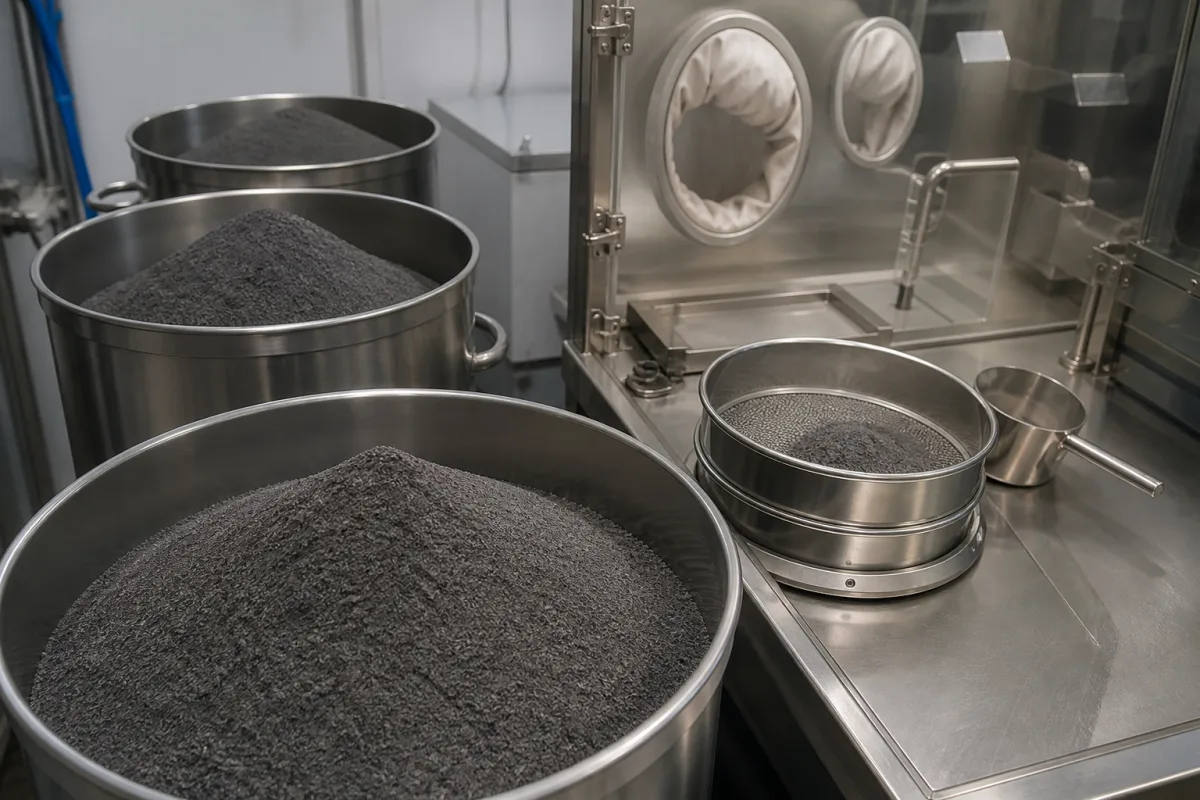
High-purity chromium nitride and nitrided Fe-Cr alloy powders for powder-metallurgy high-nitrogen stainless steel
Fine, low-oxygen nitrogen carriers for powder metallurgy, not lumps for the ladle · Cr₂N powder blended into stainless powder before HIP, Fe-Cr-Mn powder nitrided under pressure to over 5 wt.% N, and the oxygen control both depend on
Nitrided ferrochrome added to a steel melt dissolves in the liquid, so its size matters for how it is charged. Stainless steel built from powder — by hot isostatic pressing, sintering or additive manufacturing — never melts, so the nitrogen has to arrive already in the powder: as fine chromium nitride particles blended in, or inside alloy powder that has been nitrided in the solid state. That changes what the buyer specifies: particle size against the matrix powder, purity and oxygen, and the nitrogen content the nitriding process can hold without coarse nitrides. This page sets out published figures for both routes.
Fine, high-purity chromium nitride (Cr₂N) powders and solid-state nitrided iron-chromium(-manganese) alloy powders used as the nitrogen source in powder-metallurgy and additive-manufacturing routes for high-nitrogen stainless steel. Nitrided ferrochrome lumps and granules for alloying liquid steel are covered on the Industrial-grade ferrochromium nitride alloy powder page; other ferroalloys and PVD chromium nitride coatings are outside this page.
CNFX editorial research · Sources checked October 12, 2026 · 4 sources
Cr₂N powder as an additive: 99% purity, ≤45 µm, decomposed during HIP
Goodfellow lists chromium nitride powder as Cr₂N, CAS 12645-11-3, purity 99% (2N), maximum particle size 45 µm, density 5.9 g/cm³. [1] A 2025 study used that powder to add nitrogen to 316L stainless steel made by hot isostatic pressing. [2]
The blend was canned and hot isostatically pressed at 1300 °C and 100 MPa for 2 h; the authors report that the Cr₂N decomposed during HIP and gave a uniformly refined, dense austenitic structure, with average grain sizes of 17.6 µm without and 18.2 µm with the Cr₂N addition. [2] Values in the table are the design compositions from the study's table 1. [2]
Editorial calculation: Cr₂N contains 14.007 ÷ (2 × 51.996 + 14.007) ≈ 11.9 wt.% nitrogen, so 0.10 wt.% N in the steel needs about 0.84 wt.% Cr₂N, which also adds about 0.74 wt.% Cr. The study's design shows Cr rising by 1.20 points between the two alloys, so ask the alloy designer how the chromium balance was set rather than assuming the nitride supplies all of it.
Alloy (HIP study)
N (wt.%)
Cr (wt.%)
Ni equivalent
C13Ni — gas-atomised 316L-type powder, D max ≤149 µm
For a blend, specify Cr₂N phase content (Cr₂N against CrN), purity, maximum and median particle size relative to the matrix powder, and oxygen; the 45 µm limit above sits inside a matrix powder of up to 149 µm.
02
Nitriding Fe-Cr-Mn alloy powder in the solid state: 800–1000 °C, 0.5–2.5 h, 0.5–3 MPa
A 2026 study nitrided gas-atomised FeCr17Mn12Mo3.5N powder (15–53 µm; 17.24 Cr, 12.11 Mn, 3.56 Mo, 0.38 N, 0.052 O wt.%) in a high-pressure tube furnace, with 99.999% nitrogen, repeated purging and a copper treatment to remove free oxygen, since surface oxide blocks the nitriding reaction. [3]
The authors chose not to exceed 3 MPa because their calculated austenite field grows more slowly above that pressure. They report nitrided particles with no cracking, nitrogen held mainly in solid solution — XPS peak areas of about 83% solid-solution and 17% nitride nitrogen at the surface — and Cr-based nitride precipitates averaging 92 ± 24 nm. [3] The abstract gives 5.63 wt.% at 1000 °C, 2.5 h and 2.5 MPa, while the parameter table gives 5.63 wt.% at 3.0 MPa and 5.23 wt.% at 2.5 MPa; confirm the pressure with the authors or supplier before using either pair. [3]
The same paper puts previously reported high-nitrogen stainless steels at 0.4–0.9 wt.% nitrogen, so these powders are far richer in nitrogen than a finished steel and would be diluted or used as a master powder. [3]
A third route: milling iron and chromium with manganese nitride
A 2019 study made nickel-free Fe–18Cr–12Mn–N steel by mechanically alloying Alfa Aesar iron and chromium powders (about 10 µm, 99.95% and 99.92%) with Mn₄N powder (about 60 µm, 99.95%) in nitrogen for 90 h, aiming at 0.5–1.0% N, since the authors take above 0.5% N as needed for a stable austenitic structure. [4]
The milled powder reached about 1% nitrogen and a mean particle size D[4,3] of about 52 µm; after degassing at 650 °C and HIP at 1150 °C and 200 MPa for 2 h, density exceeded 96% of theoretical and tensile strength was 935 MPa with 0.5% total elongation. [4] Powders were handled in an argon glove box. [4]
Taken with the two routes above, the choice of nitrogen carrier — Cr₂N, nitrided alloy powder or Mn₄N — sets which other element rises with the nitrogen (chromium or manganese) and how long the powder must be processed before consolidation. [2][3][4]
04
Data for a nitrogen-bearing chromium powder enquiry
Paste it into your enquiry below or into an email to a maker, then replace every bracket.
Powder: [Cr₂N, CrN or nitrided Fe-Cr(-Mn) alloy powder; phase content]
Chemistry: [N wt.%; Cr; Fe; O ppm; C; impurities]
Size: [maximum; D10/D50/D90; shape]
Process: [nitriding temperature, time and pressure; atmosphere purity]
Use: [HIP, press-and-sinter or additive manufacturing; matrix powder and size]
Handling: [inert-gas packing; glove-box handling; pack size]
Documents: [certificate with N and O by inert-gas fusion; XRD phase analysis]
Explore company information and manufacturing capabilities, then discuss the scope of your project with a relevant supplier.
Share this page
Compiled and source-reviewed by the CNFX editorial team.
Each manufacturer above links to the page on that company's own website where the product is listed, with the date we checked it. How we source and review
· Page last updated 13 October 2026
Buyer questions
What purity and size is laboratory Cr₂N powder sold at?
Goodfellow lists Cr₂N powder at 99% purity with a maximum particle size of 45 µm and density 5.9 g/cm³. [1]
How much nitrogen can nitrided stainless powder hold?
FeCr17Mn12Mo3.5N powder nitrided at 800–1000 °C and up to 3 MPa reached 4.38–5.63 wt.% N in a 2026 study. [3]
Does Cr₂N stay as particles after HIP?
In a 316L HIP study at 1300 °C and 100 MPa, the authors report that Cr₂N decomposed and gave a dense, refined austenitic structure. [2]
Is Cr₂N the only nitrogen source for PM stainless?
No; one study milled iron and chromium with Mn₄N powder for 90 h in nitrogen to about 1% N before HIP. [4]
Sources and what still needs a direct check
Sources checked 2026-10-12. Powder specification from Goodfellow's chromium nitride powder page; use and nitriding data from three open-access studies in Materials (MDPI): Cr₂N addition to HIPped 316L (2025), high-pressure nitriding of FeCr17Mn12Mo3.5N powder (2026), and mechanical alloying with Mn₄N (2019).