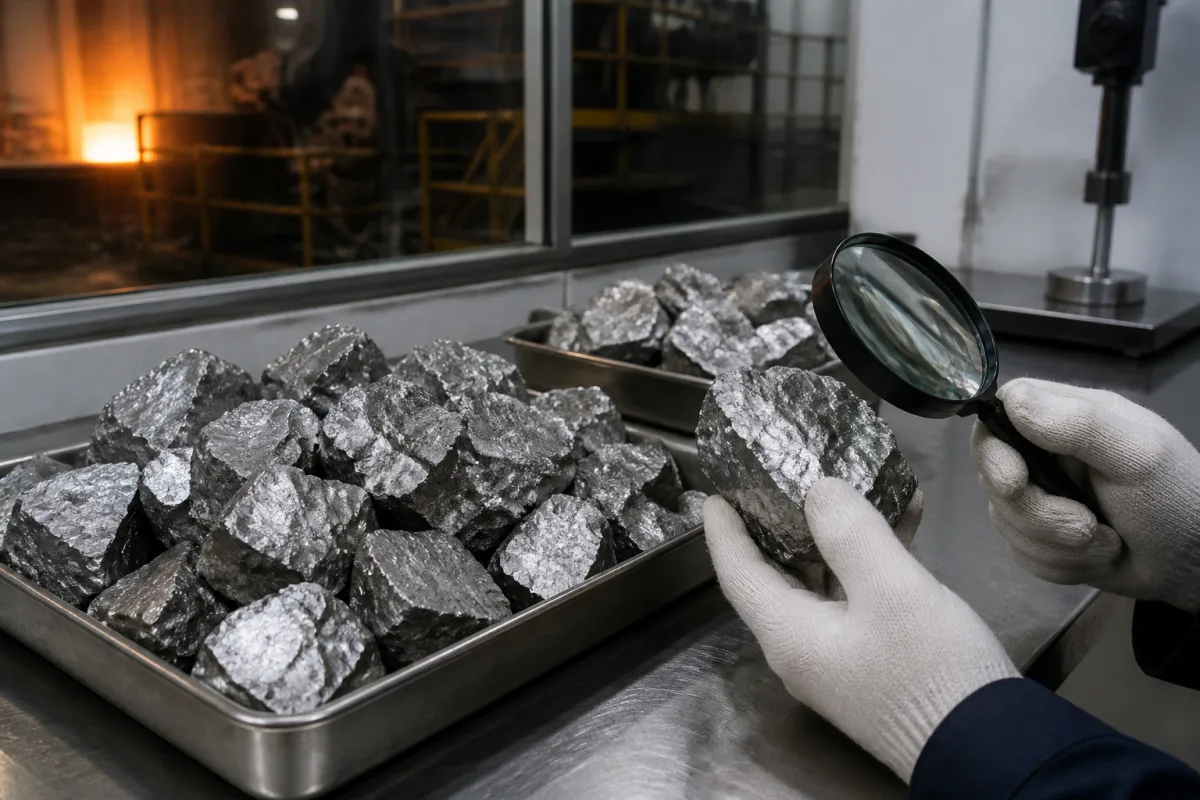
Ferrotitanium (FeTi) alloy additions for steelmaking · 40% and 70% titanium grades, induction melting of titanium scrap under a salt cover or aluminothermic reduction of ilmenite, IS 1468 grade chemistry and size bands, ASTM A324 grades A–D, uses in deoxidation, grain-size control and carbon and nitrogen stabilisation, and US price and trade data
Ferrotitanium is an iron-titanium master alloy, supplied in specified sizes, that carries titanium into molten steel and other alloys. Titanium removes oxygen, refines grain size and ties up carbon and nitrogen. Ask three things first: which titanium grade and specification you need (for example a 70% Ti grade under IS 1468 or an ASTM A324 grade), which impurity limits matter for your steel (such as carbon, aluminium, silicon and nitrogen), and what size band and packing suit your addition practice.
Ferrotitanium alloy additions for steelmaking, stainless and alloy production. Titanium sponge, titanium mill products, ferrosilicon titanium and titanium cored wire are outside this page except where compared.
CNFX editorial research · Sources checked October 12, 2026 · 7 sources
The US Geological Survey's 2021 Minerals Yearbook chapter on titanium states that "ferrotitanium usually is produced by induction melting of titanium scrap with iron or steel but may be produced through the aluminothermic reduction of ilmenite", and that "the two grades of ferrotitanium that are normally produced contain 40% and 70% titanium". The same report says that a significant amount of titanium, as ferrotitanium, scrap and sponge, was consumed in the steel and nonferrous alloy industries. In steel it was used for deoxidation, grain-size control, and control and stabilisation of carbon and nitrogen, and titanium-intensive steels include interstitial-free, stainless and high-strength low-alloy steels. [1]
USGS reports US consumption of titanium in steel and other alloys of 8,830 t in 2021, including ferrotitanium, scrap, sponge and other additives. Of this, 4,770 t went into carbon steel, 1,580 t into stainless and heat-resisting steel and 554 t into superalloys. US imports of ferrotitanium and ferrosilicon titanium were 4,150 t in 2021, up 46% from 2020, and exports were 1,280 t. [1]
Editorial calculation: carbon steel took about 54% of the 8,830 t (4,770 ÷ 8,830).
Indian Standard IS 1468:2000 defines ferrotitanium as a master alloy of iron and titanium with a minimum titanium content of 20.0 percent and a maximum of 75.0 percent by mass, obtained by reduction, and covers eight grades for the ferrous industry. [4]
02
Compare the scrap-melting and aluminothermic routes
US patent 3,410,679 (Tammet International, 1968) explains why scrap melting needs special practice. Finely divided titanium scrap such as turnings, borings and chips is highly pyrophoric and floats on the melt, so ordinary air melting leads to oxidation or ignition and poor recovery, and titanium reacts strongly with refractory linings at its melting temperature. The patented route packs the scrap into iron or steel tubes in the target titanium-to-iron ratio and lowers them into a superheated ferrotitanium heel in an induction furnace lined with high-alumina or magnesia refractory, under a liquid salt cover such as barium chloride, barium chloride–sodium chloride or cryolite. [6]
The patent states that the economics are best at 60% to 75% titanium, because of the relatively low liquidus of those alloys, which reduces reaction with linings and slag and needs less power; compositions from 10% to 80% titanium can be made by diluting that melt with iron or titanium scrap. Carbon can be controlled from 0.05% to 8.0% by scrap selection or added graphite. Its worked example filled an SAE 1015 steel tube weighing 1.22 lb with 3.78 lb of titanium-alloy turnings containing 5.5–6.75% aluminium and 3.5–4.5% vanadium, and charged it into a salt-covered melt held at 2450 °F. The scrap must be free of oil, dirt and water that would cause excessive gassing. [6]
The aluminothermic route reduces iron and titanium oxides with aluminium powder, for example 3TiO2 + 4Al → 3Ti + 2Al2O3. A 2023 ICSOBA conference paper from the National Technical University of Athens describes adding sodium chlorate as an exothermic agent so the reaction runs auto-thermally above the slag melting point, and lime as a slag former, and notes that ferrotitanium grades range from around 30 to 75 wt% titanium. [7] The 1968 patent describes ferrotitanium master alloys made by reducing ilmenite with aluminium in electric arc furnaces as relatively expensive compared with its scrap process. [6]
Editorial note: scrap-based alloy carries the alloying elements of the scrap, such as the aluminium and vanadium in the turnings of the patent example, so ask for residuals that matter to your steel.
Ask the supplier which route and raw materials it uses (scrap type, ilmenite or other oxide feed), the furnace and refractory, how scrap is cleaned, and which residual elements the route can carry into the alloy.
03
Write the specification
ASTM A324 covers four grades of ferrotitanium, designated A, B, C and D. The grades come in different sizes and must meet chemical composition requirements for titanium, carbon, silicon and aluminium. Supplementary limits can apply to manganese, phosphorus, sulphur, chromium, nickel, molybdenum, copper, cobalt, vanadium, lead, arsenic, bismuth, tin, zinc, zirconium, boron and nitrogen. The full limits are in the paid standard; ask the supplier for the grade table and a certificate of analysis. [3]
IS 1468:2000 sets primary limits for titanium, carbon, silicon, aluminium, manganese, phosphorus and sulphur, and supplementary limits for chromium, copper, cobalt, vanadium, zirconium, tin, lead and nitrogen. Its 70% grades, FeTi70Al2 and FeTi70Al5, require 65–75% titanium with maximum carbon of 0.15% and 0.20%, silicon 0.50%, aluminium 2.0% and 5.0%, and nitrogen 0.2%. The 35% and 45% grades allow up to 8.0% and 5.0% aluminium in their high-aluminium versions, and two silicon-bearing grades, FeTi28Si23 and FeTi35Si20, carry 20–25% and 15–20% silicon. [4]
The Indian standard also fixes how lots are built and checked. A consignment may be a tapped lot from one melt, a graded lot of melts whose titanium contents differ by no more than 3 percent, or a blended lot crushed below 50 mm and mixed. The manufacturer supplies a test certificate of chemical analysis for each melt; closer ranges or other element limits are agreed between buyer and maker. Material is supplied in lumps or crushed and screened sizes of over 2 to 5 mm, 5 to 15 mm and 15 to 50 mm, with oversize up to 5% or 10% and undersize up to 10%, excluding dust below 2 mm. Containers are marked with supplier, grade, cast or lot number, size designation, quantity and date of manufacture. [4]
The international standard is ISO 5454:1980, Ferrotitanium — Specification and conditions of delivery, a 3-page document sold by standards distributors. [5]
For US imports, the USGS Mineral Commodity Summaries list ferrotitanium and ferrosilicon titanium under tariff item 7202.91.0000, at 3.7% ad valorem under normal trade relations as of 31 December 2024. [2]
Give the supplier the titanium grade (for example 40% or 70% Ti) or ASTM A324 grade, the maximum carbon, aluminium, silicon, nitrogen and other residuals you need, the size range and fines limit, the packing (bags, drums), the quantity and delivery schedule, and the certificate of analysis and sampling method required.
04
Check price history and supply origins
The USGS Minerals Yearbook gives average prices from S&P Global Platts Metals Week: ferrotitanium with 70% titanium averaged $2.45 per pound in 2020 and $4.12 per pound in 2021, while unprocessed titanium scrap turnings went from $0.89 to $1.69 per pound. In 2021 US imports of ferrotitanium and ferrosilicon titanium of 4,150 t came from Russia (1,510 t), the United Kingdom (1,390 t), Canada (753 t), Ukraine (323 t) and other sources (176 t). [1]
Editorial calculation: the 70% ferrotitanium price rose by about 68% from 2020 to 2021 (4.12 ÷ 2.45), and scrap turnings by about 90% (1.69 ÷ 0.89), consistent with scrap being a raw material for the alloy.
Ask any supplier for the producing plant and country of melt, the route, current lot certificates, and the sampling method used for the certificate.
05
Compare grade chemistry in IS 1468
Selected grades from IS 1468:2000 Table 1, percent by mass. Values are maxima except titanium and the silicon range of the FeTi28Si23 grade. [4]
Grade
Ti %
C max %
Si max %
Al max %
N max %
FeTi35Al2
30–40
0.15
3.0
2.0
0.2
FeTi35Al8
30–40
0.15
5.0
8.0
0.2
FeTi45Al2
40–50
0.15
3.0
2.0
0.2
FeTi45Al5
40–50
0.20
5.0
5.0
0.2
FeTi70Al2
65–75
0.15
0.50
2.0
0.2
FeTi70Al5
65–75
0.20
0.50
5.0
0.2
FeTi28Si23
25–30
1.00
20–25 (range)
1.00
Not set
06
Fill the specification fields with values for your melt shop
A ferrotitanium quotation needs values for your process. The table explains each field, gives published information where a reviewed source states it, and says what to ask the supplier for.
Field
What it means and published information
Ask the supplier for
Titanium grade
USGS: 40% and 70% Ti grades "normally produced"; IS 1468 grades span 25–30% to 65–75% Ti. [1][4]
Ti range for your grade.
Specification
ASTM A324 grades A–D; IS 1468 eight grades; ISO 5454. [3][4][5]
Grade table; certificate.
Main impurities
Limits on C, Si and Al; supplementary elements incl. N, B, Pb. [3] IS 1468 70% grades: C 0.15–0.20%, Al 2.0–5.0%, N 0.2% max. [4]
Limits for your steel.
Size
IS 1468 bands over 2–5, 5–15 and 15–50 mm; undersize excludes dust below 2 mm. [4]
Size band; fines limit.
Lot and certificate
Tapped, graded or blended lot; test certificate for each melt. [4]
Lot method; sampling.
Production route
Scrap induction melting or aluminothermic reduction of ilmenite. [1][6]
Route and raw materials.
Use
Deoxidation; grain size; C and N stabilisation. [1]
Explore company information and manufacturing capabilities, then discuss the scope of your project with a relevant supplier.
Share this page
Compiled and source-reviewed by the CNFX editorial team.
Published product pages show what a company offers, not tested composition. Ask for a certificate of analysis for your lot. Confirm the legal seller, factory and scope. How we source and review
· Page last updated 13 October 2026
Buyer questions
What is ferrotitanium used for?
USGS says titanium is added to steel for deoxidation, grain-size control and control and stabilisation of carbon and nitrogen. [1]
Which grades are produced?
USGS states that "the two grades of ferrotitanium that are normally produced contain 40% and 70% titanium"; ASTM A324 defines grades A to D and IS 1468 defines eight grades. [1][3][4]
How is ferrotitanium made?
By induction melting titanium scrap with iron or steel, or by aluminothermic reduction of ilmenite. A 1968 patent describes charging scrap in steel tubes under a molten salt cover. [1][6]
What sizes are specified?
IS 1468 gives size bands of over 2 to 5 mm, 5 to 15 mm and 15 to 50 mm, with set oversize and undersize limits. [4]
Sources and what still needs a direct check
Sources checked 2026-10-12. The USGS reports are US government statistics and descriptions. The ASTM page is the public abstract of the standard; the full standard is sold by ASTM. IS 1468:2000 is the Bureau of Indian Standards specification, made public by Public.Resource.Org. The ISO 5454 entry is a distributor listing only. US 3,410,679 is an expired patent describing one scrap-melting method, and the ICSOBA paper is a research study of the aluminothermic route.