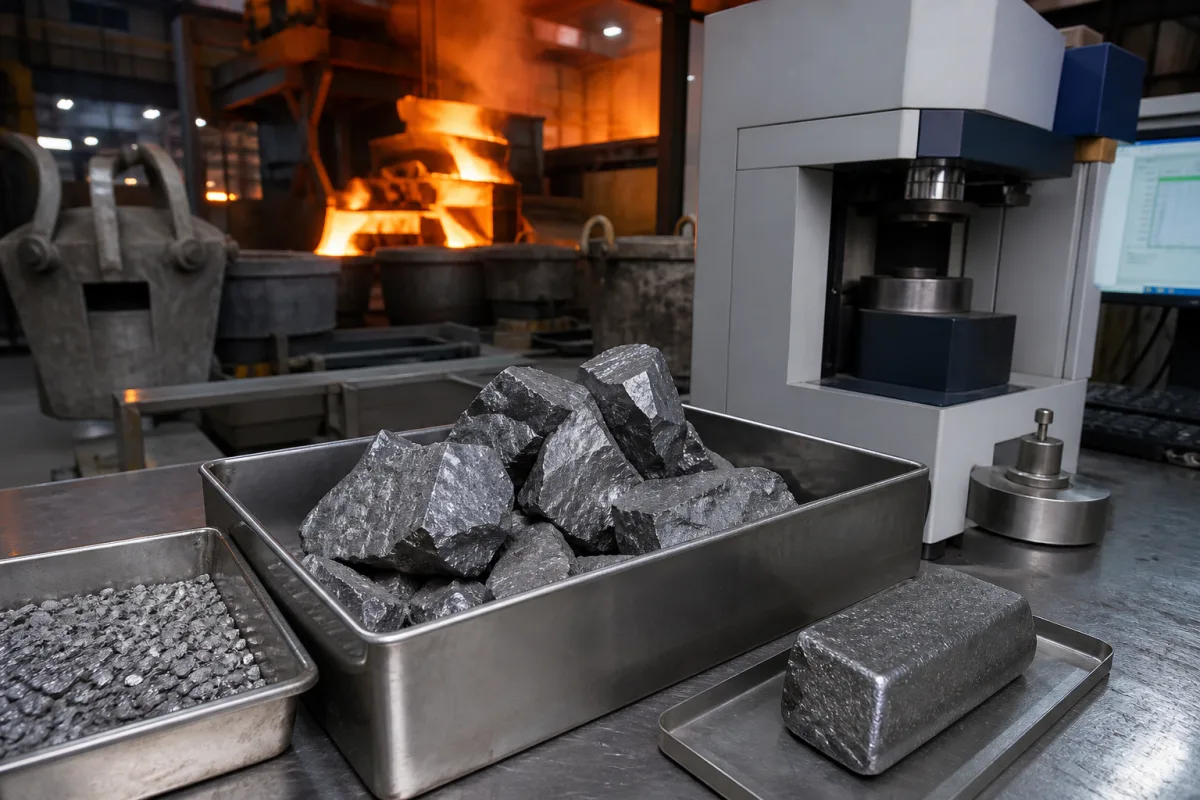
Cast iron inoculants · Barium-bearing ferrosilicon grades, the role of Ca, Al and Ba, addition rate and sizing for furnace, ladle and stream
A ferrosilicon-barium inoculant is ferrosilicon alloyed with barium, together with calcium and aluminium, that foundries add to molten grey, ductile or compacted graphite iron just before or during pouring to create nuclei for graphite, reduce chill (white iron) and improve structure. Ask three things first: which Si, Ba, Ca and Al contents your iron and process need, at what rate and point it is added, and which particle size suits furnace, ladle or stream addition.
Barium-bearing ferrosilicon inoculants for cast iron. Plain ferrosilicon (covered by a separate CNFX guide), magnesium ferrosilicon nodularisers, strontium or zirconium inoculants and steel deoxidisers are outside this page, except where compared.
CNFX editorial research · Sources checked October 18, 2026 · 4 sources
In a 2005 Archives of Foundry paper, Guzik and co-authors from AGH University in Kraków and Silesian University of Technology tabulate inoculants used in Polish foundries. Barium-bearing ferrosilicon grades include Foundrysil (Si 73–78%, Ca 0.75–1.25%, Al 0.75%, Ba 0.75–1.25%), SB5 (Si 64–70%, Ca 1%, Al 1.5%, Ba 2%), Barinoc (Si 73–78%, Ca 1–2%, Al 0.8–1.5%, Ba 2–3%) and Inobar (Si 64%, Ca 1%, Al 1.3%, Ba 9%), alongside Ca–Al, Sr and Zr grades. [1]
The authors explain that reactive elements combine with Ca, Al, Ba and Sr in FeSi75 to form heterogeneous nucleation sites for graphite, and that the combined effect of Ca, Al, Ba and Sr gives better chill control than Ca + Al alone; their complex inoculant (76% Si, 0.49% Ca, 1.1% Al, 0.44% Ba, 0.45% Sr) contained Ba–Al–Sr–Si and Sr–Ca–Ba–Si phases and, the authors report, raised nodule count in ductile iron and in grey and vermicular irons, with industrial trials confirming the effect. [1]
Cometal describes its SB 10 (Si 60–77%, Ba 8–12%, Al 1.0–1.8%, Ca 0.5–1.8%) as a pre-inoculant for grey and nodular iron, adding barium with aluminium and calcium to favour graphite precipitation, reduce the tendency to white solidification and improve mechanical properties. [2]
Give the supplier the iron type (grey, ductile, compacted), base composition and sulfur, section sizes and chill problems, where and when the inoculant is added (furnace, ladle, stream, in-mould), pouring delay, target Si, Ba, Ca and Al ranges, size range, packaging, and the analysis certificate required for each lot.
02
Set addition rate, point and sizing
Cometal gives an SB 10 addition rate of 0.1–0.5%, depending on iron temperature and the type and time of addition, and says it can be added in the melting furnace, during tapping or during transfer. Its sizes are 0.2–0.7 mm for in-stream inoculation (with silicon slightly lower in this size) and 0.6–3 mm or 2–6 mm for ladle inoculation, packed in 25 kg sacks, 100 kg drums or 1,000 kg big bags; it should be kept away from moisture. [2]
Editorial calculation: assuming a 1,000 kg base-iron batch, an SB 10 addition of 0.3% of that base mass and alloy Ba content at the specified 8–12% endpoints, the charge contains 3 kg inoculant and 0.24–0.36 kg barium, equivalent to 0.024–0.036% of the original iron mass. This is a nominal charged-mass calculation, not manufacturer-published or measured residual barium in the melt; it makes no recovery, dissolution or retained-Ba assumption. Confirm the actual batch analysis and addition practice. [2]
Editorial note: agree the addition point and the maximum time from addition to pouring with the supplier, and confirm the effect with chill-wedge or nodule-count results in trials.
03
Judge inoculant performance by chill depth and nodule count
Elkem's US patent 6,102,983 (priority 8 December 1997, granted 15 August 2000) explains how inoculant power is compared: by its ability to reduce chill depth (iron carbide formed in rapidly cooled thin sections) and, in ductile iron, by the number of graphite spheroids per unit area in the as-cast condition. It states that barium used with calcium gives a greater reduction in chill than an equivalent amount of calcium, and that a high nucleation rate may also give better resistance to fading of the inoculating effect when the iron is held after inoculation. [3]
In Example 4, the patent gives final ductile-iron composition 3.7% C, 2.5% Si, 0.2% Mn, 0.04% Mg and 0.01% S, with inoculant added to the pouring ladle after magnesium treatment. Its 5 mm sand-moulded plates gave 399 nodules/mm² for Ca–FeSi reference F and 478 for Ca–Ba–FeSi plus sulphide/oxide mixture J. Example 2 identifies J’s base alloy as 1.1% Ca and 1.2% Ba, mixed with iron sulphide and iron oxide. The comparison changes more than barium content and does not isolate a barium-only effect. [3] A separate Example 6 uses 25 mm-diameter cylindrical bars and reports 174 nodules/mm² for commercial 1% Ca/1% Ba reference P, 508 for Bi/rare-earth reference Q and 601 for oxygen/sulphur-bearing R. These are separate experiments, not values to pool into one section-size comparison. [3]
The patent describes a base alloy with 40–80% Si and 0.5–10% of one or more of Ca, Sr or Ba, with Al below 5%; the claimed finished inoculant also includes oxide and sulphide additions and other allowed constituents. Its examples use 0.5–2 mm or 0.2–1 mm base-particle sizes, with some agglomerated mixtures re-crushed to 0.5–2 mm. Compare the actual grade, addition rate and treatment in foundry trials rather than applying these patent ranges to every FeSiBa product. [3]
04
Separate barium inoculant offers from nodulariser and deoxidiser offers
The chemistry and the addition operation identify the offered grade: Cometal describes SB 10 for pre-inoculation, while the Guzik paper compares barium-bearing and multi-element inoculants. A magnesium treatment and a later inoculation serve different functions; request the chemical ranges and addition instructions for the named product. [2][1]
05
Compare a low-barium 75% FeSi grade and check its trial claims
Miller and Company's specification for its 75% FeSi-Ca+Ba inoculant (effective date 5/12/08) gives 70.0–79.0% Si, 0.80–1.50% Ca, 0.80–1.50% Ba and 1.50% Al maximum, in the size 3/8″ × 20M, and notes that product specifications are subject to change. [4]
For grey iron, Miller states that about 40% less of this alloy is needed to reach the chill depths obtained with standard inoculating-grade ferrosilicon, and that it is particularly useful in irons of 3.6–3.8 carbon equivalent. For ductile iron it reports a two-day trial in a commercial foundry in which the calcium-plus-barium alloy gave nodule counts 18% higher than a regular calcium-bearing ferrosilicon or a high-aluminium European inoculant. [4] These are the supplier's own claims without published test conditions; ask for the trial data or repeat the comparison on your own chill wedges and test bars.
The Miller specification and Cometal’s SB 10 have different barium ranges and process descriptions. Quote the actual Si, Ba, Ca and Al limits with the grade name and addition instructions. A ratio between their Ba percentages alone does not establish equivalent dosage, retained barium or chill-control performance. [4][2]
06
Specify reactive elements and size fraction as separate controls
Use the actual grade limits: Cometal SB 10 lists 60–77% Si, with its 0.2–0.7 mm fraction slightly below that Si range; Guzik’s listed barium grades have their own ranges or stated values. [2][1]
2 companies list this product among what they make. Company figures are quoted from each
company's own website; every card states where the relationship came from.
Anyang Jinfang Metallurgy Co.,Ltd.
TBC
Lists ferro silicon barium and silicon barium calcium with other inoculants and nodularisers.
Manufactures ferroalloys and lists ferro-silicon-barium inoculant for cast-iron applications; obtain the contracted chemistry and sieve fraction for the selected grade.
Explore company information and manufacturing capabilities, then discuss the scope of your project with a relevant supplier.
Share this page
Compiled and source-reviewed by the CNFX editorial team.
Each manufacturer above links to the page on that company's own website where the product is listed, with the date we checked it. How we source and review
· Page last updated 13 October 2026
Buyer questions
How much barium is in ferrosilicon-barium inoculants?
It varies by grade; Guzik et al. list about 0.75–1.25% (Foundrysil), 2–3% (Barinoc) and 9% (Inobar), and Cometal's SB 10 has 8–12%. [1][2]
How much FeSiBa inoculant is added to iron?
Cometal gives 0.1–0.5% for SB 10, depending on iron temperature and the type and time of addition. [2]
Why combine barium with calcium and aluminium?
Guzik et al. report the combined Ca, Al, Ba and Sr elements form nucleation sites for graphite and control chill better than Ca + Al alone. [1]
How is a barium inoculant's effect measured?
Elkem's US patent 6,102,983 compares inoculants by chill depth and, in ductile iron, by graphite nodules per mm², and states that barium with calcium reduces chill more than calcium alone. [3]
How much barium is in a 75% ferrosilicon Ca+Ba inoculant?
Miller and Company's 75% FeSi-Ca+Ba specification gives 0.80–1.50% Ba, with 0.80–1.50% Ca, 70.0–79.0% Si and 1.50% Al maximum. [4]
Sources and what still needs a direct check
Sources checked 2026-10-18. The Archives of Foundry paper is a university study with a table of commercial inoculants; Cometal describes its own SB 10 product; Elkem's patent reports its own nodule-count trials. Inoculation practice for your iron should be confirmed in foundry trials.