Industry-Verified Manufacturing Data (2026)

Plate Support Table

Based on aggregated insights from multiple verified factory profiles within the CNFX directory, the standard Plate Support Table used in the Other Transport Equipment Manufacturing sector typically supports operational capacities ranging from standard industrial configurations to heavy-duty production requirements.

Technical Definition & Core Assembly

A canonical Plate Support Table is characterized by the integration of Support Frame and Table Surface/Deck. In industrial production environments, manufacturers listed on CNFX commonly emphasize Carbon Steel construction to support stable, high-cycle operation across diverse manufacturing scenarios.

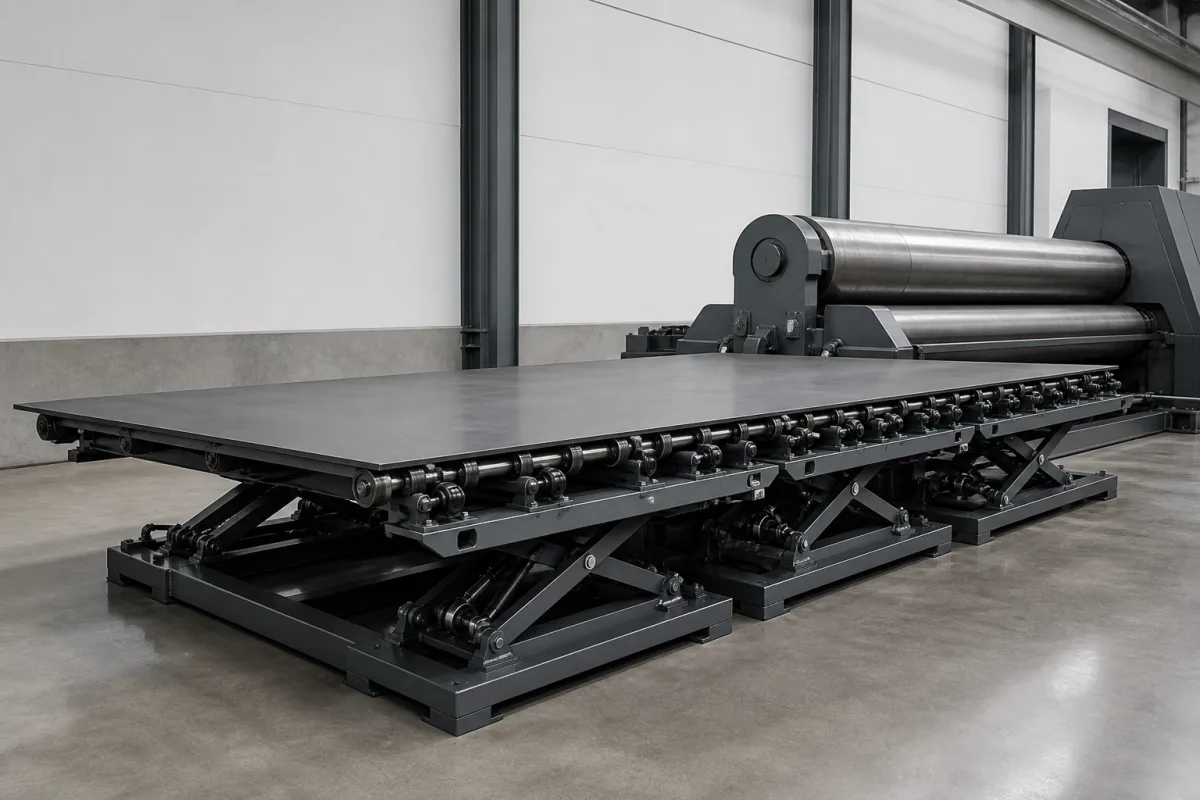
A structural component of a Marine Hull Plate Bending Roller that provides stable support and alignment for steel plates during the bending process.

Product Specifications

Technical details and manufacturing context for Plate Support Table

Definition
The Plate Support Table is an integral part of the Marine Hull Plate Bending Roller, specifically designed to hold, position, and stabilize large steel plates (typically used in ship hull construction) as they are fed into and processed by the bending rollers. It ensures proper alignment, prevents sagging or deformation of the plate under its own weight before bending, and facilitates smooth material handling throughout the forming operation.
Working Principle
The table provides a flat, rigid, and often adjustable surface that supports the plate from below. It may incorporate rollers, guides, or clamps to assist with plate feeding and positioning. Its primary function is to maintain the plate in the correct horizontal plane and orientation relative to the bending rollers, ensuring consistent and accurate bends by counteracting gravitational forces and initial plate irregularities.
Common Materials
Carbon Steel, Alloy Steel
Technical Parameters
  • Table length, width, and load-bearing capacity to match the maximum plate dimensions and weight handled by the bending roller. (mm) Standard Spec
Components / BOM
  • Support Frame
    Provides the main structural rigidity and foundation for the table surface.
    Material: Structural Steel
  • Table Surface/Deck
    The flat, load-bearing surface that directly contacts and supports the plate. May include wear plates.
    Material: Hardened Steel Plate
  • Alignment Guides/Rails
    Side guides or rails to ensure the plate enters the bending rollers straight and aligned.
    Material: Steel
  • Height Adjustment Mechanism
    Allows vertical positioning of the table to match the roller entry point (if equipped).
    Material: Steel, Hydraulic/Gear Components
Engineering Reasoning
0-150 MPa compressive stress, 0-25 mm deflection, 20-200°C temperature
Yield strength exceedance at 250 MPa (ASTM A36 steel), buckling at 15 kN/m² distributed load, permanent deformation at 0.3% strain
Design Rationale: Plastic deformation due to von Mises yield criterion exceedance, Euler buckling instability at critical load P_cr = π²EI/L², thermal expansion mismatch at Δα = 11.7×10⁻⁶/°C (steel)
Risk Mitigation (FMEA)
Trigger Cyclic loading at 10⁶ cycles with stress amplitude Δσ = 180 MPa
Mode: Fatigue crack initiation at stress concentration factor K_t = 3.2 weld toe
Strategy: Shot peening to induce 400 MPa compressive residual stress, radius optimization to reduce K_t to 1.8
Trigger Corrosion rate of 0.5 mm/year in 3.5% NaCl seawater environment
Mode: Section loss reducing moment of inertia I by 40%, leading to deflection exceedance
Strategy: Hot-dip galvanizing with 85 μm zinc coating, cathodic protection at -0.85 V vs Ag/AgCl reference

Industry Taxonomies & Aliases

Commonly used trade names and technical identifiers for Plate Support Table.

Industrial Ecosystem & Supply Chain DNA

Complementary Systems
Downstream Applications
Specialized Tooling

Application Fit & Sizing Matrix

Operational Limits
pressure: N/A (structural support component, not pressure vessel)
other spec: Max Plate Load: 50-500 tons (depending on configuration), Alignment Tolerance: ±0.5mm, Vibration Damping: ≤0.1g RMS
temperature: -20°C to 150°C (ambient to heated plate conditions)
Media Compatibility
✓ Marine-grade steel plates (AH36/DH36) ✓ High-strength low-alloy (HSLA) steel ✓ Stainless steel plates (316L/duplex grades)
Unsuitable: Corrosive saltwater immersion environments without cathodic protection
Sizing Data Required
  • Maximum plate dimensions (length × width × thickness)
  • Required bending radius/plate curvature specifications
  • Anticipated dynamic loading during rolling operation

Reliability & Engineering Risk Analysis

Failure Mode & Root Cause
Structural fatigue cracking
Cause: Cyclic loading from repeated plate placement/removal causing stress concentration at weld joints or material discontinuities
Surface deformation and wear
Cause: Impact damage from dropped plates or abrasive sliding contact during plate positioning, exacerbated by inadequate surface hardness or protective coating degradation
Maintenance Indicators
  • Visible cracks or permanent deformation in support structure members
  • Abnormal vibration or audible metallic ringing during plate handling operations
Engineering Tips
  • Implement regular non-destructive testing (magnetic particle or dye penetrant) at high-stress weld locations to detect early-stage cracking
  • Apply wear-resistant surface treatments (hardfacing or ceramic coatings) to contact areas and establish controlled plate handling procedures to minimize impact loading

Compliance & Manufacturing Standards

Reference Standards
ISO 9001:2015 - Quality management systems ASTM A36/A36M-19 - Standard Specification for Carbon Structural Steel CE Marking - Directive 2006/42/EC for machinery safety
Manufacturing Precision
  • Flatness: +/- 0.5mm per meter
  • Hole diameter: +/- 0.1mm
Quality Inspection
  • Dimensional verification with CMM (Coordinate Measuring Machine)
  • Ultrasonic testing for material integrity

Factories Producing Plate Support Table

Verified manufacturers with capability to produce this product in China

✓ 93% Supplier Capability Match Found

S Sourcing Manager from Germany Jan 08, 2026
★★★★★
"The technical documentation for this Plate Support Table is very thorough, especially regarding technical reliability."
Technical Specifications Verified
P Procurement Specialist from Brazil Jan 05, 2026
★★★★☆
"Reliable performance in harsh Other Transport Equipment Manufacturing environments. No issues with the Plate Support Table so far. (Delivery took slightly longer than expected, but technical support was excellent.)"
Technical Specifications Verified
T Technical Director from Canada Jan 02, 2026
★★★★★
"Testing the Plate Support Table now; the technical reliability results are within 1% of the laboratory datasheet."
Technical Specifications Verified
Verification Protocol

“Feedback is collected from verified sourcing managers during RFQ (Request for Quote) and factory evaluation processes on CNFX. These reports represent historical performance data and technical audit summaries from our B2B manufacturing network.”

16 sourcing managers are analyzing this specification now. Last inquiry for Plate Support Table from Germany (51m ago).

Supply Chain Compatible Machinery & Devices

Container Crane

A large crane designed specifically for loading and unloading intermodal containers from container ships at port terminals.

Explore Specs →
Ship-to-Shore Crane

A large gantry crane used at container terminals to load and unload containers from ships.

Explore Specs →
Offshore Crane

A heavy-duty crane specifically designed and engineered for marine and offshore operations, capable of lifting and moving loads in challenging sea environments.

Explore Specs →
Reach Stacker

A specialized container handling vehicle used in ports and terminals for stacking and transporting shipping containers.

Explore Specs →

Frequently Asked Questions

What materials are used in plate support tables for marine applications?

Our plate support tables are constructed from high-grade carbon steel or alloy steel to withstand the demanding conditions of marine hull fabrication and provide long-lasting structural integrity.

How does the height adjustment mechanism work on these support tables?

The height adjustment mechanism allows precise vertical positioning of the table surface to accommodate different plate thicknesses and ensure optimal alignment with the bending roller for consistent results.

What maintenance is required for marine plate support tables?

Regular inspection of alignment guides, lubrication of adjustment mechanisms, and surface cleaning to prevent corrosion are recommended. The durable steel construction minimizes maintenance needs in industrial environments.

Can I contact factories directly on CNFX?

CNFX is an open directory, not a transaction platform. Each factory profile provides direct contact information and production details to help you initiate direct inquiries with Chinese suppliers.

Get Quote for Plate Support Table

Request technical pricing, lead times, or customized specifications for Plate Support Table directly from verified manufacturing units.

Your business information is encrypted and only shared with verified Plate Support Table suppliers.

Thank you! Your message has been sent. We'll respond within 1–3 business days.

Need to Manufacture Plate Support Table?

Connect with verified factories specializing in this product category

Add Your Factory Contact Us
Previous Product
Plate Conveyor System
Next Product
Platform Deck