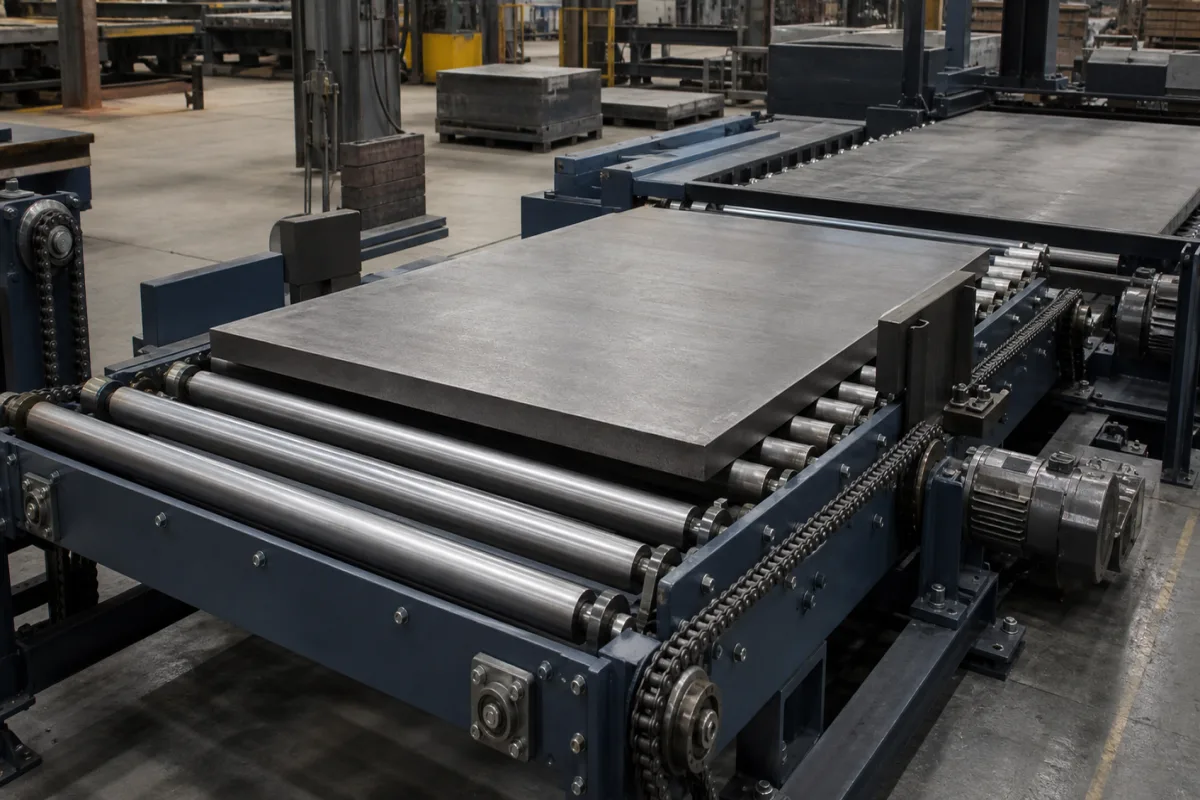
Chain-driven roller tables that carry steel plates through a wheel blast machine: speed against plate length, and roller and frame ratings against plate weight per metre
Hull plate blasting · the powered roller tables that feed plates into a wheel blast machine, carry them through at a set speed and take them away again, and the plate weight per metre they have to carry
In a through-feed wheel blast machine the plate never stops: powered rollers push it into the blast chamber, carry it under the wheels at the speed the blast result needs, and deliver it onto an outfeed table. That roller table decides how long each part of the plate is exposed to the shot, which plate lengths the line can take without the plate dropping between rollers, and how heavy a plate it can carry without bending rollers or overloading the drive chain.
Powered roller conveyors that carry steel plates and profiles into, through and out of wheel blast machines and shipyard plate preservation lines: chain-driven roller tables, variable conveyor speed, plate length and thickness limits, roller and chain ratings and frame support spacing. Complete wheel blast machines are covered on the Wheel shot blasting machines page; full preheat-blast-prime lines on the Hull plate preservation line page; blast wheel shafts and bearings on the Wheel drive shaft and bearings page; and abrasive recovery plants on the Steel grit recycling plant for air-nozzle blasting page. Roller lines for switchgear cabinets are covered on the Cabinet assembly transport line page, roller conveyors for upright 200-litre drums on the Drum conveyor page, and the rolls that bend hull plates on the Main (top) bending roll for hull and heavy shell plates page.
CNFX editorial research · Sources checked October 13, 2026 · 4 sources
Conveyor speed, plate length and thickness in one maker's roller-conveyor blast range
ATHI's guide to its Q69 roller-conveyor machines describes the sequence: the plate is loaded onto the infeed roller conveyor, all rollers run on variable-frequency drives so the operator or PLC can set 0.5 to 4.0 m/min, slower for heavily corroded plate and faster for light mill scale, and the cleaned plate leaves on the outfeed rollers. [2] Its product page adds that the roller conveyor can run forwards and backwards. [1]
The two ATHI documents disagree on the Q6940 conveyor speed and the shortest workpiece on the Q6930 and Q6940; both readings are shown, and the figure for a given order has to come from the supplier's quotation. ATHI's guide also warns against choosing a model by plate width alone: a 3 m plate with heavy rust may need more blast wheels or a slower conveyor than the standard Q6930 provides. [2]
The speed sets the time per plate. ATHI gives the example of a 6 m plate at 2 m/min taking about 3 minutes from entry to exit. [2] Editorial calculation with the range in the table: a 12 m plate needs 24 minutes to pass one point at 0.5 m/min and 3 minutes at 4 m/min, so the slow end of the speed range, chosen for heavily rusted plate, cuts throughput by a factor of eight against the fast end.
2–8 m/min on the product page; 0.5–4 m/min in the guide [1][2]
Give the supplier the shortest and longest plate, the thickness range, the worst surface condition (rust grade) to be blasted and the plates per shift; ask for the conveyor speed range that delivers the required cleanliness on the worst plate, and whether it has been confirmed on a test plate.
02
Plate weight per metre against roller, chain and frame ratings
A plate on a roller table loads the rollers it is resting on, the drive chain that pushes it and the frame between floor supports. Published chain-driven roller conveyor ratings show that each of these is a separate limit.
ACSI rates its heavy-duty 251CRR and 267CRR chain-driven live roller conveyors, built with 2-1/2 in × 11 gauge or 2-5/8 in × 7 gauge steel rollers, at 300 lb per linear foot with supports on 10 ft centres and 1,000 lb per linear foot with supports on 5 ft centres; No. 50 chain is used on 5, 7-1/2 or 10 in roller centres and No. 60 chain on 6, 7-1/2 or 12 in centres, with a 3/4 hp motor and 30 ft/min. [3] Editorial calculation: those ratings are about 446 kg/m and 1,488 kg/m. The same conveyor carries the 942 kg/m plate only with the closer support spacing, and neither rating covers the 2,590 kg/m plate.
Heavier rollers move the per-roller limit, not the frame limit. Barron Equipment lists a Model 535 chain-driven live roller conveyor with 3-1/2 in diameter, 0.300 in wall schedule 80 pipe rollers rated at 2,500 lb per roller, #60 or #80 roller-to-roller chain chosen by the chain pull required, roller centres of 6 in for #60 and 6-7/16 in for #80 chain, a 6 in structural channel frame and 30 ft/min. [4] Editorial calculation: 2,500 lb per roller at 6 in centres is about 7,400 kg per metre of rollers, which leaves the frame, supports and chain pull as the limits to check for the heaviest plate.
Inside the blast chamber the conveyor works under the shot stream. ATHI lines its chamber with rolled Mn13 wear plates, which it says reach a service life of 15,000 hours, and fixes them without bolts. [1] The rollers that pass through that zone and their seals at the chamber openings are part of the conveyor specification, not only of the machine.
Plate on the table (editorial calculation, steel at 7,850 kg/m³)
Weight per metre of conveyor
10 mm × 1,500 mm
≈ 118 kg/m
60 mm × 2,000 mm (thickest plate on the ATHI Q6920)
≈ 942 kg/m
110 mm × 3,000 mm (thickest plate on the ATHI Q6930)
≈ 2,590 kg/m
State the heaviest plate as kg per metre (thickness × width × length), the floor support spacing the pit or foundation allows, and ask for the roller rating, chain size and chain pull at that load, and how the rollers inside the blast chamber are protected and replaced.
03
Data to send with a plate blast conveyor enquiry
Paste it into your enquiry below or into an email to a maker, then replace every bracket.
Plates: [thickness range; width range; shortest and longest length; heaviest plate in kg]
Profiles: [section types and sizes, if any]
Line: [infeed and outfeed table lengths; machine model or chamber length; position in a preheat-blast-prime line]
Speed: [range in m/min; forward and reverse; control from the line PLC]
Rollers: [diameter and wall; roller centres; rating per roller]
Drive: [chain size; motor and gearbox; zones]
Frame: [support spacing; height to top of roller; foundation or pit]
Explore company information and manufacturing capabilities, then discuss the scope of your project with a relevant supplier.
Share this page
Compiled and source-reviewed by the CNFX editorial team.
Each manufacturer above links to the page on that company's own website where the product is listed, with the date we checked it. How we source and review
· Page last updated 13 October 2026
Buyer questions
What conveyor speed does a plate blast machine run at?
ATHI's guide gives 0.5 to 4.0 m/min on variable-frequency drives, slower for heavily corroded plate and faster for light mill scale; its product page lists 2 to 8 m/min for the 4,000 mm Q6940, so the figure has to be confirmed for the model ordered. [2][1]
How long does a plate take to go through?
ATHI's example is a 6 m plate at 2 m/min taking about 3 minutes. Editorial calculation: a 12 m plate takes 24 minutes to pass one point at 0.5 m/min. [2]
Can a standard chain-driven roller conveyor carry thick plate?
Check the frame as well as the rollers: ACSI rates its heavy-duty CDLR at 300 lb per foot on 10 ft support centres and 1,000 lb per foot on 5 ft centres, about 446 and 1,488 kg/m; a 60 mm × 2,000 mm plate is about 942 kg/m. [3]
How heavy can a single conveyor roller be rated?
Barron lists a Model 535 conveyor with 3-1/2 in schedule 80 pipe rollers rated at 2,500 lb per roller on 6 in centres with #60 chain. [4]
Sources and what still needs a direct check
Sources checked 2026-10-13. ATHI's product page and buyer's guide give conveyor speeds, plate sizes and chamber lining for one roller-conveyor blast range; ACSI and Barron Equipment publish load ratings for heavy-duty chain-driven live roller conveyors.