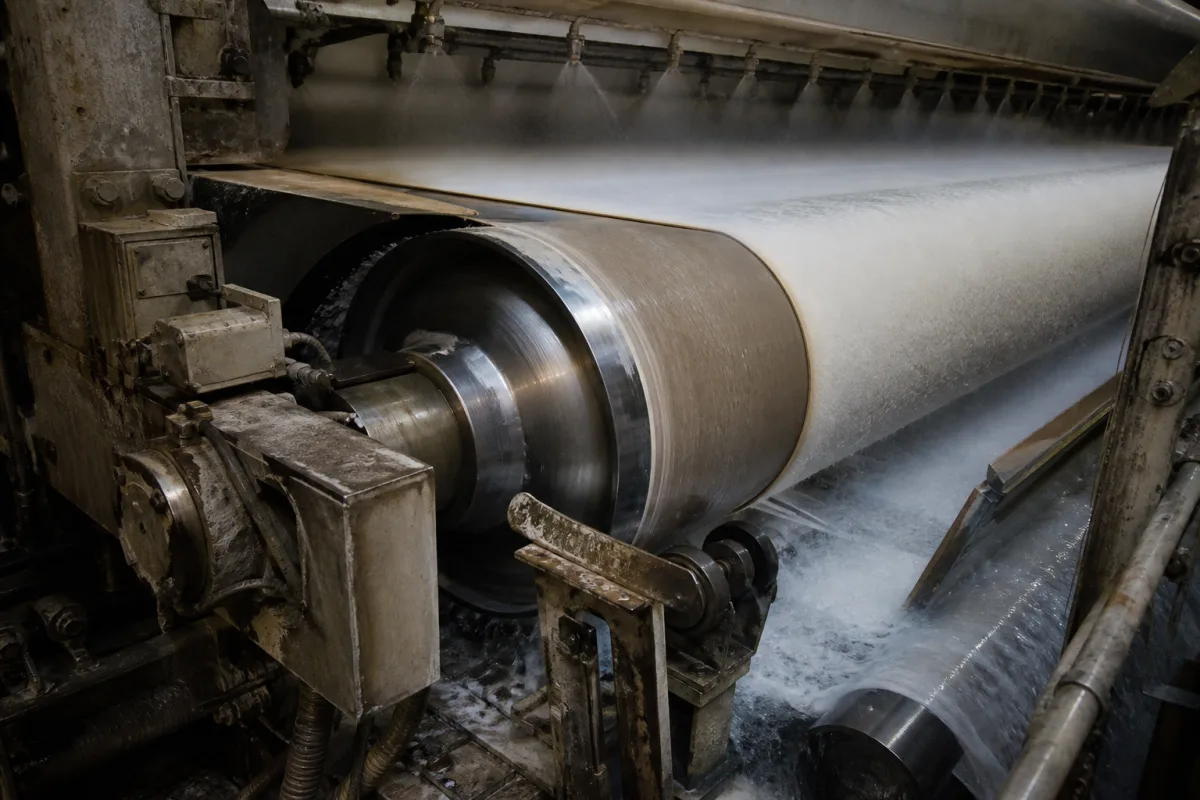
Paper machine felt rolls: the guide, stretch and carrying rolls of a press felt loop
The rolls that carry a press felt round its loop — and the two that do more than carry it: the guide roll skewed a few degrees to steer the felt, and the stretch roll that holds the loop tight
A press felt is an endless loop that passes through the press nips and then returns over a set of felt rolls, past showers and suction boxes, back to the nip. Two of those rolls decide whether the felt runs at all: a guide (alignment) roll that is skewed slightly to steer the felt sideways, and a stretch (tensioning) roll that is moved to keep the loop tight as the felt stretches with wear. Their geometry — wrap angle, free lengths before and after the roll, and the load the bearings carry — is what a supplier needs to know.
Felt rolls in the felt loops of paper, board and tissue machine press sections: carrying rolls, guide (alignment) rolls with their positioning actuators, and stretch (tensioning) rolls with their stretchers, with the felt tension, wrap angles and load measurement that govern them. Press rolls in the nips and their covers are covered on the Press roll page; the press section as a whole, including nip layout, shoe presses and felt conditioning, on the Paper machine press section page; forming-section suction boxes and doctoring systems on their own pages; dryer fabrics and their rolls on the Paper machine dryer section page.
CNFX editorial research · Sources checked October 12, 2026 · 4 sources
Guide roll: pivot on one bearing, 20–40° wrap, about 2/3 of felt width before it and 1/3 after
Erhardt+Leimer describes the principle: a roll set at an angle to the direction of fabric travel makes the fabric drift sideways, so the guide roll pivots about one of its two end bearings while an actuator moves the other end by the correction needed, with feedback closing the loop. For its felt and wire guides it asks for these geometries: [1]
Valmet's patent on fabric tensioning gives the same role to the roll in plain terms: inside each fabric loop an alignment roll is used, whose axial alignment controls the transverse position of the fabric. [3] Editorial calculation: on a 5.7 m wide felt such as the tissue pick-up felt described below, [4] Erhardt+Leimer's proportions call for roughly 3.8 m of free felt before the guide roll and 1.9 m after it.
Editorial note: those free lengths decide where in the loop a guide roll can go; when a press section is rebuilt or a felt run is shortened, check that the guide roll still has them, and size the guiding unit's nominal load against the felt tension and roll weight it will carry.
In the outfeed, as close to the roll as possible [1]
Nominal load of guiding units
2,500 N (SKA02), 13,000 N (SKA04), 18,000 N (SKA07), 30,000 N (SKA11) [1]
Give the guide supplier the felt width, loop layout drawing with free lengths and wrap angles, felt tension, roll weight and the space available at the actuator end.
02
Stretch roll: loop tension around 1–5 kN/m in Valmet's patent, 180° wrap preferred, compensation below 150°
Valmet's 1994 European patent application on fabric tensioning states that the loops of forming wires, drying wires and press felts must be tensioned to a tension T which is, in its words, “as a rule, set in the range of T ≈ 1...5 kN/m”, by a tensioning roll inside the loop whose bearing supports sit on sledges moved synchronously on the drive and operating sides. It criticises the older carriage-and-cable tensioner for friction, play and vibration. [3]
Erhardt+Leimer's spindle-type stretcher shows how the tension is held: tension sensors measure the fabric tension continuously, a digital three-point controller compares it with the set value and drives the spindle to move the stretch roll. A 180° wrap on the stretch roll is desirable, the adjusting plane should lie on the bisector between infeed and outfeed, and wrap-angle compensation is needed when the wrap is less than 150°. [2]
Editorial note: the felt stretches as it wears, so the stretch roll's travel has to cover the whole life of the felt from a new, short loop to a worn, longer one; ask the felt supplier for the expected stretch and the roll supplier for the stretcher stroke.
State the felt tension range in kN/m, felt length and expected stretch, the stretch roll's wrap and its adjusting direction, and whether tension is to be measured and controlled or only set.
03
Measuring felt tension through the roll bearings: a 5.7 m tissue pick-up felt on 50 kN load cells
A VPG (BLH Nobel) case study gives working figures for one felt roll. A Finnish tissue maker wanted the tension of the pick-up felt measured in an existing press section with high humidity, splashing water and chemicals at up to +60 °C. [4]
Editorial calculation: at 5 kN/m across 5.7 m the felt pulls 28.5 kN in each strand; with 145° of wrap the resultant on the roll is 2 × 28.5 × sin(72.5°) ≈ 54 kN, about 27 kN per bearing side, in line with the 26 kN tension force the case lists if that figure is per side (the note does not say). The roll's own 900 kg (about 8.8 kN) acts on the bearings as well.
Erhardt+Leimer offers sensors both ways: a tension sensor with bearing bracket on a guide roller, a sensor on a separate guide roller for pedestal bearings, and a sensor integrated in a stainless spindle stretcher for the press section. [2] The tissue mill's comment was that measured tension gave it control of felt wear and stretch and made start-up after a felt change easier. [4]
Editorial note: the wrap angle of the measuring roll fixes how much of the felt tension reaches the bearings, so a measuring roll should keep a constant wrap as the stretch roll moves; Erhardt+Leimer's wrap-angle compensation addresses the same issue on the stretch roll itself.
Explore company information and manufacturing capabilities, then discuss the scope of your project with a relevant supplier.
Share this page
Compiled and source-reviewed by the CNFX editorial team.
Each manufacturer above links to the page on that company's own website where the product is listed, with the date we checked it. How we source and review
· Page last updated 13 October 2026
Buyer questions
What does a felt guide roll do?
It is skewed about one end bearing to make the felt drift sideways and keep it centred; Erhardt+Leimer asks for 20–40° wrap, about 2/3 of felt width of free infeed and 1/3 of outfeed. [1]
What tension does a press felt run at?
Valmet's patent says paper machine fabric loops, press felts included, are “as a rule, set in the range of T ≈ 1...5 kN/m”; a tissue pick-up felt in VPG's case ran at 0–5 kN/m. [3][4]
What wrap does a stretch roll need?
Erhardt+Leimer says 180° is desirable and compensation is needed below 150°. [2]
How is felt tension measured?
With force transducers under the bearings of a felt roll: VPG fitted two 50 kN units, one each side, on a 5.7 m pick-up felt roll with 145° wrap. [4]
Sources and what still needs a direct check
Sources checked 2026-10-12. Guide roll geometry and guiding unit loads come from Erhardt+Leimer's ELGUIDE page; stretch roll wrap and tension control from its ELSTRETCHER page; the 1–5 kN/m loop tension and tensioner layout from Valmet's European patent application EP 0 611 267; working figures for a measured felt roll from VPG's BLH Nobel case study 41000.