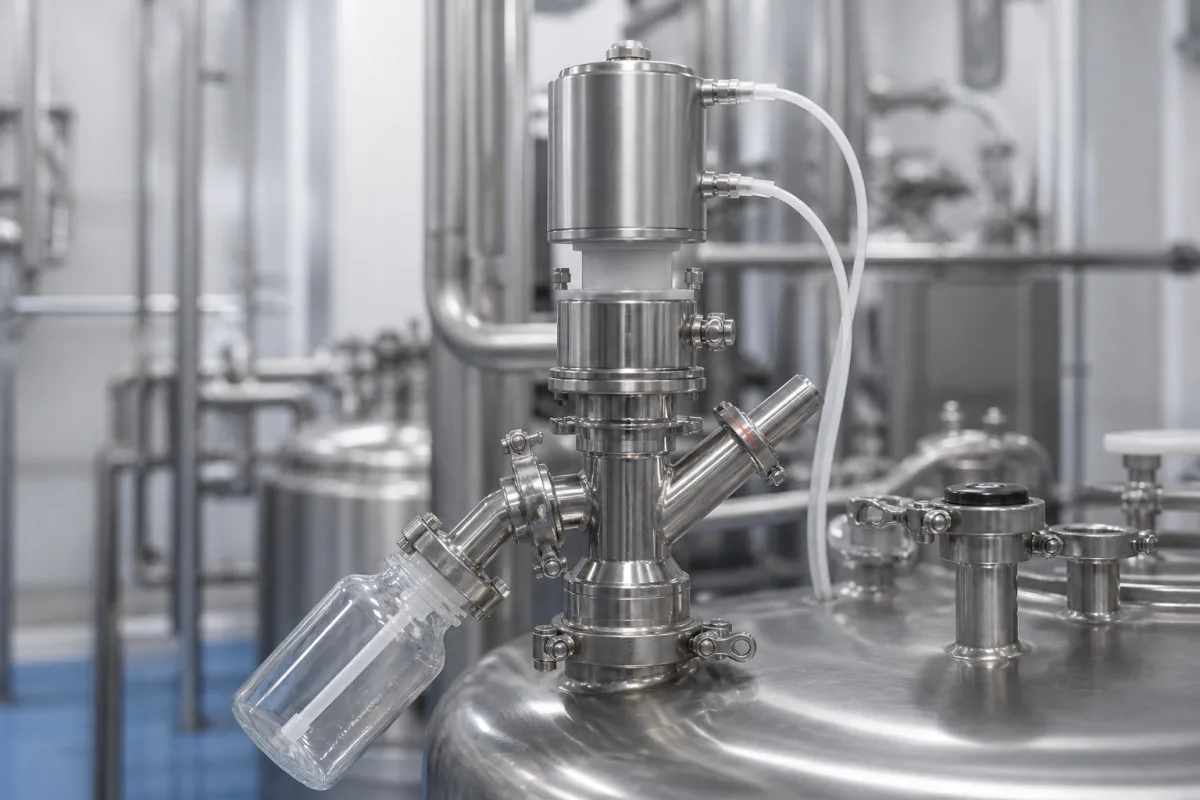
Steam-sterilisable sampling · Valve size for viscosity and particles, membrane or bellows sealing, steam-in-place before each sample
A sterile or aseptic sampling valve is welded or clamped to a tank or pipe so that a representative product sample can be drawn without contaminating the sample or the process; its chamber and seat are cleaned and steam-sterilised in place around each sample. Ask three things first: which size suits your product's viscosity and particles, how the stem is sealed (membrane, diaphragm or bellows) and how dead space is avoided, and what steam pressure and temperature it is rated for, with what seal-replacement interval.
Steam- or CIP-sterilisable sampling valves for pharmaceutical, biotech, dairy and beverage processes, manual or pneumatic, with tank, pipe or clamp bodies. General sanitary valves, sampling bags and bottles, and automatic samplers are outside this page.
CNFX editorial research · Sources checked October 11, 2026 · 5 sources
Keofitt's catalogue sizes its Classic sampling valves by product: the 4KAI (5 mm bore) for 0–100 cP with particles under 1.5 mm, the W9 (9 mm) for 0–1,000 cP with particles under 3 mm, the W15 for 0–50,000 cP with particles up to 8 mm, and the W25 for 0–250,000 cP with particles under 17 mm. More viscous liquids can be sampled, but take longer depending on process pressure. [2] On its W9 page, Keofitt notes that the 3 mm particle limit applies with a PTFE membrane and 2 mm with silicone or EPDM. [4]
Alfa Laval sizes its Unique sampling valve the same way: Size 4 for 0–100 cP products such as water, beer, wine and milk with particles up to 2.5 mm, Size 10 for 0–1,000 cP products such as fruit yoghurt and syrup with particles up to 7 mm, and Size 25 for very viscous products such as jam with particles up to 20 mm. [1]
Editorial note: different makers set different particle limits for similar viscosity classes, so give the supplier your product's viscosity range, particle size and process pressure rather than a valve size alone.
Give the supplier the product, its viscosity and largest particles, process pressure and temperature, the connection (tank weld, pipe weld, clamp, sterile connector), manual or pneumatic operation, sterilising medium (steam pressure and temperature, or chemical), CIP sequence, sample container (bottle, bag, syringe), seal material and certificates, surface finish, and documentation required.
02
Plan steam sterilisation and seal life
Alfa Laval's leaflet for its single-seat Unique sampling valve gives a temperature range of 1–130 °C and a maximum sterilisation temperature of 121 °C with dry steam at 2 bar, warns that condensate will damage the membrane, and recommends changing the membrane seal every 500 samples or sterilisations, or according to conditions. It recommends an optional pressure relief valve on the outlet when steam is used, to keep the proper temperature, and lists a maximum working pressure of 6 bar, a 316L body with 3.1 certificate, and EPDM or silicone membranes. [1]
Rieger's white paper explains that steam sterilisation of a sampling valve is done immediately before taking the sample, for about one minute in a recommendation it attributes to the German Dairy School in Kempten, with steam injected at the sampling point so that 121 °C is reached quickly. [5] Keofitt describes its Classic valves as coaxial steam-sterilisable designs with a separate inlet for SIP and CIP, so the valve can be cleaned and sterilised between samples. [2]
Keofitt's Sesame design adds a second seat so that the sampling seat and the steam seat cannot open at the same time; Keofitt notes that with conventional valves the steam inlet stays open during sampling, which risks steam or CIP fluid entering the process or airborne contamination of the sample. [3] Editorial note: write the sampling procedure (sterilise, sample, re-sterilise or clean) into the batch instructions and validate it on site.
03
Compare membrane, diaphragm and bellows sealing
Rieger's white paper defines an aseptic valve as one that hermetically seals the stem so that stem travel cannot pull contaminants from the environment into the process, and groups the seals into elastomer diaphragms and bellows (metal or PTFE). It argues that soft diaphragms can pump product into dead spaces at the seal interface, that metal bellows suit sterilisation above 135 °C for long periods, and that PTFE bellows withstand 135 °C for up to about 20 minutes. [5]
Keofitt offers silicone, EPDM and PTFE membranes for its W9 and BASIX valves. [2][3] Editorial note: Rieger, Keofitt and Alfa Laval each describe their own sealing concept; ask suppliers for drainability, dead-space and cleaning test evidence for the exact valve and orientation.
04
Sanitary sample valves and aseptic sampling valves with weld, clamp or KF ends
Listings range from sanitary sample valves to aseptic sampling valves with weld, clamp or KF ends; ask each for the sterilisation rating, seal options, surface finish and certificates.
05
Valve body, membrane or bellows, steam inlet, sample outlet, actuator and pressure relief
The steam inlet and the seal decide whether sampling stays aseptic: Keofitt's Sesame design stops the sampling seat and the steam seat opening at the same time, and Alfa Laval warns that condensate damages its membrane. [3][1]
Connection, pressure and temperature, sterilisation cycles, body and seal materials for a sampling valve order
Seal life is counted in sterilisations, not years: Alfa Laval recommends a new membrane every 500 samples or sterilisations, so the replacement interval follows from how often you sample. [1]
Field
What it means and published values
Ask the supplier for
Connection Size (inches)
Tank, pipe or clamp; e.g. 1 in or 1½ in clamp. [3]
5 companies list this product among what they make. Company figures are quoted from each
company's own website; every card states where the relationship came from.
AVM Extraordinary Intelligent Control (Zhejiang) Co., Ltd.
Manufacturing site to be confirmed for the order
Lists sanitary aseptic sampling valves and powder sampling valves with other sanitary valves.
Explore company information and manufacturing capabilities, then discuss the scope of your project with a relevant supplier.
Share this page
Compiled and source-reviewed by the CNFX editorial team.
Each manufacturer above links to the page on that company's own website where the product is listed, with the date we checked it. How we source and review
· Page last updated 13 October 2026
Buyer questions
What temperature are sterile sampling valves steam-sterilised at?
Alfa Laval rates its Unique valve for dry steam at 121 °C and 2 bar; Rieger notes 121 °C is reached quickly when steam is injected at the sampling point. [1][5]
How do I choose a sampling valve size?
By viscosity and particle size; Keofitt's W9 covers 0–1,000 cP with particles under 3 mm, and its W25 up to 250,000 cP. [2]
How often should the membrane be changed?
Alfa Laval recommends every 500 samples or sterilisations, or according to working conditions. [1]
Sources and what still needs a direct check
Sources checked 2026-10-11. Keofitt, Alfa Laval and Rieger are sampling-valve makers describing their own designs and practice; your sterilisation cycle must be validated on site.