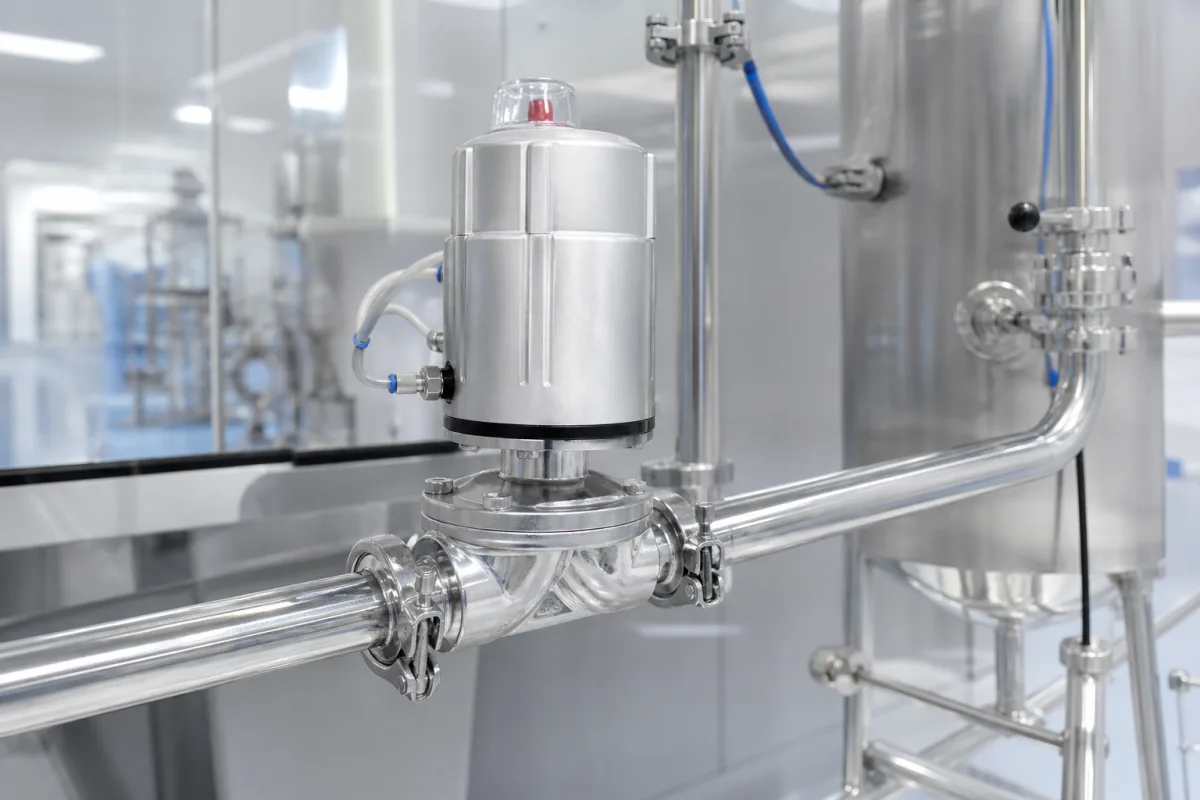
Control head for sterile diaphragm valve actuators: stem position sensing, pilot solenoid and fieldbus feedback
Biopharma and hygienic lines · the control head that sits on a pneumatic diaphragm-valve actuator: stem position sensing to ±0.1 mm, the pilot solenoid, LED status, AS-i or IO-Link, and the air and washdown it has to tolerate
In a sterile process line the diaphragm valve body and its pneumatic actuator do the shutting off; what tells the control system that the valve really opened or closed is a cylindrical control head on top of the actuator, like the one pictured with its clear indicator dome and push-in air lines. It holds a sensor that follows a target on the actuator stem, a small pilot solenoid that switches the actuator air, LEDs, and the electrical interface. Three choices define it: how it senses the stem and what valve sizes it fits, the pilot and air it runs on, and the interface and environment ratings for washdown and audit trails.
Control heads (control tops, switch boxes) mounted on pneumatic diaphragm-valve actuators in pharmaceutical, biopharma and other hygienic lines: stem position sensing, integrated pilot solenoids, status indication and AS-Interface, IO-Link or digital interfaces. The pneumatic actuator head itself, its control functions, air pressure and closing force, is covered on the Pneumatic actuator for sanitary diaphragm valves page; the valve body and diaphragm on the Sanitary diaphragm valve for dairy processing page; positioners on angle-seat control valves on the Sanitary flow control valve page, and positioners on hygienic seat-type regulating valves on the Hygienic pneumatic regulating valve page. Limit switch boxes for quarter-turn valves are covered on the Valve position indicator and limit switch box page.
CNFX editorial research · Sources checked October 12, 2026 · 3 sources
Reading the actuator stem: one sensor target, ±0.1 mm accuracy, automatic setup and the diaphragm valve sizes it fits
Both makers below replace separate proximity switches with a single path-measuring sensor that follows a target on the stem and learns the open and closed positions.
Editorial calculation: ±0.0039 in is ±0.1 mm and 2.56 in is 65 mm, so the head suits actuators whose stem is shorter than about 65 mm and places the stem to within a tenth of a millimetre. Alfa Laval's leaflet is the US edition in inch units; conversions are ours. [1]
GEA's control top includes a service mode, activated at the buttons, for valves that must be driven through their main stroke for maintenance; while it is active all feedback signals are stopped as a warning to the control system, and inputs from the control room are not executed, to protect the person at the valve. [2] GEA's D-tec diaphragm control valve for UltraClean and aseptic duty is supplied with the T.VIS P-15 positioner as its control and feedback system, rated for 6 bar air against 5 bar product pressure and sterilisation at up to 150 °C for 30 minutes. [3]
Give the valve maker, type and size, actuator type and stroke, the positions to be reported (open, closed, intermediate), the tolerance you need on the closed position, and whether the head must fit valves from more than one maker.
02
Pilot solenoid, air quality and interface: 24 V DC at 0.3 W on 3–8 bar air, AS-i or IO-Link, and a five-million-cycle B10
The control head converts a PLC output into actuator air, so its solenoid and air path decide how reliably the diaphragm valve moves.
Alfa Laval lets valve speed be tuned at the head: opening speed reduction of 0–100 % at the head's outlet fitting, closing speed reduction at the actuator inlet, and a quick air exhaust to speed closing. Its leaflet also lists vibration testing at 18 Hz–1 kHz and 7.54 g RMS and shock of 100 g. [1]
Editorial calculation: +14 to +140 °F is −10 to +60 °C, against −20 to +55 °C for the GEA head; a cold room below −10 °C or an enclosure above 55 °C rules out one of the two. The ThinkTop's B10 of 5 million cycles reached by a valve switching once a minute around the clock comes after about 3,470 days, roughly 9.5 years (5,000,000 ÷ 1,440). [1][2]
Item
Alfa Laval ThinkTop V50
GEA T.VIS A-15
Pilot solenoid
0 or 1 solenoid, 3/2-way, 24 V DC ±10 %, 0.3 W, manual hold override [1]
Solenoid valves protected by a filter at the air inlet [2]
Air supply
300–800 kPa (3–8 bar); air quality class 3,3,3 to DIN ISO 8573-1 [1]
2–8 bar; ISO 8573-1:2010 solids class 6, water class 4, oil class 3 [2]
State the PLC interface (AS-i, IO-Link or hard-wired), the number of pilot solenoids, the plant air pressure and its ISO 8573-1 class, cleaning and washdown method (IP69K or IP66), ambient temperature, and the switching frequency so solenoid life can be estimated.
03
Valve, air and control details for a diaphragm valve control head
Paste it into your enquiry below or into an email to a maker, then replace every bracket.
Valve: [maker; type; size DN; actuator type and stroke]
Function: [NC or NO; positions to report; intermediate position]
Pilot: [number of solenoids; 24 V DC; manual override]
Air: [pressure range; ISO 8573-1 class; fitting size]
Interface: [AS-i; IO-Link; digital; M12 or gland]
Environment: [washdown; IP rating; ambient temperature; hazardous area]
Duty: [switching frequency; required life]
Explore company information and manufacturing capabilities, then discuss the scope of your project with a relevant supplier.
Share this page
Compiled and source-reviewed by the CNFX editorial team.
Each manufacturer above links to the page on that company's own website where the product is listed, with the date we checked it. How we source and review
· Page last updated 13 October 2026
Buyer questions
What does a control head on a diaphragm valve do?
It senses the actuator stem position, switches the actuator air through a pilot solenoid and reports valve status to the PLC; Alfa Laval's ThinkTop V50 does this with one sensor target and up to one 3/2 solenoid. [1]
How accurate is control-head position sensing?
Alfa Laval states ±0.0039 in (about ±0.1 mm) for the ThinkTop V50 on stems shorter than 2.56 in (about 65 mm). [1]
What compressed air do control heads need?
ThinkTop V50 takes 3–8 bar air of class 3,3,3 to DIN ISO 8573-1; GEA's T.VIS A-15 takes 2–8 bar with solids class 6, water class 4 and oil class 3. [1][2]
Sources and what still needs a direct check
Sources checked 2026-10-12. Alfa Laval and GEA are hygienic valve makers describing their own control heads; GEA's D-tec order code shows a control head specified on a diaphragm control valve for aseptic duty.