This page explains how Polycarbonate Injection Molded Lens Housing is classified within Manufacture of Plastic Products. Technical values and manufacturer relationships are research references; confirm the current specification and supplier evidence for each order.
This precision injection molded component is designed to house and protect optical elements in industrial applications.
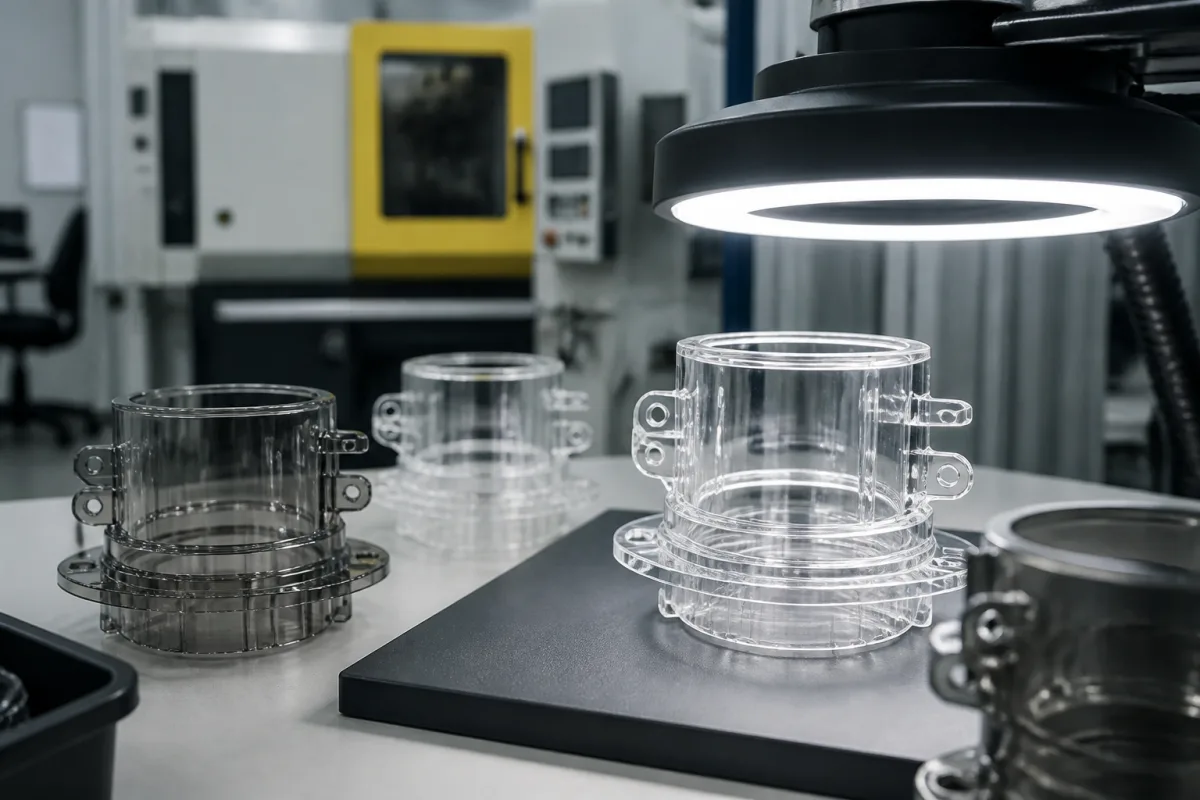
Technical details and manufacturing context for Polycarbonate Injection Molded Lens Housing
| Parameter | Typical range | Notes & selection driver |
|---|---|---|
| Wall ThicknessRequired | 2.0–3.5 mm | Minimum material thickness for structural integrity |
| Light TransmissionRequired | 88–92 % | Percentage of visible light transmitted at 550nm wavelengthASTM D1003 |
| Haze LevelRequired | 0.5–1.5 % | Percentage of transmitted light scattered more than 2.5 degreesASTM D1003 |
| Operating TemperatureRequired | -40–120 °C | Continuous service temperature range |
| Flammability RatingRequired | V-2–V-0 class | UL 94 flammability classificationUL 94 |
| Surface Roughness | Ra 0.05–0.2 μm | Arithmetic average surface roughness of optical surfacesISO 4287 |
| Diameter | 20–100 mm | Custom sizes available; typical range for LED housings. |
| Tensile Strength | 60–70 MPa | Ensures structural integrity during assembly.ISO 527 |
| Impact Strength (Izod) | 600–800 J/m | High impact resistance for durability.ISO 180 |
| Heat Deflection Temperature | 125–135 °C | At 1.8 MPa; ensures stability under heat.ISO 75 |
| Water Absorption | 0.15–0.25 % | 24h immersion; low absorption maintains dimensional stability.ISO 62 |
| UV Resistance | ≥1000 h | Accelerated weathering; no significant yellowing.ASTM G154 |
| Mold Shrinkage | 0.5–0.7 % | Critical for dimensional accuracy in molding.ISO 294-4 |
| Density | 1.19–1.21 g/cm³ | Typical for polycarbonate.ISO 1183 |
Ranges are indicative industry figures for RFQ preparation, not a supplier commitment. Confirm every value and standard with the legal manufacturer before ordering.
Commonly used trade names and technical identifiers for Polycarbonate Injection Molded Lens Housing.
| pressure: | Atmospheric to 2 bar (29 psi) max, typical for LED/sensor housings |
| other spec: | UV exposure: 5000+ hours at 0.35 W/m² @ 340nm with <5% transmittance loss; Flow rate: N/A (static housing); Slurry concentration: N/A (non-flow application) |
| temperature: | -40°C to +125°C continuous, up to +140°C intermittent |
Indicative industry ranges for design and RFQ preparation. Confirm the exact figures and applicable standard with the manufacturer before specifying.
Quoted from the published standard.
Manufacturer profiles associated with Polycarbonate Injection Molded Lens Housing.
Manufacturer listings support early research and capability understanding. They are not certification, ranking, or transaction guarantees.
A practical evidence checklist for RFQ preparation and supplier evaluation.
CNFX does not score or rank suppliers. Buyers must verify all claims and documents with the legal manufacturer before ordering.
The housing is typically made from polycarbonate (PC) or optical-grade PMMA. These materials offer transparency and impact resistance. The specific material grade should be confirmed with the supplier for your application.
Light transmission is typically 88–92% at 550 nm, and haze is 0.5–1.5%, both measured per ASTM D1003. These values are reference ranges; actual performance depends on the specific design and material.
The housing has a UV resistance of ≥1000 hours per ASTM G154, indicating resistance to yellowing. However, long-term outdoor performance depends on the specific material and design. Verify with the manufacturer for your environmental conditions.
Check the listed parameters such as wall thickness, operating temperature, and flammability rating against your needs. Always confirm model-specific values and standards with the legal manufacturer or supplier before procurement.
Editorial classification, named public sources where available, and source-reviewed manufacturer records.
Ask for use case, specification boundaries, supplier type, and RFQ preparation information for this product.
Compare manufacturer profiles with relevant product and process capability.