Editorial Technical Reference

Polypropylene Injection Molded Gear Wheel

This page explains how Polypropylene Injection Molded Gear Wheel is classified within Manufacture of Plastic Products. Technical values and manufacturer relationships are research references; confirm the current specification and supplier evidence for each order.

Technical Definition & Core Assembly

Precision plastic gear component manufactured via injection molding for mechanical power transmission.

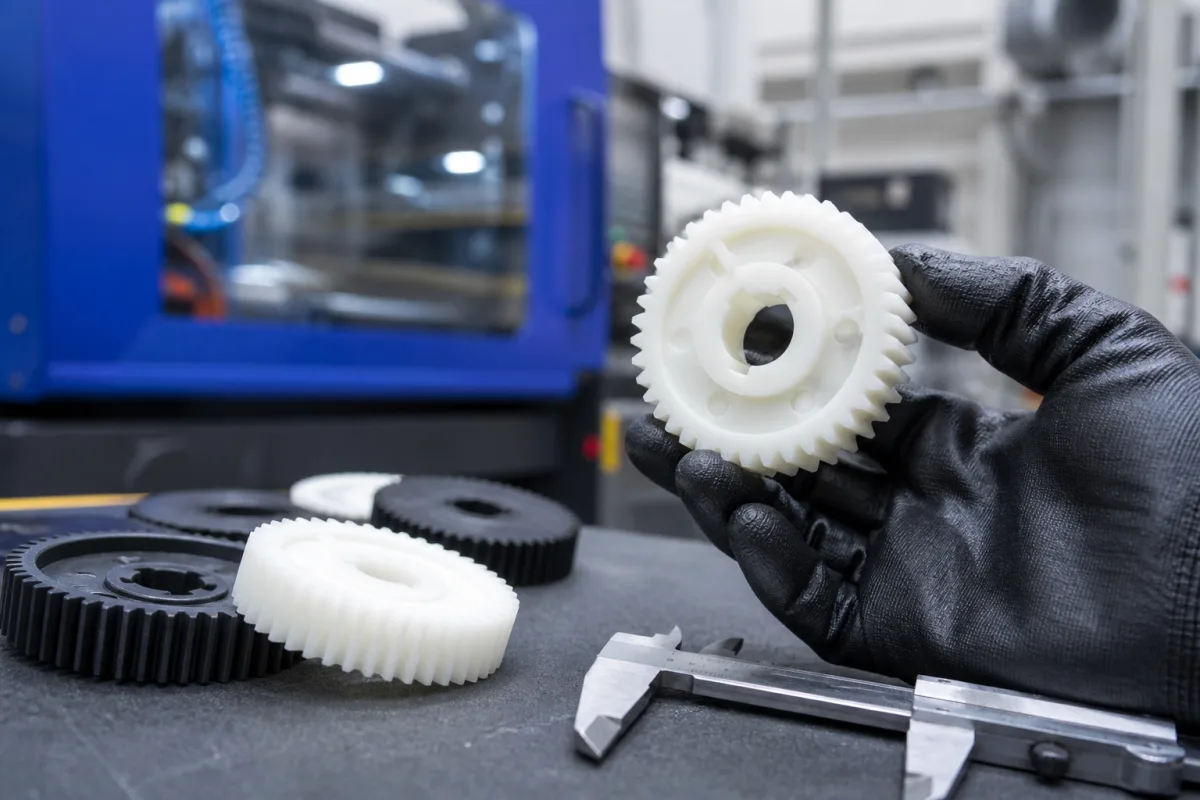
Representative product image. Confirm appearance and specifications with the manufacturer.

Product Specifications

Technical details and manufacturing context for Polypropylene Injection Molded Gear Wheel

Definition
This gear wheel is a precision-engineered plastic component produced by injection molding, intended for mechanical power transmission in various industrial and consumer applications. It is made from polypropylene (PP) or glass-filled polypropylene, offering a balance of lightweight construction, corrosion resistance, and cost-effectiveness compared to metal gears. The gear transfers torque and rotational motion between shafts through interlocking teeth, with a standard involute tooth profile. Key parameters include a module range of 0.5–2.5 mm, a pressure angle of 20 degrees, face width from 5 to 30 mm, and an operating temperature range of -20 to 80 °C. Tensile strength is specified as 25–35 MPa, and the gear is rated for operating pressures of 1.0–1.6 MPa, speeds up to 3000 rpm, and torque capacities from 0.5 to 5 N·m. Precision grade is ISO 8–9, with surface roughness Ra 0.8–1.6 µm. Weight ranges from 5 to 50 g. These gears are supplied to OEM manufacturers in automotive, appliance, and industrial equipment sectors as standardized components for assembly integration. In B2B supply chains, they serve as critical elements in larger assemblies, offering noise reduction and self-lubricating properties. For procurement, verify model-specific values and standards with the legal manufacturer or supplier, as listed parameters are reference ranges. The gear is designed for use in systems where lightweight, corrosion-resistant gearing is required, and it operates within defined load and speed limits. Proper selection requires consideration of module, face width, and material grade to match application demands. Maintenance signals include excessive wear, noise, or dimensional changes, indicating potential failure. Failure boundaries are defined by operating temperature, pressure, and speed limits; exceeding these may cause deformation or breakage.
Working Principle
The gear wheel transmits rotational force through interlocking teeth that mesh with corresponding gears. When input torque is applied to the gear's shaft, the teeth engage with those of a mating gear, converting input torque to output motion with a specific speed ratio determined by the gear ratio. The involute tooth profile ensures smooth meshing and constant velocity ratio. The gear operates by transferring rotational motion and torque from one shaft to another, with the teeth providing positive engagement. The module and pressure angle define tooth size and load capacity, while face width affects contact area and strength. The gear's material properties, such as tensile strength, determine its ability to withstand applied loads without failure. The gear is designed to operate within specified temperature, pressure, and speed ranges, and its performance depends on proper lubrication and alignment. In a gear train, multiple gears work together to achieve desired speed reduction or increase, with each gear transmitting force to the next. The self-lubricating nature of polypropylene reduces friction and wear, contributing to efficient power transmission.
Common Materials
Polypropylene (PP), Glass-filled Polypropylene
Technical Parameters
ParameterTypical rangeNotes & selection driver
ModuleRequired0.5–2.5 mmRatio of pitch diameter to number of teeth defining tooth sizeISO 53
Pressure AngleRequired20 degreesAngle between tooth profile and radial line affecting load capacityISO 53
Face WidthRequired5–30 mmAxial length of gear teeth determining contact area and strength
Tooth ProfileRequiredInvolute textShape of gear teeth (involute, cycloidal, etc.) affecting meshing characteristicsISO 53
Operating Temperature RangeRequired-20–80 °CTemperature limits for proper mechanical performance
Tensile Strength25–35 MPaMaximum stress material can withstand while being stretchedISO 527
Operating Speed100–3000 rpmMax speed depends on load and lubrication
Torque Capacity0.5–5 N·mDepends on gear size and material
Precision GradeISO 8–9Typical for injection molded gearsISO 1328
Surface RoughnessRa 0.8–1.6 µmMolded surface finishISO 4287
Weight5–50 gDepends on gear size
Material GradePP-HHomopolymer polypropyleneISO 1873

Ranges are indicative industry figures for RFQ preparation, not a supplier commitment. Confirm every value and standard with the legal manufacturer before ordering.

Components / BOM
  • Gear Hub Part
    Central mounting interface for shaft connection
    Material: Polypropylene
  • Tooth Ring Part
    Peripheral teeth structure for power transmission
    Material: Glass-filled Polypropylene
  • Reinforcement Ribs Optional Part
    Structural supports preventing deformation under load
    Material: Polypropylene

Industry Taxonomies & Aliases

Commonly used trade names and technical identifiers for Polypropylene Injection Molded Gear Wheel.

Industrial Ecosystem & Supply Chain Structure

Complementary Systems
Downstream Applications
Specialized Tooling

Application Fit & Sizing Matrix

Operational Limits
pressure: Max 50 MPa contact pressure, 0.5 MPa ambient
other spec: Max 3000 RPM, 98% efficiency at rated load
temperature: -20°C to 100°C continuous, 120°C peak
Media Compatibility
✓ Dry mechanical assemblies ✓ Lubricated gear systems (mineral oil) ✓ Clean air environments
Unsuitable: High-temperature steam (>120°C) or aggressive chemical exposure
Sizing Data Required
  • Torque requirement (Nm)
  • Operating speed (RPM)
  • Required service life (hours)

Reliability & Engineering Risk Analysis

Failure Mode & Root Cause
Thermal degradation and warping
Cause: Excessive heat from friction or high ambient temperatures exceeding polypropylene's glass transition temperature (~0°C to 100°C), leading to dimensional instability and loss of mechanical properties.
Fatigue cracking and tooth fracture
Cause: Cyclic loading causing stress concentration at gear tooth roots, exacerbated by improper meshing, misalignment, or shock loads beyond polypropylene's fatigue strength.
Maintenance Indicators
  • Audible high-pitched squealing or grinding noises during operation indicating excessive friction or misalignment
  • Visual deformation or discoloration (yellowing/whitening) of gear teeth suggesting thermal overload or chemical degradation
Engineering Tips
  • Implement precision alignment during installation and maintain proper backlash (0.1-0.3mm typical for PP gears) to reduce stress concentrations
  • Control operating temperature below 80°C using cooling systems or intermittent operation cycles, and apply dry lubricants (PTFE/silicone based) compatible with polypropylene

Indicative industry ranges for design and RFQ preparation. Confirm the exact figures and applicable standard with the manufacturer before specifying.

Compliance & Manufacturing Standards

Applicable Standards
ISO 1328-1:2013 (Cylindrical gears - ISO system of flank tolerance classification) ASTM D4101-17 (Standard Specification for Polypropylene Injection and Extrusion Materials) DIN 5480-1:2006 (Involute splines based on reference diameters)

Quoted from the published standard.

Manufacturing Precision
  • Bore diameter: ±0.02 mm
  • Tooth profile deviation: ±0.05 mm
Quality Inspection
  • Dimensional verification with coordinate measuring machine (CMM)
  • Material verification via Fourier-transform infrared spectroscopy (FTIR)

Manufacturers of Polypropylene Injection Molded Gear Wheel

Manufacturer profiles associated with Polypropylene Injection Molded Gear Wheel.

Sourcing Polypropylene Injection Molded Gear Wheel from China?
Tell us your specification and target quantity — we will match it against manufacturer records and come back with the factories that fit.
Request manufacturers We manufacture this

Manufacturer listings support early research and capability understanding. They are not certification, ranking, or transaction guarantees.

Technical documentation
Request current drawings, revision history, and a signed specification sheet.
Manufacturing capability
Verify equipment lists, process limits, capacity, and representative production evidence.
Inspection readiness
Confirm test methods, calibrated equipment, sampling plans, and traceable reports.
Supplier transparency
Check the legal entity, factory address, ownership, certifications, and direct contacts.

CNFX does not score or rank suppliers. Buyers must verify all claims and documents with the legal manufacturer before ordering.

Frequently Asked Questions

What materials are used for this gear wheel?

The gear wheel is made from polypropylene (PP) or glass-filled polypropylene, as listed in the product data. These materials provide lightweight, corrosion-resistant properties suitable for many applications.

What are the key dimensional parameters?

Key parameters include a module of 0.5–2.5 mm, pressure angle of 20 degrees, face width of 5–30 mm, and tooth profile of involute. These values are reference ranges and must be verified for the specific model with the manufacturer.

What are the operating limits?

The gear operates within a temperature range of -20 to 80 °C, pressure of 1.0–1.6 MPa, speed up to 3000 rpm, and torque capacity of 0.5–5 N·m. Exceeding these limits may cause failure.

What standards apply to this gear?

Relevant standards include ISO 53 for gear geometry, ISO 527 for tensile strength, ISO 1328 for precision grade, ISO 4287 for surface roughness, and ISO 1873 for material grade. These are references for verification, not certification.

Data Basis

Editorial classification, named public sources where available, and source-reviewed manufacturer records.

Preliminary Technical Classification
This page supports structured research, RFQ preparation, and supplier evaluation. It does not replace buyer-led supplier qualification, standards review, or technical approval.
Buyer enquiry

Request manufacturing insight for Polypropylene Injection Molded Gear Wheel

Ask for use case, specification boundaries, supplier type, and RFQ preparation information for this product.

Where it goes
Straight to the CNFX editorial desk, and to the manufacturer if this product is linked to a claimed profile. Nothing is broadcast to a supplier list.
Your details stay here
We do not sell or rent enquiry data, and we do not add you to a mailing list. Used only to answer this request.
No commission, no middleman
CNFX is a directory. We take no cut of any order and never negotiate on a supplier's behalf.
What we don't claim
A listing is not an endorsement. Qualify every supplier and verify every figure yourself before ordering.

Your business information is used only to process this request.

Thank you! Your message has been sent. We'll respond within 1–3 business days.
Sorry, we couldn't send your message. Please try again, or email us at contact@cnfx.com.

Need to Manufacture Polypropylene Injection Molded Gear Wheel?

Compare manufacturer profiles with relevant product and process capability.

Previous Product
Injection Molding Machine
Last Product
Get QuotesChat