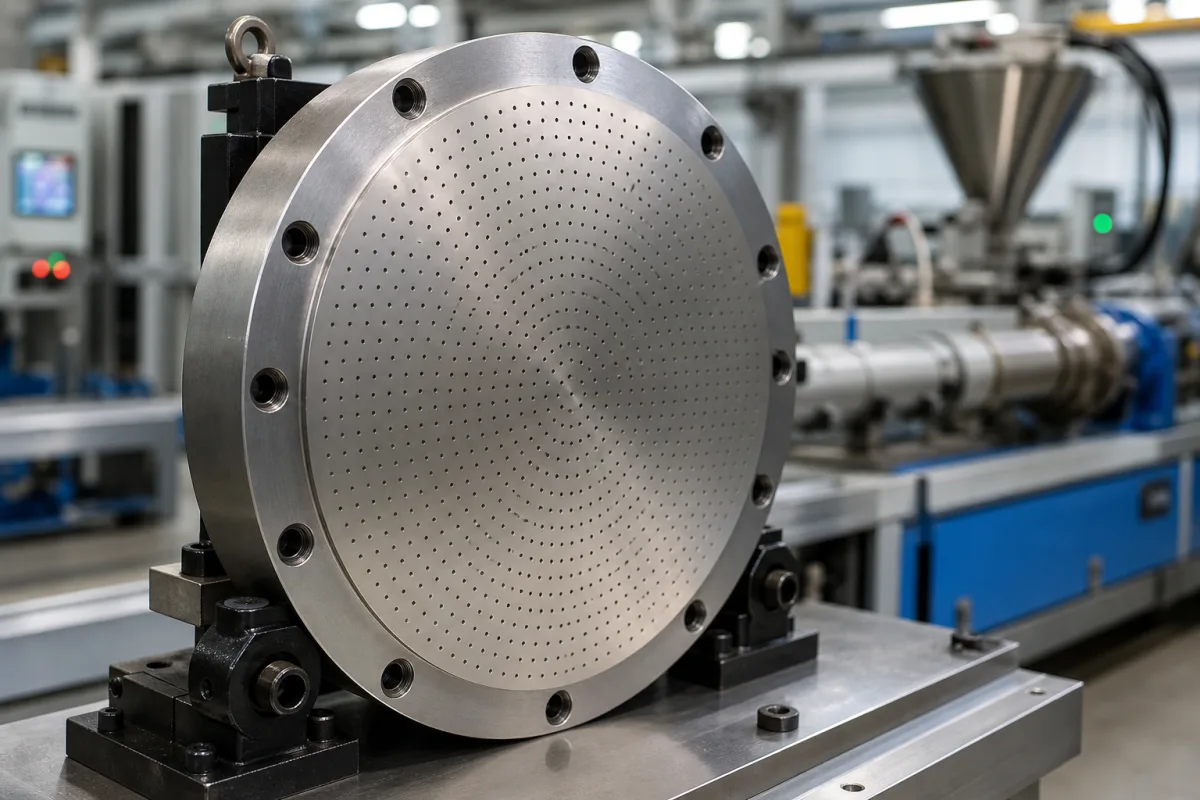
Orifice array as an extruder breaker plate: the drilled hole pattern that carries the screen pack between screw and die
Extruder breaker plates · drilled hole arrays behind the screen pack, 5–15 mm holes in 5–20 mm plates, 30–60 % open area, backup plates and blade grids
Between the end of the screw and the die, the melt passes through a screen pack, and the screens would burst without a rigid plate behind them. That plate is an array of drilled holes. Its hole size, hole count, open area and thickness decide how much pressure the melt loses on the way through, how much of each screen actually filters, and how hard the melt can push before a screen tears over a hole.
Breaker plates as hole arrays: the drilled or perforated plates that support filter screens at the extruder outlet or in the screen cavity of a screen changer, their hole diameter, pattern, open area and thickness, backup plates behind them, and blade-grid alternatives. The wire-cloth screen packs and filter elements that sit on the plate are covered on the Polymer extrusion melt filter screen (screen pack) page; profile die plates that shape the extrudate on the Polymer extrusion die plate page; pelletiser die plates on the Polymer pelletizing strand cutter page. Other orifice plates have their own pages: the outlet orifice of a dispensing valve on the Precision dispensing nozzle page and the feed holes of an aerostatic pad on the Air bearing pad orifice plate page.
CNFX editorial research · Sources checked October 13, 2026 · 3 sources
5–15 mm holes in a 5–20 mm plate: the breaker plate and backup plate split in a large twin-screw extruder
EP 3 323 589 A1 (Nihon Spindle Manufacturing and Sumitomo Rubber Industries, priority 2015) starts from a conflict in large, high-throughput extruders: the plate has to get thicker to resist the melt, but a thicker plate raises the resistance to the melt passing through, which raises extrusion pressure, load power and heat in the material, and in a twin-screw machine increases leakage past the screws. [1]
The patent's answer is to keep the hole array thin and put a second, much more open plate behind it. The breaker plate carries holes of about 5 to 15 mm diameter in a plate about 5 to 20 mm thick; for the oval discharge port of a twin-screw extruder the holes are set at zigzag positions. The backup plate behind it is about 20 to 80 mm thick, preferably 30 to 70 mm, with large openings divided by a square, rhombic or circular-hole lattice. [1]
Open area is stated against the area of the melt channel just in front of the screen: about 30 % to 60 % for the breaker plate and about 60 % to 85 % for the backup plate. Every opening in the breaker plate is placed to open into a backup-plate opening, so that no material is held up in a blocked hole. [1]
Ask for hole diameter, hole count and pattern, plate thickness and open area stated against the melt channel area, and whether a separate backup plate is part of the design.
02
50–55 % open area and what it does to the screen: larger-hole Class 3 and 4 plates and a blade grid with up to 95 % exposed
PSI-Polymer Systems, in Extrusion International 3/2023, gives the open area of a conventional breaker plate as 50 % to 55 % (typ.), so that 45 % to 50 % of the screen rests on solid metal. [2] PSI states that the screen over each hole then blinds quickly while melt has to travel sideways through the wire cloth to reach a hole, which shows on spent screen packs as dense pockets of contaminant over the holes. [2]
PSI describes the hole diameter as the remaining variable for cutting pressure drop once the screen's micron rating and wire diameter are fixed, and says a breaker plate design has to balance open area against yield strength. Its standard Class 2 holes are sized to support a 20-mesh screen. For high-viscosity, fractional-melt materials PSI offers Class 3 and Class 4 plates with successively larger holes, used with a 10-mesh support screen or with its blade-grid plate behind finer screens. [2]
The blade-grid alternative is a cross-welded grid of diamond-shaped stainless steel blades on whose edges the screen pack rests. PSI states it exposes up to 95 % or more of the screen to flow, a gain of 30 % to 55 % in effective filtration area over a conventional plate, and that the blade spacing can allow a support screen of 20 mesh or higher to be left out. It also removes the blow-through case PSI describes, where the pressure differential exceeds the tensile strength of the wire cloth sitting over a breaker plate hole. [2]
Editorial calculation: on a 200 mm screen, PSI's 50 % to 55 % (typ.) open area leaves about 157 to 173 cm² of the 314 cm² face over holes, and 95 % exposure would leave about 298 cm². [2][3]
State the polymer and its melt flow, the finest screen mesh and the support screen, and the maximum pressure differential the screens will see, so the hole class can be chosen against blow-through.
03
Plate diameter against throughput: 30 to 400 mm screens and a 300 bar differential in a piston screen changer
In Maag's DSC discontinuous screen changer the breaker plate sits in a screen-bearing piston and is fitted with screen mesh for the required filtration; the piston is moved out of the housing by a hydraulic cylinder to change the screen during a stop. The datasheet gives operating pressure up to 700 bar, pressure differential up to 300 bar and temperature up to 350 °C, with options up to 1,000 bar and 450 °C. [3]
Maag notes that throughput depends on viscosity, filtration area and degree of contamination. [3] Editorial calculation from the listed figures: throughput per cm² of screen rises from about 4.3 kg/h at size 030 and 4.8 kg/h at size 200 to about 17.9 kg/h at size 400, so the listed throughput is not a fixed loading per unit of plate area.
Explore company information and manufacturing capabilities, then discuss the scope of your project with a relevant supplier.
Share this page
Compiled and source-reviewed by the CNFX editorial team.
Each manufacturer above links to the page on that company's own website where the product is listed, with the date we checked it. How we source and review
· Page last updated 13 October 2026
Buyer questions
What hole size and thickness does a breaker plate use?
EP 3 323 589 gives holes of about 5 to 15 mm in a plate about 5 to 20 mm thick, backed by a 20 to 80 mm backup plate in a large twin-screw extruder. [1]
How much open area does a breaker plate have?
PSI-Polymer Systems gives 50 % to 55 % (typ.) for a conventional plate; the Nihon Spindle patent sets 30 % to 60 % for the breaker plate and 60 % to 85 % for its backup plate. [2][1]
Why use larger breaker plate holes?
PSI offers Class 3 and 4 plates with larger holes than its standard Class 2 to cut pressure drop with high-viscosity, fractional-melt materials, with a 10-mesh support screen or blade grid behind finer screens. [2]
What pressure does a screen changer breaker plate see?
Maag's DSC screen changer is rated for up to 700 bar operating pressure and up to 300 bar pressure differential across the screen. [3]
Sources and what still needs a direct check
Sources checked 2026-10-13. A patent from Nihon Spindle Manufacturing and Sumitomo Rubber Industries (hole size, thickness, open area, backup plate), PSI-Polymer Systems' statements in Extrusion International 3/2023 (open area, hole classes, blade grid) and Maag's DSC screen changer datasheet (screen diameters, pressures, throughput).