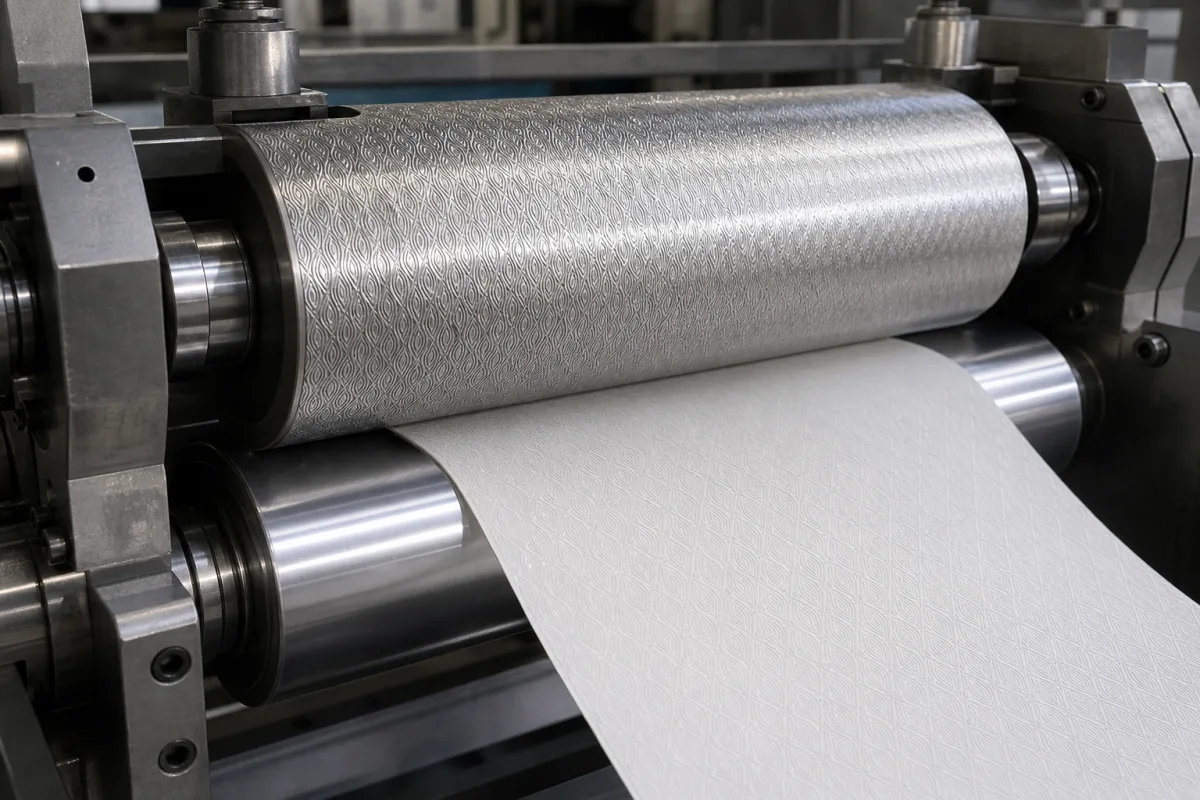
Engraved steel embossing and texture rollers for leather, paper, film and nonwovens · face width, engraving depth, counter roll and rubber hardness, heating method and temperature, nip pressure and line force, hard chrome and surface hardness
An embossing roller, also sold as a texture or pattern roller, is an engraved steel cylinder that presses a raised pattern into leather, paper, film or nonwoven as the web passes through the nip against a rubber-covered, paper or steel counter roll, heated or unheated. Ask three things first: the face width and engraving depth your pattern needs, which counter roll it runs against, and how it is heated, to what temperature and under what nip pressure.
Engraved embossing and texture rollers for leather, artificial leather, paper and tissue, plastic film and sheet, and nonwovens, including their counter rolls and the heating and pressure they run with. Complete embossing machines and calenders, plate embossing presses, anilox and coating rollers, and mirror rolls are outside this page except where compared.
CNFX editorial research · Sources checked October 11, 2026 · 5 sources
Set the face width, engraving depth and counter roll
A Crown Zellerbach patent describes the conventional arrangement for embossing paper toweling and tissue as a two-roll press: a steel or otherwise hard roll carrying the embossment pattern, forming a nip with a rubber roll. Soft rubber rolls give good definition at light nip pressure but generate heat and wear out quickly; hard rubber rolls need very high nip pressure, which reduces sheet caliper and strength. Its grooved counter (platen) roll has an outer element of about 40–80 Shore A; the example used 52 Shore A with grooves 0.030 in wide and 0.25 in deep on 0.060 in centres. [1]
A Kimberly-Clark patent states that spot embossing elements are engraved in a steel roll about 0.060 inch in relief and run against a rubber-covered backing roll. It claims male embossing elements about 0.005–0.035 inch high; its example compared elements 0.040 inch and 0.025 inch high against a rubber-covered roll of 70 Shore A, and the lower elements improved rewinder efficiency and the visual quality of the embossing. [2]
Face widths follow the machine: Brenu's roller embossing machines for leather list working widths of 1800, 3000 and 3200 mm, and ANDRITZ lists nonwoven calenders up to 5,800 mm wide. [4][5]
Editorial calculation: at 25.4 mm per inch, 0.060 inch of relief is about 1.52 mm, the claimed 0.005–0.035 inch range is about 0.13–0.89 mm, and the example heights of 0.040 inch and 0.025 inch are about 1.02 mm and 0.64 mm. [2]
Give the supplier the substrate and thickness, pattern artwork or sample, engraving depth or element height, face width and working width, roll diameter, journal and bearing drawing, the counter roll (rubber and its Shore A hardness, paper or steel), machine model, and quantity.
02
Check heating, temperature, pressure and surface
Brenu's roller embossing machines for leather (DCH-1800, DCH 3-3000, DCH 3-3200) list oil heating power of 17.5/35 kW, a maximum temperature of 190 °C, a maximum working pressure of 250 kgf/cm2, a working speed of 3–16 m/min and net weights of 10000–13500 kg; its plate embossing presses use electric heating of 9–18 kW. [4] ANDRITZ's nonwoven calenders, used for thermobonding, embossing, perforation and lamination, run up to 1,250 m/min with up to 150 N/mm line force; each neXcal calender has a deflection-controlled Hot S-Roll with a surface temperature up to 275 °C, and ANDRITZ cooperates with roll engravers for patterns. [5]
Changzhou Aodun, an embossing roller maker, describes building the roll body from seamless steel tube bored to an even wall thickness, then welded, stress-relieved, turned, ground and finished; the roll is statically and dynamically balanced to a coaxiality of ≤0.02 mm, engraved by a process chosen for the pattern, and finally hard-chrome plated or otherwise treated to a hardness of HRC58-62. It lists uses in paper (art paper, wallpaper, tissue, packaging papers) and plastics (artificial and PU leather, film, sheet, car carpets). [3]
Steam heating is not described in the reviewed sources; ask the supplier which heating media the roll and its rotary joint accept.
Editorial calculation: 150 N/mm of line force across a 5,800 mm face is a total nip load of about 870 kN. [5]
Ask for the heating medium (thermal oil, electric or other), maximum surface temperature and temperature uniformity across the face, nip pressure or line force, roll deflection compensation, core material, plating type and thickness, surface hardness, balancing grade, and runout.
03
Leather-pattern rollers sold alongside embossing machines
The listing reviewed offers embossing, engraved and mirror rollers with grain, snake and crocodile leather patterns alongside plate and roller embossing machines.
04
Roll body, engraving, chrome, heating and the counter roll
The engraved steel roll is only half of the nip: the Crown Zellerbach patent shows the rubber counter roll's hardness trading pattern definition against heat, wear and nip pressure. [1]
Part
Role
Fix in the order
Roll body / shaft
Seamless steel tube, balanced, coaxiality ≤0.02 mm. [3]
Material, journals.
Engraved surface
Carries the pattern; about 0.060 in relief in one patent. [2]
Explore company information and manufacturing capabilities, then discuss the scope of your project with a relevant supplier.
Share this page
Compiled and source-reviewed by the CNFX editorial team.
Each manufacturer above links to the page on that company's own website where the product is listed, with the date we checked it. How we source and review
· Page last updated 13 October 2026
Buyer questions
What roll does an embossing roller run against?
The patents reviewed pair an engraved steel roll with a rubber-covered roll: about 40–80 Shore A in one, 70 Shore A in another example. [1][2]
How deep is the engraving on an embossing roller?
A Kimberly-Clark patent states spot elements are engraved in steel about 0.060 inch in relief, and claims lower elements of about 0.005–0.035 inch. [2]
How are embossing rollers heated?
Brenu's roller embossing machines for leather use oil heating up to 190 °C, its plate presses use electric heaters, and ANDRITZ calenders have a heated roll up to 275 °C. [4][5]
Sources and what still needs a direct check
Sources checked 2026-10-11. Two patents describe steel-and-rubber embossing nips; Brenu, ANDRITZ and Changzhou Aodun describe their own machines and rollers. Values for your roller must come from the supplier's drawing and trials.