Industry-Verified Manufacturing Data (2026)

Ink Channel / Manifold

Based on aggregated insights from multiple verified factory profiles within the CNFX directory, the standard Ink Channel / Manifold used in the Printing and Reproduction of Recorded Media sector typically supports operational capacities ranging from standard industrial configurations to heavy-duty production requirements.

Technical Definition & Core Assembly

A canonical Ink Channel / Manifold is characterized by the integration of Inlet Port and Distribution Channels. In industrial production environments, manufacturers listed on CNFX commonly emphasize Stainless steel construction to support stable, high-cycle operation across diverse manufacturing scenarios.

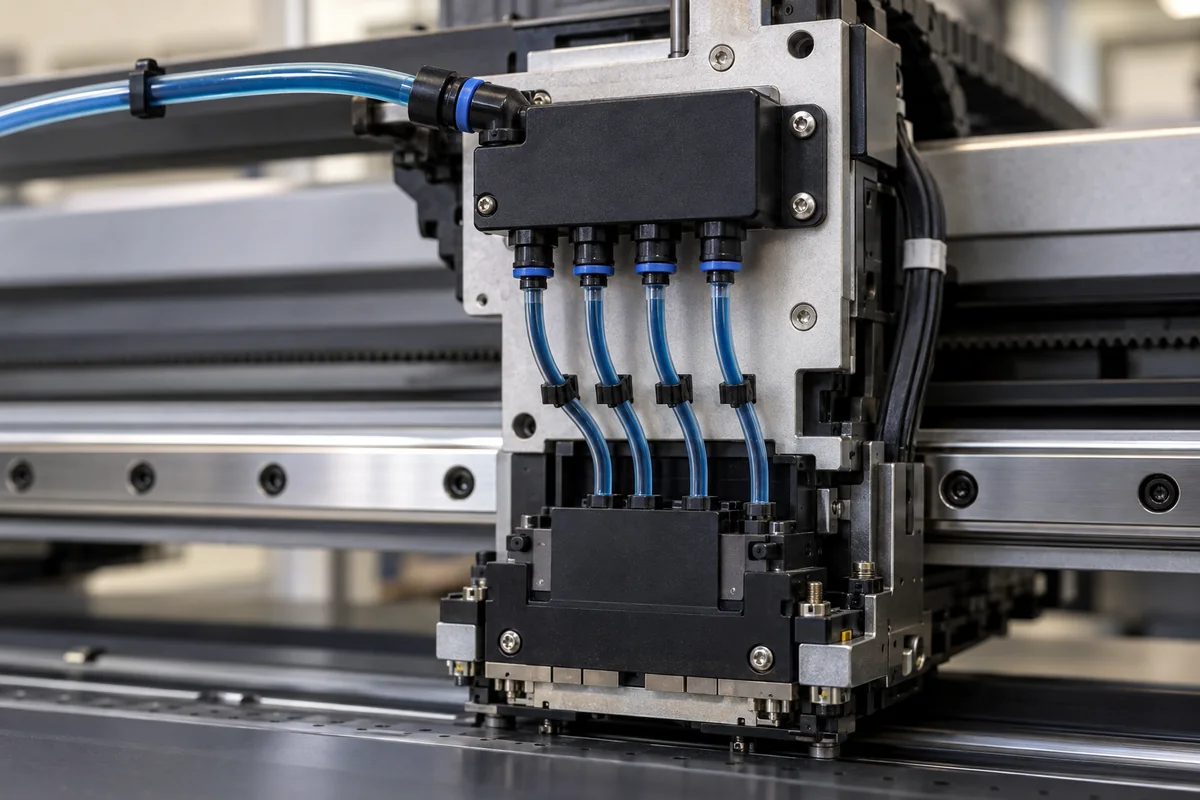
A fluid distribution component within a print head that directs ink from the reservoir to individual nozzles.
Product Specifications

Technical details and manufacturing context for Ink Channel / Manifold

Definition
The ink channel/manifold is a critical internal component of a print head that serves as the ink distribution network. It receives ink from the main reservoir and precisely routes it through branching pathways to supply individual ink ejection nozzles. This component ensures uniform ink delivery, maintains proper flow rates, and prevents air bubbles or blockages that could disrupt printing quality.
Working Principle
Ink flows from the reservoir into the manifold inlet, where it is distributed through multiple internal channels. The manifold's geometry controls flow dynamics, ensuring equal pressure and volume to each nozzle. In thermal inkjet systems, it supplies ink to heating chambers; in piezoelectric systems, it feeds ink to pressure chambers. The design minimizes turbulence and maintains consistent ink supply during rapid firing sequences.
Common Materials
Stainless steel, Polymer composites, Ceramic
Technical Parameters
  • Channel diameter and manifold dimensions critical for flow control (mm) Standard Spec
Components / BOM
  • Inlet Port
    Connection point for ink supply from reservoir
    Material: Stainless steel
  • Distribution Channels
    Branching pathways that route ink to individual nozzles
    Material: Polymer composite
  • Pressure Equalization Chamber
    Maintains consistent pressure across all outlets
    Material: Ceramic
Engineering Reasoning
0.5-3.0 bar (7.25-43.5 psi)
4.5 bar (65.3 psi) internal pressure causing manifold deformation >0.1 mm
Design Rationale: Plastic deformation of polyether ether ketone (PEEK) manifold body due to exceeding yield strength of 92 MPa at 120°C operating temperature
Risk Mitigation (FMEA)
Trigger Ink pigment sedimentation forming >50 μm particle agglomerates
Mode: Nozzle orifice blockage reducing flow rate below 0.05 mL/min
Strategy: Integrated 40 μm sintered stainless steel filter mesh at manifold inlet
Trigger Thermal cycling between 20-120°C at >5 cycles/hour
Mode: Manifold-to-nozzle seal failure with leak rate >0.01 mL/hour
Strategy: Perfluoroelastomer O-rings with 300% compression set resistance at 150°C

Industry Taxonomies & Aliases

Commonly used trade names and technical identifiers for Ink Channel / Manifold.

Applied To / Applications

This component is essential for the following industrial systems and equipment:

Industrial Ecosystem & Supply Chain DNA

Complementary Systems
Downstream Applications
Specialized Tooling

Application Fit & Sizing Matrix

Operational Limits
pressure: 0-50 psi (0-3.45 bar)
flow rate: 0.1-10 mL/min per channel
temperature: -10°C to 80°C
slurry concentration: ≤5% solids by weight
Media Compatibility
✓ Water-based inks ✓ UV-curable inks ✓ Solvent-based inks
Unsuitable: Highly abrasive ceramic slurries
Sizing Data Required
  • Number of nozzles
  • Required flow rate per nozzle
  • Ink viscosity

Reliability & Engineering Risk Analysis

Failure Mode & Root Cause
Clogging and buildup
Cause: Ink drying, pigment sedimentation, or contamination from foreign particles, leading to restricted flow and pressure imbalances.
Leakage and seal failure
Cause: Wear of O-rings or gaskets due to chemical degradation, thermal cycling, or improper assembly, resulting in ink seepage and system contamination.
Maintenance Indicators
  • Inconsistent ink flow or color output, indicating partial blockage or pressure loss.
  • Visible ink seepage or drips around manifold joints, suggesting seal compromise.
Engineering Tips
  • Implement regular flushing cycles with compatible solvents to prevent ink drying and sediment accumulation.
  • Use high-quality, chemically resistant seals and perform periodic torque checks on fittings to maintain proper sealing integrity.

Compliance & Manufacturing Standards

Reference Standards
ISO 9001:2015 Quality Management Systems ASTM B117-19 Standard Practice for Operating Salt Spray (Fog) Apparatus CE Marking (EU Machinery Directive 2006/42/EC)
Manufacturing Precision
  • Bore Diameter: +/-0.01mm
  • Surface Flatness: 0.05mm across mating surfaces
Quality Inspection
  • Dye Penetrant Test for crack detection
  • Dimensional Verification via CMM (Coordinate Measuring Machine)

Factories Producing Ink Channel / Manifold

Verified manufacturers with capability to produce this product in China

✓ 97% Supplier Capability Match Found

P Project Engineer from Canada Feb 10, 2026
★★★★★
"Great transparency on the Ink Channel / Manifold components. Essential for our Printing and Reproduction of Recorded Media supply chain."
Technical Specifications Verified
S Sourcing Manager from United States Feb 07, 2026
★★★★★
"The Ink Channel / Manifold we sourced perfectly fits our Printing and Reproduction of Recorded Media production line requirements."
Technical Specifications Verified
P Procurement Specialist from United Arab Emirates Feb 04, 2026
★★★★★
"Found 39+ suppliers for Ink Channel / Manifold on CNFX, but this spec remains the most cost-effective."
Technical Specifications Verified
Verification Protocol

“Feedback is collected from verified sourcing managers during RFQ (Request for Quote) and factory evaluation processes on CNFX. These reports represent historical performance data and technical audit summaries from our B2B manufacturing network.”

12 sourcing managers are analyzing this specification now. Last inquiry for Ink Channel / Manifold from Thailand (1h ago).

Frequently Asked Questions

What materials are best for ink manifolds in high-volume printing?

Stainless steel offers durability for industrial use, polymer composites resist chemical corrosion, and ceramic provides thermal stability for high-temperature applications.

How does the pressure equalization chamber improve print quality?

It maintains consistent ink pressure across all nozzles, preventing uneven flow and ensuring uniform droplet formation for precise, high-quality prints.

Can ink manifolds be customized for specific printer models?

Yes, manifolds can be engineered with custom inlet ports, channel layouts, and materials to match the exact specifications of different printing systems.

Can I contact factories directly on CNFX?

CNFX is an open directory, not a transaction platform. Each factory profile provides direct contact information and production details to help you initiate direct inquiries with Chinese suppliers.

Get Quote for Ink Channel / Manifold

Request technical pricing, lead times, or customized specifications for Ink Channel / Manifold directly from verified manufacturing units.

Your business information is encrypted and only shared with verified Ink Channel / Manifold suppliers.

Thank you! Your message has been sent. We'll respond within 1–3 business days.

Need to Manufacture Ink Channel / Manifold?

Connect with verified factories specializing in this product category

Add Your Factory Contact Us
Previous Product
Embossing Roller
Next Product
Ink Pump