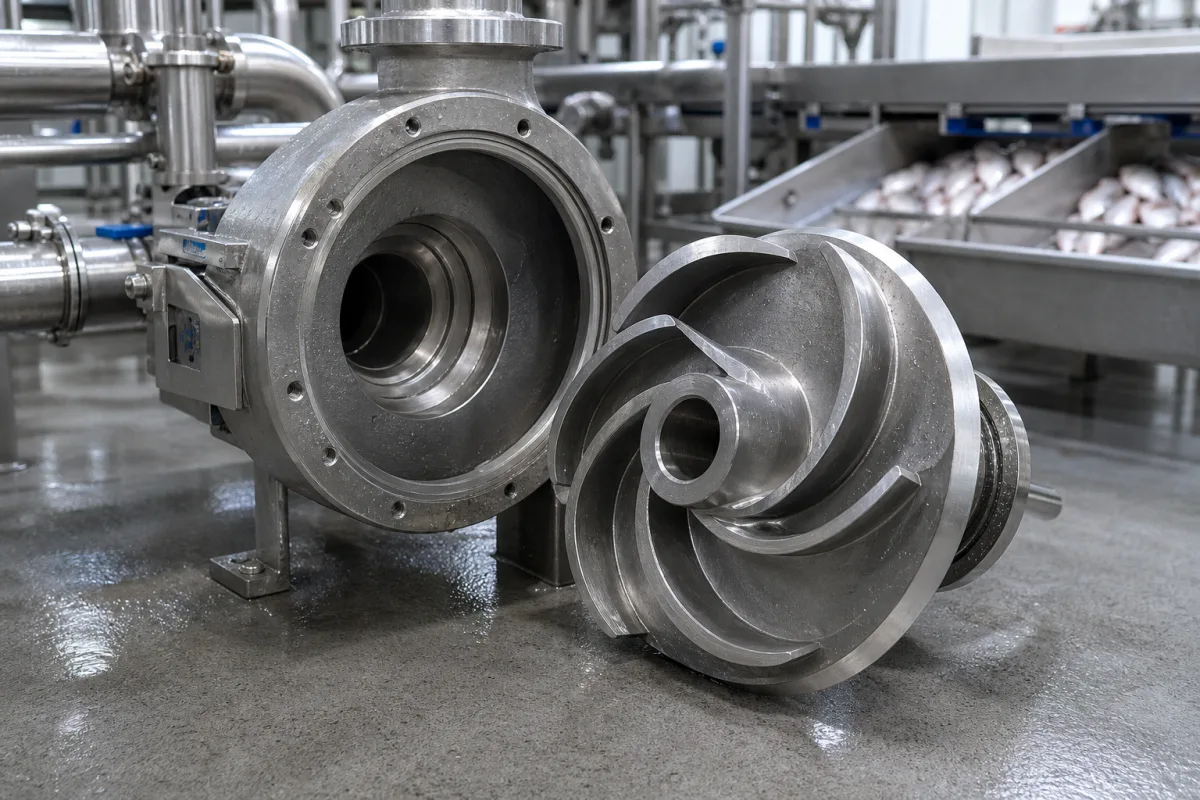
Impellers for centrifugal fish pumps · Rounded one- or two-vane impellers that pass whole fish, impeller speed versus pumping height and flesh damage, air-assisted lift, non-clog oblique-cone impellers, and what to test on your fish
A fish pump impeller is the rotating part of a centrifugal pump used to move live or freshly caught fish with water, for example from a net or hold to a vessel, dock or processing line. Its passages must let whole fish through, and its speed sets both the lift and the damage to the fish. Ask three things first: what species and sizes of fish must pass, how high and how far they must be pumped, and what damage limit applies and how it will be tested.
Impellers for centrifugal and similar rotary fish pumps used to transfer fish with water in fishing, aquaculture and fish processing, including their passage geometry, speed and materials. Vacuum-pressure fish pumps without impellers, general process pump impellers (see centrifugal pump impeller), and fish-friendly pumps for irrigation or flood-control stations are outside this page except where compared.
CNFX editorial research · Sources checked October 12, 2026 · 5 sources
US patent 3,314,184 (Method and apparatus for transferring fish by pumping, 1967) describes fish pumping from a net, boat hold or similar place where fish are concentrated in water. Its submersible unit uses a centrifugal pump of the kind “normally used as a sludge pump in sewage systems”, which the patent says “usually comprise a centrifugal impeller having one or two rounded vanes” and can pass solids without damage. It notes that the suction pumps used in earlier deck installations had to be kept constantly primed, either by a priming pump that reduced useful fish capacity or by a vacuum eductor system. [1]
US patent 11,867,192 B2 (Pump comprising an impeller body provided as an oblique cone, 2024) explains that conventional bladed impellers clog with solids and suffer cavitation, and describes an impeller with a hub base and an impeller body whose base is concentric with the rotational axis and which has at least one eccentric apex; it states the pump can be a non-clog pump for sewage, a fish-friendly pump for pumping stations, or a pump for transporting freshly caught fish. [3]
Editorial note: ask the supplier for the free passage size of the impeller and for references pumping your species and size range, not only for the impeller's diameter and speed.
Give the supplier the species, maximum fish length and weight, fish-to-water ratio, required capacity (tonnes of fish per hour), suction lift or submergence, discharge height and pipe length, pump type (deck-mounted or submersible), drive and speed control, damage acceptance (scale loss, bruising, mortality) and how it will be checked, cleaning and hygiene needs, and materials in contact with fish and seawater.
02
Limit fish damage at the lift you need
US patent 4,756,671 (Low damage hydraulic fish pumping system, 1988) states that submersible rotary impeller fish pumps gained wide acceptance for brailing nets and transferring fish from holds, but that flesh damage from fish passing through the impeller remained a serious limitation; damage grows with pumping height because the rotor must turn faster, larger and softer fish are more vulnerable, and for fish going to fishmeal plants flesh damage causes loss of valuable proteins by leaching. [2]
Its solution injects large volumes of pressurised air from a blower into the pump's discharge as close as practicable to the pump outlet, reducing the average density of the rising column of fish and water so the system can reach the same or greater heights at materially lower impeller speeds with less damage. [2]
Editorial note: because impeller speed rises with required lift, ask the supplier for the impeller speed at your duty point and for damage test results at that speed and height, and consider whether the lift can be reduced or assisted.
03
Compare a screw-centrifugal impeller's published range
Hidrostal, which says its first pump was developed in the 1960s to transfer fresh fish from trawlers without damage, describes its F-type ("Fish") screw centrifugal pumps as using a single-vane impeller with a shroud, and its fish-friendly brochure lists the features it relies on: a large, smooth open channel with no abrupt change of direction, a large ball passage for big fish and non-clog running, an enclosed impeller that keeps fish off the suction cover, low rotating and peripheral speed, and an extra-large clearance between impeller and diffuser vane. A twin-blade variant serves higher flows. The brochure's range covers discharge sizes of 50–1,600 mm, heads of 2–14 m, flows of 7–9,000 l/s, motor powers of 2.5–500 kW at 50 or 60 Hz or with a variable-frequency drive, hydraulic efficiency up to 86%, and impellers in cast iron, ductile iron, high-chrome steel, duplex steel, Ni-resist or aluminium bronze. One case pumps fresh water for eel and fish migration at about 4,000 l/s for around 4,000 hours a year. [4][5]
Editorial calculation: 4,000 l/s is 14,400 m³/h, and a 14 m head is about 0.14 MPa; the brochure's low-head, high-flow range shows these impellers are built for passing whole fish at low speed rather than for high lift, which matches the speed-and-damage concern in the air-assist patent above. For seawater or fish-farm duty, choose among the listed materials, such as duplex steel or aluminium bronze, and ask for the ball passage in millimetres. [5][2]
Vane count, free passage, speed, lift and priming of a fish pump impeller
The 1967 patent took its impeller from sewage sludge pumps: a centrifugal impeller with one or two rounded vanes that passes solids without damage. [1]
Impeller type, diameter, speed, flow and material for a fish pump impeller
Published values here cover the flow range, impeller materials and impeller types, from Hidrostal's brochure and the patents; diameter and speed have to come from the maker for your lift. [5][1][3]
Explore company information and manufacturing capabilities, then discuss the scope of your project with a relevant supplier.
Share this page
Compiled and source-reviewed by the CNFX editorial team.
Each manufacturer above links to the page on that company's own website where the product is listed, with the date we checked it. How we source and review
· Page last updated 13 October 2026
Buyer questions
What impeller do fish pumps use?
US 3,314,184 describes centrifugal fish pumps with a rounded one- or two-vane impeller able to pass solids without damage. [1]
Why does pumping fish higher cause more damage?
US 4,756,671 says the impeller must turn faster for more height, and flesh damage increases, especially for larger and softer fish. [2]
Can fish be pumped higher without faster impellers?
The same patent injects air into the discharge to lighten the column, reaching the same height at lower impeller speed. [2]
What head and flow do fish-friendly impeller pumps cover?
One maker's fish-friendly screw centrifugal range lists 2–14 m head, 7–9,000 l/s flow, 50–1,600 mm discharge sizes and efficiency up to 86%. [5]
Sources and what still needs a direct check
Sources checked 2026-10-12. All three sources are US patents (1967, 1988, 2024) that describe fish pumping and impeller designs in their own terms; they do not give tested damage rates for a particular product.