Structured Manufacturing Data (2026)

Fish Bone Detection Sensor Module

Based on aggregated insights from structured factory profiles within the CNFX directory, the standard Fish Bone Detection Sensor Module used in the Processing and Preserving of Fish sector typically supports operational capacities ranging from standard industrial configurations to heavy-duty production requirements.

Technical Definition & Core Assembly

A canonical Fish Bone Detection Sensor Module is characterized by the integration of X-ray Source Tube and Detector Array. In industrial production environments, manufacturers listed on CNFX commonly emphasize Stainless Steel 316L construction to support stable, high-cycle operation across diverse manufacturing scenarios.

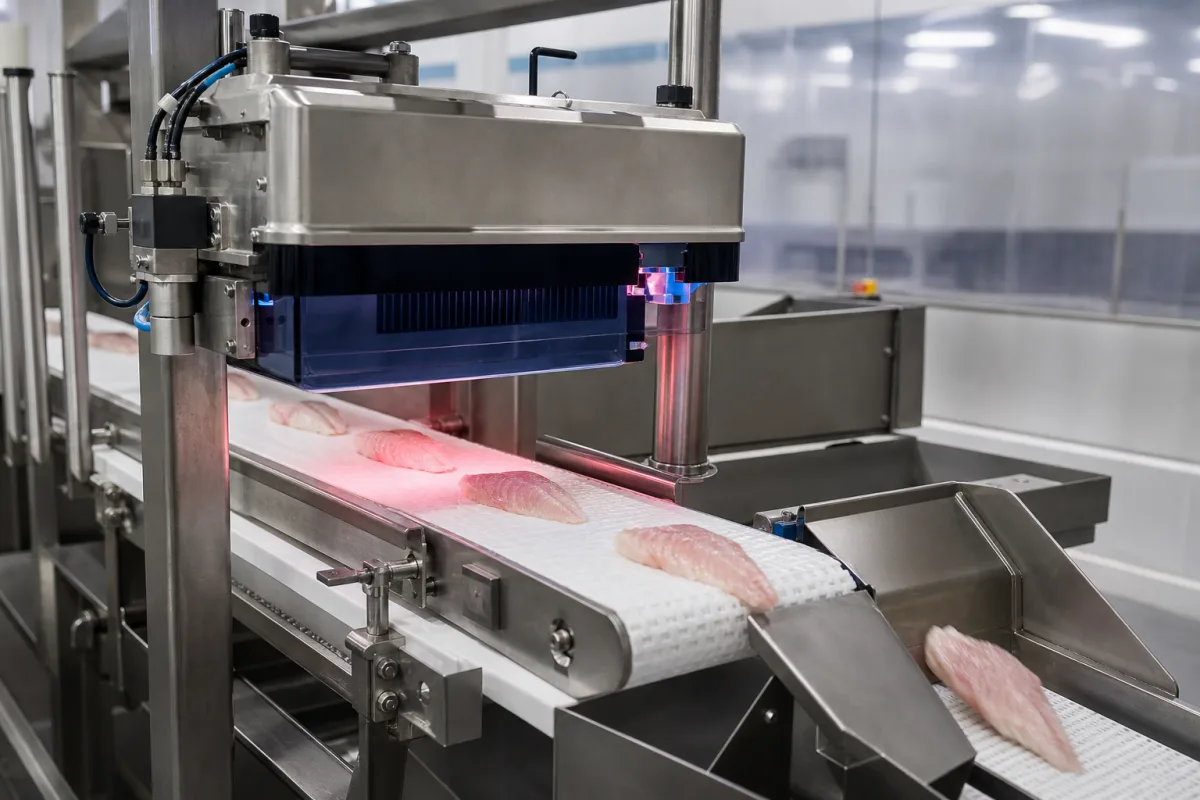
X-ray based sensor module for detecting bones in processed fish fillets.

Product Specifications

Technical details and manufacturing context for Fish Bone Detection Sensor Module

Definition
This sensor module integrates X-ray detection technology specifically optimized for identifying residual bones in fish fillets during industrial processing. It serves as a critical quality control component within automated fish processing lines, ensuring food safety compliance and reducing manual inspection labor. The module interfaces with processing machinery control systems to trigger rejection mechanisms when bone fragments are detected. Industrial manufacturers integrate this component into filleting and portioning equipment to meet international food safety standards.
Working Principle
Utilizes low-energy X-ray transmission through fish tissue, with specialized detectors measuring differential absorption between soft tissue and bone calcium, triggering signals when bone density thresholds are exceeded.
Common Materials
Stainless Steel 316L, Lead-Free Radiation Shielding Composite, Ceramic X-ray Detector Array
Technical Parameters
  • Maximum conveyor speed for reliable detection (m/s) Customizable
  • Minimum detectable bone fragment diameter (mm) Customizable
Components / BOM
  • X-ray Source Tube
    Generates controlled X-ray beam for tissue penetration
    Material: Tungsten target with beryllium window
  • Detector Array
    Measures X-ray transmission through fish fillets
    Material: Cadmium Telluride semiconductor
  • Signal Processing Board
    Analyzes detector data and triggers rejection signals
    Material: FR4 PCB with embedded processor
  • Radiation Shielding Housing
    Contains radiation within safe operational limits
    Material: Lead-free composite with stainless steel casing
  • Interface Connector Optional Part
    Provides electrical and data connection to host machine
    Material: IP67 rated industrial connector

Industry Taxonomies & Aliases

Commonly used trade names and technical identifiers for Fish Bone Detection Sensor Module.

Industrial Ecosystem & Supply Chain Structure

Complementary Systems
Downstream Applications
Specialized Tooling

Application Fit & Sizing Matrix

Operational Limits
pressure: Atmospheric (non-pressurized system)
other spec: Maximum conveyor speed: 2 m/s, Minimum fillet thickness: 5 mm, Maximum fillet thickness: 50 mm, X-ray power: 50-100 kV (adjustable), Detection sensitivity: >1.5 mm bone diameter
temperature: 0°C to 40°C (operating), -20°C to 60°C (storage)
Media Compatibility
✓ Processed white fish fillets (cod, haddock, pollock) ✓ Salmon and trout fillets ✓ Breaded or battered fish products
Unsuitable: High-moisture slurries or liquid fish mixtures (causes X-ray scattering and false readings)
Sizing Data Required
  • Production line speed (fillet/minute)
  • Maximum fillet dimensions (width x thickness)
  • Required detection threshold (minimum bone size to detect)

Reliability & Engineering Risk Analysis

Failure Mode & Root Cause
Optical sensor fouling
Cause: Accumulation of fish scales, biofilms, or debris on sensor lenses, reducing detection accuracy due to marine environment exposure.
Corrosion-induced electrical failure
Cause: Saltwater ingress into housing or connectors leading to short circuits or signal degradation, often from compromised seals or material fatigue.
Maintenance Indicators
  • Inconsistent or erratic detection readings despite stable fish presence
  • Visible corrosion, moisture, or algae growth on sensor housing or mounting points
Engineering Tips
  • Implement regular cleaning schedules with non-abrasive, marine-safe solutions to prevent biofilm buildup without damaging optical components
  • Use corrosion-resistant materials (e.g., titanium, marine-grade stainless steel) for housings and ensure periodic seal integrity checks to prevent water ingress

Compliance & Manufacturing Standards

Reference Standards
ISO 9001:2015 - Quality Management Systems CE Marking - Directive 2014/35/EU (Low Voltage) IEC 61000-6-2:2016 - Electromagnetic Compatibility (Industrial Environments)
Manufacturing Precision
  • Detection Accuracy: +/- 0.5mm
  • Response Time: +/- 10ms
Quality Inspection
  • Environmental Sealing Test (IP67/IP68)
  • Calibration Verification Test

Factories Producing Fish Bone Detection Sensor Module

Manufacturer profiles with relevant production capability in China

Manufacturer listings support early research and capability understanding. They are not certification, ranking, or transaction guarantees.

Technical documentation
4/5
Manufacturing capability
4/5
Inspection readiness
5/5
Supplier transparency
3/5

These scores are example evaluation dimensions, not real customer ratings, country-specific buyer feedback, or live inquiry activity.

Frequently Asked Questions

What is the minimum bone size this sensor can detect in fish fillets?

The sensor detects bones as small as 0.5mm, ensuring thorough inspection for food safety and quality control in fish processing.

How does the lead-free radiation shielding ensure food safety?

Our composite shielding material provides effective radiation containment without lead, meeting strict food safety regulations while protecting workers and products.

What maintenance is required for the stainless steel housing?

The 316L stainless steel housing requires only routine cleaning with food-safe sanitizers and periodic inspection for corrosion resistance in wet processing environments.

Can I contact factories directly on CNFX?

CNFX is an open directory, not a transaction platform. Each factory profile provides direct contact information and production details to help you initiate direct inquiries with Chinese suppliers.

Data Basis

CNFX manufacturer profiles, technical classification, publicly available product information, and ongoing plausibility checks.

Preliminary Technical Classification
This page supports structured research, RFQ preparation, and supplier evaluation. It does not replace buyer-led supplier qualification, standards review, or technical approval.

Request Manufacturing Insight for Fish Bone Detection Sensor Module

Ask for use case, specification boundaries, supplier type, and RFQ preparation information for Fish Bone Detection Sensor Module.

Your business information is used only to process this request.

Thank you! Your message has been sent. We'll respond within 1–3 business days.

Need to Manufacture Fish Bone Detection Sensor Module?

Compare manufacturer profiles with relevant product and process capability.

Create Manufacturer Profile Contact Us
Previous Product
Automated Cryogenic Fish Freezing Tunnel System
Next Product
High-Pressure Fish Pump Impeller