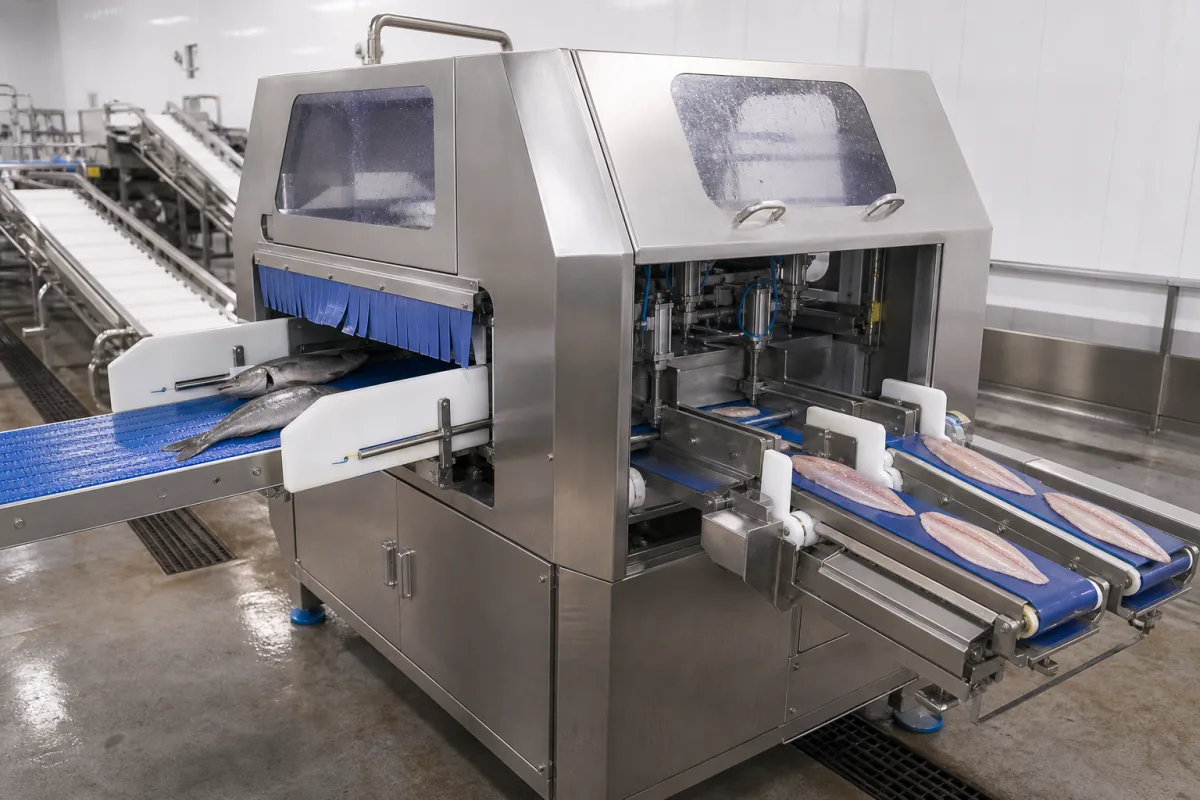
Fish filleting machines · Fish species and size range, capacity in fish per minute, circular and band knife cutting, automatic size adjustment, back and belly trimming, yield monitoring, water, power and hygiene
An industrial fish filleting machine takes headed and gutted fish on an infeed, measures or guides each fish, and cuts the two fillets away from the backbone with circular knives, band knives or disc blades, sometimes trimming back and belly in the same pass, before the fillets move on to pin-boning, skinning or portioning. Ask three things first: which species and size range it must fillet, what capacity and yield it delivers on your fish, and what infeed, trimming, cleaning and utilities the line needs.
Machines that cut fillets from whole headed and gutted fish, for salmon, trout, whitefish and freshwater species, with their infeed and trimming options. Deheaders, gutting machines, pin-bone removers, skinners, portion cutters and complete fish processing lines are outside this page except where integrated.
CNFX editorial research · Sources checked October 11, 2026 · 4 sources
Marel's salmon filleting brochure (2019) lists two machines for salmon and trout: the MS 2730 for 1.5–8 kg fish at up to 25 fish per minute, or up to 20 with trim tools, using 7.0 kW of power, 15 L/min of water and weighing about 1,450 kg (1,780 kg with trim tools); and the CT 2630 for 2–7 kg fish at up to 20 fish per minute, using 4.0 kW, 10 L/min and weighing about 675 kg. Both have integrated compressors and run on three-phase supply. [1]
The MS 2730 capacity is stated for an average fish of 4 kg and 670 mm length, and the brochure says throughput depends on fish length. [1]
For small-scale freshwater processing, Jayraj and Machavaram (IIT Kharagpur, World Aquaculture 2025) report a rohu filleting machine with two parallel disc blades, belt conveying and water spraying, tested on 300–2,000 g fish, that reached 33 ± 1 fish per minute, 82.48 ± 0.97% overall filleting efficiency and 93.16 ± 0.28 Wh energy use, with sensory scores of 4–5 out of 5 for fillet quality. [2]
Editorial calculation: 25 fish per minute at an average 4 kg is 6,000 kg of whole fish an hour, and 15 L/min of water is 900 L an hour; size the upstream deheading and downstream trimming for that rate, and ask for capacity at your fish size, not the maximum.
Give the supplier the species, fish size and length range, condition (pre-rigor or post-rigor, headed and gutted), required capacity, trim specification, infeed type (manual or automatic), downstream processes, yield-measurement needs, power and water supply, cleaning regime, floor space and quantities.
02
Check cutting principle, trimming and yield control
The brochure describes the CT 2630 as feeding fish belly up into band knives that adjust to fish size and shape, with circular knives cutting close to the backbone and four sets of finger pressures for the belly-bone cut on pre-rigor and post-rigor fish. The MS 2730 takes fish belly down, measures each fish's profile and size to adjust electronically controlled tools, and adds a set of circular knives from vent to tail so meat close to the centre bone stays on the fillet. [1]
Optional back and belly trimming tools on the MS 2730 cut based on the fish height measured at the infeed; an automatic infeed or pace infeeder presents fish upright at the machine's rate. A yield control station weighs whole fish and then heads, frames, belly trim and fillets per batch to report total yield, and software records fish dimensions, fillet counts and alarms. The machines are stainless steel with materials described as FDA-approved. [1]
Editorial note: yield depends on species, size, condition and trim specification; ask the supplier for a yield trial on your own fish, measured by batch weights from whole fish to fillets.
03
Understand how circular blades cut along the backbone
Baader's US patent 8,814,637 (Nordischer Maschinenbau Rud. Baader; priority 31 May 2010, granted 26 August 2014) describes the filleting stage for headed and gutted fish: an endlessly rotating conveyor carries transport saddles, each fish lies with its backbone on the saddle's supporting edge, back up and tail first, and passes between a lower pair of circular blades that cut the belly bones free and an upper pair that cut the back bones free, the two blades of each pair running left and right of the backbone on axes transverse to the direction of travel. [3]
The patent explains that when both blades of a pair turn the same way, the cutting forces push the flesh outwards and pull the fish along the saddle, so holding elements such as fangs are needed and the fish can still be mispositioned for later cuts. Its answer is to drive the two blades of each pair in opposite directions, so one retards and the other accelerates the fish and the forces cancel; diagonally opposite blades of the upper and lower pairs share a direction of rotation. [3]
The preferred blades of each pair are angled so they are closest together where they enter the fish, to cut as close as possible to the backbone, and the upper and lower pairs may run at the same speed or at different speeds. [3] Editorial note: ask the supplier how its blades are driven and angled, how fish are held on the saddle, and for fillet yield and backbone-meat results from a trial on your species and size, since the patent itself gives no yield figures.
04
Benchmark fillet yield against published species data
FAO Fisheries Technical Paper 309, prepared by the Torry Research Station (Aberdeen) for FAO in 1989, compiles published yields of skinless fillets and total edible flesh as a percentage of whole fish weight. It warns that the term ‘fillet’ is used in the literature without saying whether skin is present or how far belly flaps and pin bones were trimmed, and where fillets were known or suspected to include skin it subtracted 5% of the fillet yield. [4]
FAO marks values in square brackets as resting on limited data: for Pacific salmon the 50% skinless fillet figure is the only one found in the literature, and for tilapias the fillet value is borrowed from related groups. The yields above are per whole fish, while the Baader patent describes filleting beheaded and eviscerated fish, so convert both to the same basis before comparing a supplier's yield claim. [4][3]
Editorial calculation: at the MS 2730's 25 fish per minute and its 4 kg reference fish, 100 kg of fish enters the machine each minute, so each percentage point of fillet yield is 1 kg of fillet per minute, or 60 kg per hour. Ask the supplier for a yield trial on your own fish, stating skin-on or skinless, trim level and the weight basis. [1]
Species (FAO FTP 309)
Selected skinless fillet yield (% of whole weight)
40.1% edible flesh by deboning machine (T. nilotica) [4]
05
Capacity at your fish size and a batch yield trial: what to ask any filleting machine maker
This page lists no checked filleting machine maker yet. Ask each bidder for capacity at your own fish size rather than the maximum — Marel states its MS 2730 rating for a 4 kg, 670 mm fish — and for a yield trial on your fish weighed batch by batch. [1]
06
Infeed, saddle conveyor, size measurement, knives, trim tools, water spray and controls
The three sources cut in three different ways: Marel combines band and circular knives, the rohu prototype uses two parallel disc blades, and Baader drives each blade pair in opposite directions so the cutting forces cancel. [1][2][3]
Fish size range, fish per minute, yield, power and water for a filleting machine quotation
Read the yield row against the FAO benchmarks only on the same basis: FAO's figures are skinless fillets as a share of whole fish, while the rohu prototype reports a filleting efficiency. [4][2]
82.48% filleting efficiency for rohu. [2] Published species benchmarks: skinless fillets 34% of whole weight for Atlantic cod, 35% for haddock, [50%] for Pacific salmon. [4]
Explore company information and manufacturing capabilities, then discuss the scope of your project with a relevant supplier.
Share this page
Compiled and source-reviewed by the CNFX editorial team.
Each manufacturer above links to the page on that company's own website where the product is listed, with the date we checked it. How we source and review
· Page last updated 13 October 2026
Buyer questions
How many fish per minute can a filleting machine process?
One maker lists up to 25 salmon per minute (20 with trim tools); a small-scale rohu machine reached 33 per minute. [1][2]
How much water does a filleting machine use?
One maker lists 15 L/min and 10 L/min for its two salmon machines. [1]
How is filleting yield measured?
By weighing whole fish and then heads, frames, trims and fillets per batch, as in one maker's yield control station. [1]
Why are some filleting blades driven in opposite directions?
Baader's US patent 8,814,637 drives the two blades of each pair oppositely so their cutting forces cancel and the fish stays in position on the saddle without extra holding elements. [3]
What fillet yield can I expect from a fish?
FAO Fisheries Technical Paper 309 selects skinless fillet yields of 34% of whole weight for Atlantic cod, 35% for haddock, 36% for Alaska pollack and about 50% for Pacific salmon, and notes that published fillet definitions vary. [4]
Sources and what still needs a direct check
Sources checked 2026-10-11. Marel's brochure describes its own machines and is used here to show what a filleting machine specification covers; Baader's patent describes its own blade arrangement; the IIT Kharagpur abstract reports tests of a research prototype. FAO Fisheries Technical Paper 309 compiles published species yields. Values for your plant must come from trials on your own fish.